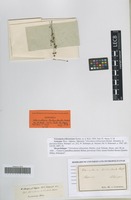
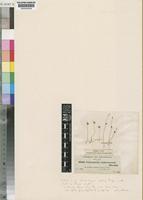
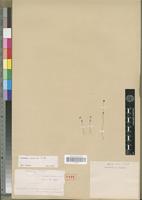
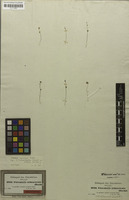
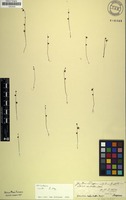
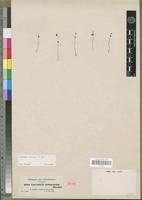
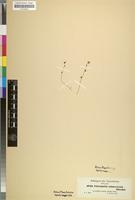
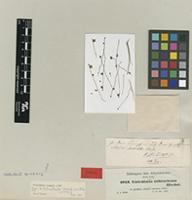
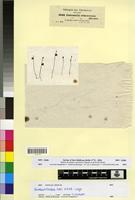
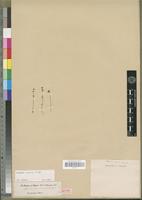
a delicate, dwarf terrestrial herb, including the inflorescence, 1 1/2–3 in. high; stolons finely filiform, much branched, forming small matted tufts; rhizoids numerous from the base of the peduncles, 3–4 lin. long; leaves few at the base of the scape or scattered or in very small tufts from the stolons, usually decayed at the time of flowering; blades spathulate-cuneate, 1 1/2–3 (rarely 4) lin. long, rarely more than 1/2 lin. broad, gradually passing into the long (up to 5 lin.) and very slender petiole; bladders from the leaves (particularly the petioles) and stolons, globose-ovoid, up to 1/2 lin. long, on a very short or somewhat longer (over 1/4 lin.) stalk, mouth distinctly 2-lipped, lips fimbriate, lower lip much smaller than the upper; peduncle straight or nearly so, filiform, simple, 4–1-flowered, if 3- or 4-flowered the flowers scattered over the upper half of the floral axis; bracts and bracteoles very similar, equal, lanceolate, acute, up to 1/2 lin. long, lowest bract often barren; pedicel about as long as the bracts or ultimately exceeding them; sepals subequal, about 1 1/4–1 1/2 lin. long, obtuse, the upper orbicular to ovate-orbicular, lower elliptic; corolla purple, 2 1/2–3 lin. long; upper lip 1 1/2–2 lin. long, obovate, rounded or subemarginate, constricted below the middle; lower lip subquadrate or rounded, 1 1/2–2 lin. long, more or less parallel to the spur, palate much raised (usually to an acute angle), often parallel to the upper lip, double crested, crests dark, minutely tubercled; spur straight or almost so, conic, often broad, as long as or longer than the lower lip; anthers 1/3– 1/2 lin. long; filaments filiform, 1/2– 2/3 lin. long; style about as long as the stigma; upper stigma-lip oblong or ovate, 1/2 as long as the large rotundate lower lip; capsule globose, 1 1/4 lin. in diam.; seeds irregularly hemi-ellipsoid or shortly pyramidal, angular, 1/8– 1/6 lin. long, top flat, more or less elliptic, with a thin membranous or obscure margin; embryo top flat or slightly concave. null