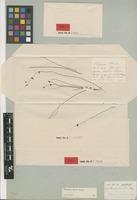
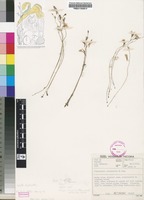
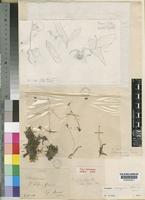
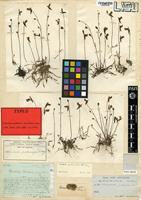
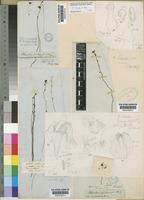
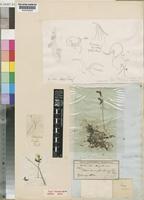
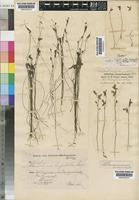
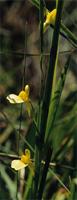
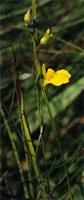
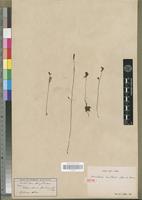
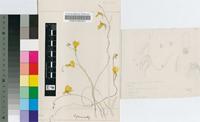
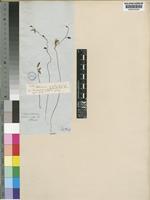
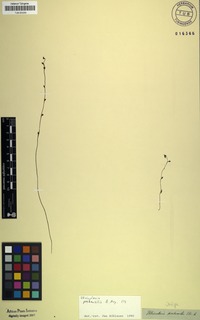
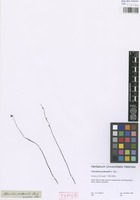
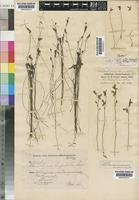
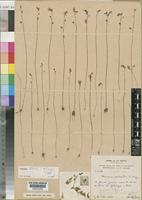
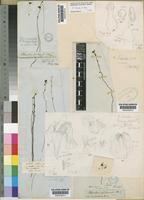
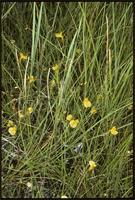
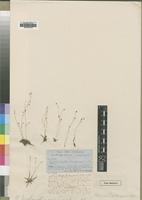
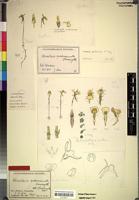
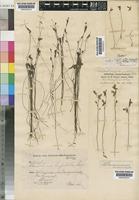
a slender terrestrial herb; stolons filiform, whitish, brittle, loosely matted; leaves scattered on the stolons, usually decayed at the time of flowering, linear-lanceolate or lingulate, obtuse, up to almost 1 in. long and 1 lin. broad, narrowed into a very slender petiole about 1/2 or 2/3 of the length of the blade, thin; bladders numerous from the leaves, and the stolons, with the mouth near the short stalk, globose or ovoid-globose, almost 1/2 lin. in diam., upper lip with 2 horn-like curved tentacles, lower lip 0; peduncle filiform, 3 in. to more than 1 ft. long, erect and more or less flexuous when short, twining when long; flowers 1–6, remote; bracts ovate to ovate-lanceolate, acute, over 1 lin. long, the lowest barren; bracteoles lanceolate to subulate, as long as or shorter to much shorter than the bracts; pedicels filiform, 2–5 lin. long; sepals membranous, somewhat dissimilar, upper ovate, acute or acuminate, many-nerved, in flower 2–2 1/2 lin. long, in fruit up to 4 lin. long, lower usually shorter, more or less elliptic and obtuse; corolla 6–8 lin. long, yellow; upper lip broadly oblong, spathulate, with a rounded, entire or emarginate tip, 2 1/2–4 lin. long; lower lip 3–4 lin. long, broadly ovate, palate erect, almost parallel to the upper lip, 2-gibbous, with a small tuft of cilia at its inner angle; spur straight, descending, acute, 3–4 1/2 lin. long; anthers 1/2 lin. long; style short, stout, gradually passing into the ovary; upper lip of stigma very short and flat, lower depressed, rounded; capsule ellipsoid, 2 1/2 lin. long; seeds very obliquely ovoid, tubercled on the back, 1/3 to almost 1/2 lin. long. null