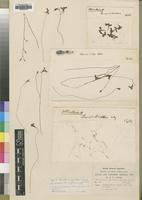
Terrestrial herb. Rhizoids and stolons capillary, numerous from the base of the peduncle. Leaves few, usually decayed at anthesis, leaf-opposed on the stolons, linear, up to 5 cm. ×2.5 mm., 1–3-nerved. Traps numerous, globose, shortly stalked, glandular, 0.6–1.0 mm. long; mouth basal, with 2 dorsal simple subulate appendages. Inflorescence erect or usually twining, 20–70 cm. high; peduncle filiform, glabrous; flowers 3–10, usually distant; scales few, similar to the bracts; bracts basifixed, broadly ovate, 2 mm. long; bracteoles linear-lanceolate, usually shorter than the bracts; pedicels erect or ascending, 5–15 mm. long, flattened or more or less narrowly winged, always longer than the fruiting calyx. Calyx lobes subequal 3–6 mm. long, ovate to narrowly ovate with apex of upper acute, of lower minutely bidentate. Corolla usually violet with a dark blue, greenish, yellow or white spot in the throat, rarely wholly yellow or white, 1–3 cm. long; superior lip oblong to circular; inferior lip circular; palate raised; spur subulate, usually curved, acute. Filaments linear; anther-thecae subdistinct; ovary ovoid; style indistinct; stigma-lips short, truncate, subequal. Capsule narrowly ovoid, dehiscing by longitudinal dorsal and ventral slits; capsule-wall of uniform thickness. Seeds numerous, globose, 0.2–0.3 mm. in diam.; testa thin, cells distinct, more or less isodiametric.