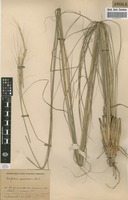
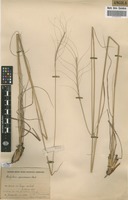
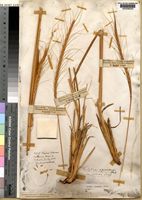
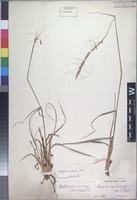
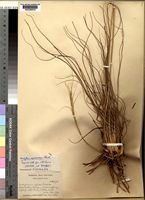
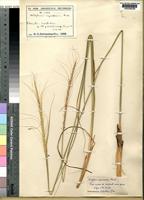
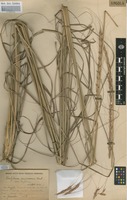
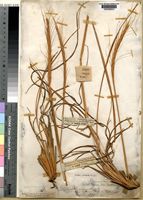
compactly tufted, culms 2–2 1/2 ft. long, glabrous, few-noded; sheaths exceeding the internodes except the uppermost, tight, terete, glabrous, smooth, the lower widened, very firm, shining, persistent; ligules oblong, 2–3 lin. long, glabrous or with a few long hairs behind; blades very narrow, linear, tapering to a setaceous point, lowest up to 1 ft. by 3/4–1 1/4 lin., flat convolute, rather rigid, glabrous, prominently nerved and finely scaberulous above; raceme (false spike) 5–6 in. long, 1 1/2–2 lin. thick, almost glabrous to villous, joints 3–4 lin. long, silky at the base, scantily pubescent to villous above, appendage up to 2 lin. long, unequally lobed or toothed, ciliolate; sessile spikelets about 4 lin. long; lower glume oblong to lanceolate, obtuse to acute, glabrous and smooth or punctate, or pubescent to villous, keels acute at least above, distantly (sometimes obscurely) spinulous muricate at the middle, rigidly ciliate above, with 1–3 intracarinal nerves which are more or less prominent towards the tips; upper glume lanceolate, acute, firmly membranous, 3-nerved, side-nerves submarginal, keel rigidly ciliate above, margins softly ciliate; valves about 3 lin. long, softly ciliate, lower lanceolate, acute, upper ovate-lanceolate, obtuse to subacute, mucronulate; anthers 2–1 1/2 lin. long; pedicelled spikelets varying in hairiness like the sessile, narrow, and usually smaller than them, with 2 ♂ florets, or (often in the same raceme) more or less reduced, sometimes to an awn representing the lower glume and a minute rudiment of the upper; awn squarrose, flattened below, scabrid, 1 1/2–3 1/2 in. long. null