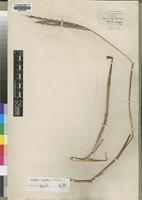
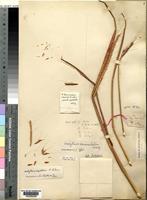
Perennial. Culms erect, rather robust, terete, smooth, glabrous. Leaf-sheaths somewhat loose, terete, keeled above, smooth, glabrous, striate (only the upper known); ligules membranous, truncate, sparingly ciliate, 1 lin. long; blades linear, over 6 lin. long, 3 lin. wide, flat, sparingly hairy above, very rough along the edges, midrib whitish on both sides. Racemes in pairs, on peduncles which are about 1/2 lin. long, erect, rather stiff, glabrous, with the exception of the calli; joints 3–3 1/2 lin. long, linear, slightly clavate above, with the back more or less rounded and prominently nerved, slightly concave on the inner face, quite smooth, disarticulating obliquely, scar with a scarious ciliate irregularly toothed coronulate appendage; pedicels linear, much compressed, without an apical appendage, otherwise similar to the joints, subcontiguous with them, few-nerved. Sessile spikelets with slightly bearded obovate calli, with a deep transverse groove above it, including the callus 5 lin. long, linear-lanceolate, subacuminate, reddish straw-coloured or dull purplish-brown. Glumes equal, lower subcoriaceous, obscurely 2-toothed, rather flat on the back, keels spinulously ciliolate above the middle, intracarinal nerves 4–5, some of them more or less raised on the back, quite distinct on the inner side; upper glume thinly chartaceous, narrowly boat-shaped, acute, 3-nerved, keel rigidly ciliolate above, lateral nerve close to the glabrous margin. Lower floret: valve hyaline, lanceolate-linear, acute, 3 1/2 lin. long, ciliolate, finely 3-nerved with a similar 2-nerved valvule. Upper floret: valve and valvule very like those of the lower floret. Anthers 2 lin. long. Stigmas 2 lin. long. Pedicelled spikelets more or less reduced, sometimes containing 2 florets, with rudimentary ♂ flowers or rudimentary valves only, the outer glume similar to that of the sessile spikelet but smaller and tapering into a scabrid squarrose awn, about 1 in. long.