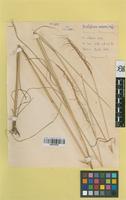
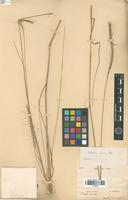
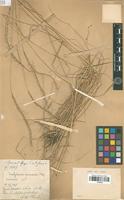
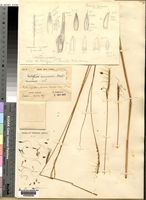
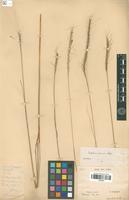
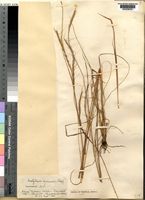
Annual. Culms tufted, up to 5 ft. high, slender, straight, terete, with flowering branches from the lower nodes, 3–5-noded, smooth. Leaf-sheaths glabrous, smooth, terete, tight; ligules membranous, 1 1/2 lin. long, the sides firm, forming an acute auricle, decurrent along the sheath, the central portion longitudinally striate; blades narrowly linear, flat or convolute, tapering to a long setaceous point, up to 1 foot long and 1 1/2 lin. wide, glabrous, scabrid on both sides and particularly along the margin, often with a few long hairs near the base, midrib and lateral nerves rather prominent below and the latter also above. Racemes solitary, up to 6 in. long, over 1 1/2 lin. wide, dull purplish-green, erect, pubescent or glabrous; joints linear, up to 2 1/2 lin. long, slightly wider above, rounded on the back, slightly concave on the inner face, glabrous or pubescent, disarticulating very obliquely, scar with a membranous margin, produced into 2 or 3 unequal teeth; pedicels similar to the joints, but shorter, with 2 minute or obscure teeth at the apex. Sessile spikelet with a short broad bearded callus, up to 3 lin. long, lanceolate-oblong. Glumes subequal; lower cartilaginous, subobtuse, slightly convex, glabrous or pubescent upwards, finely granular, minutely muricate along the thickened keels and rigidly ciliolate towards the apex, with 1 central nerve, prominent above, and 2 close lateral nerves at each keel; upper glume very slightly shorter, firmly membranous, obliquely linear-lanceolate in profile, glabrous except the pubescent tips, 3-nerved, keels and margins ciliate above. Lower floret: valve somewhat shorter than the glumes, lanceolate, acute, 2-nerved, ciliate upwards; valvule similar but narrower and glabrous. Upper floret: valve almost as long as that of the lower floret, hyaline, very acute, 3-nerved, minutely ciliate; valvule slightly shorter, faintly 2-nerved. Anthers almost 2 lin. long. Stigmas over 1/2 lin. long. Grain narrowly oblong, 2 lin. long, terete at the middle, scutellum not quite reaching to the middle, hilum obovate, basal. Pedicelled spikelet: lower glume lanceolate, produced into a ciliolate awn, which is twisted below and passes into a horizontally spreading bristle, about 1 in. or more long, frequently all the awns of the racemes pointing one way, flat, 3-nerved, pubescent or glabrous; upper glume broadly lanceolate with an eccentric acute keel, with the broader side concave, otherwise as in the sessile spikelet; florets as in the sessile if not smaller, the upper ♂.