JSTOR Global Plants Home
  • Home
  • Browse
  • About
  • Access
  • Account
    • Saved Items
    • Profile
  • Log in

Global Plants

Skip to Main Content
  • JSTOR Global Plants Home
  • Global Plants

    • Browse
    • About
    • Access
    • Account
      • Saved Items
      • Profile
Log in
  • Browse
  • About
  • Access
  • Account
    • Saved Items
    • Profile
Advanced Search

Compilation
Tylecodon similis

2 Images see all

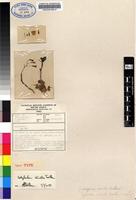
Holotype of Tylecodon similis (Toelken) Toelken [family CRASSULACEAE]
Tylecodon similis (Toelken) Toelken
Previous
Next

Name

Identification
Tylecodon similis (Toelken) Toelken [family CRASSULACEAE ]
Related name
  • Tylecodon similis

Flora

Entry for Tylecodon similis [family CRASSULACEAE]
Herbarium
South African National Biodiversity Institute, Compton Herbarium, Cape Town (SAM)
Collection
Flora of Southern Africa
Resource Type
Reference Sources
Entry From
Flora of South Africa, (2003) Author: Dr J.P. Roux
Names
Tylecodon similis [family CRASSULACEAE]
Common names
Cotyledon similis Tolken in Bothalia 12: 192 (1977).
Information
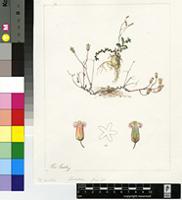
Perennials with a branched under­ground tuber producing one erect, rarely branched stem up to 120 mm long and with a grey bark with darker striations. Leaves nar­rowly elliptic to oblong, 5-13 X 2—4 mm, acute to obtuse, almost terete and flat or grooved above, glabrous, green often with reddish brown striations. Inflorescence a monochasium with l(-3) flowers, glabrous; peduncle 8-30 mm long, grey; pedicels 4-6 mm long. Calyx 2-3 mm long, glabrous, green; lobes triangular-lanceolate, acute. Corolla glabrous outside, pale yellow to cream; tube cylindrical, 6-8 mm long, inside with long fine hairs in throat; lobes 3,5-5 mm long, recurved. Anthers 0,8-1 mm long. Squamae narrowly oblong, 1,2-1,4 X 0,2-0,3 mm, usually deeply emarginate, slightly fleshy, orange to yellow.
Use
24. Tylecodon similis (Tolken) Tolken in Bothalia 12: 380 (1978). Type: Cape, N. of Grootmis, Wisura 1303 (NBG, holo.!).
Range
Recorded from the north-western Cape Province from the western foothills of the mountains from the Orange River to near Komaggas, but also from near Steinkopf; usually growing in crevices of quartzite out­crops, sometimes half hidden by other plants. Flow­ering period: September, October.

Related Materials

  • Terms and Conditions
  • Privacy Policy
  • Cookie Policy
  • Cookie Settings
  • Accessibility
  • Help
  • Contact Us
  • Facebook
  • Twitter
ITHAKA

JSTOR is part of ITHAKA, a not-for-profit organization helping the academic community use digital technologies to preserve the scholarly record and to advance research and teaching in sustainable ways.

©2000-2026 ITHAKA. All Rights Reserved. JSTOR®, the JSTOR logo, JPASS®, Aluka®, and ITHAKA® are registered trademarks of ITHAKA.

╳