JSTOR Global Plants Home
  • Home
  • Browse
  • About
  • Access
  • Account
    • Saved Items
    • Profile
  • Log in

Global Plants

Skip to Main Content
  • JSTOR Global Plants Home
  • Global Plants

    • Browse
    • About
    • Access
    • Account
      • Saved Items
      • Profile
Log in
  • Browse
  • About
  • Access
  • Account
    • Saved Items
    • Profile
Advanced Search

Compilation
Tylecodon racemosus

7 Images see all

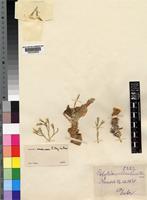
Tylecodon racemosus (Harv.) Toelken [family CRASSULACEAE]
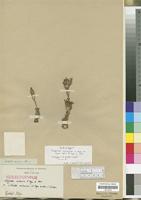
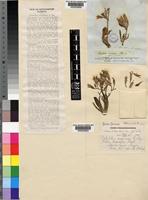
Isolectotype of Tylecodon racemosus (E. Meyer ex Harv.) Tölken [family CRASSULACEAE]
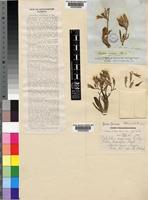
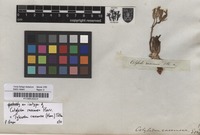
Isotype of Tylecodon racemosus ( Harv.) Toelken [family CRASSULACEAE]
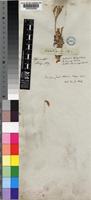
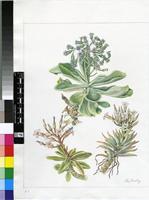
Tylecodon racemosus (Harv.) Toelken [family CRASSULACEAE]
Tylecodon racemosus (Harv.) Toelken
Previous
Next

Name

Identification
Tylecodon racemosus (Harv.) Toelken [family CRASSULACEAE ]
Related name
  • Tylecodon racemosus

Flora

Entry for Tylecodon racemosus [family CRASSULACEAE]
Herbarium
South African National Biodiversity Institute, Compton Herbarium, Cape Town (SAM)
Collection
Flora of Southern Africa
Resource Type
Reference Sources
Entry From
Flora of South Africa, (2003) Author: Dr J.P. Roux
Names
Tylecodon racemosus [family CRASSULACEAE]
Common names
Cotyledon racemosa Harv. in F.C. 2: 375 (1862), pro parte, excl. specimen b; N.E. Br. in Gdnr's Chron. ser. 3, 51: 348 (1912); Schonl. in Rec. Albany Mus. 3: 149 (1915); V. Poelln. in Reprium nov. Spec. Regni veg. 42: 22 (1937). C. chloroleuca Dinter ex Friedr. in Mitt. bot. StSamml., Munchen 3: 597, one fig. (1960); in F.S.W. A. 52: 8 (1968). Type: South West Africa/Nami­bia, 20 km north of Sendelingsdrift, Herre in SUG 20039 (M, holo.!).
Information
Perennials with sparsely branched erect stems up to 0,4 m high covered with remains of old leaves when young, later with pale brown peeling bark. Leaves linear, oblan-ceolate to obovate rarely almost orbicular, (10-)20-45(-60) x (2-)5-25(-35) mm, more or less abruptly cuneate, acute to obtuse, te­rete or slightly grooved to dorsiventrally flattened, glandular-pubescent to glabrous, green to grey-green. Inflorescence a thyrse with 1-5 monochasia, each with 1—4(-6) flowers, glandular-pubescent to glabrous; peduncle 30-50(-80) mm long, green; ped­icels 5-12 mm long. Calyx 7-12 mm long, glandular-pubescent to glabrous, pale green; lobes lanceolate-triangular, acute and usually with a colourless apex. Corolla glandular-puberulous to glabrous on out­side; tube cylindrical but slightly broadened at mouth, 7-10 mm long, glabrous inside, pale green; lobes 4-6 mm long, recurved, white more or less tinged pink. Anthers 1,1—1,8 mm long. Squamae oblong-cuneate to almost square, 1-1,8 x 0,6-1 mm, entire to deeply emarginate, slightly fleshy, pale yellow.
Habitat
The size and shape of the leaves varies consider­ably and in the southern parts of the distribution area they are almost terete. At about Lekkersing they are as broad as those described for C. chloroleuca. Consider­able variation in the amount of hairiness is encountered in different populations but this character seems to be linked to shape of the squamae. Densely hairy plants always seem to have deeply emarginate squamae, irre­spective of the locality.
Use
21. Tylecodon racemosus (Harv.) Tolken in Bothalia 12: 380 (1978). Type: Cape, between Kaus, Natvoet and Doorn-p'oort, Drege s.n. (S, lecto!; BM!; K!).
Range
Found from near Witputz in south-western South West Africa/Namibia, mainly west of the mountains to the Wildepaardehoek Pass but also eastwards to near Steinkopf in the north-western Cape Province; growing on lower gravelly slopes but often in somewhat shel­tered localities such as ravines or larger rock outcrops. Flowering period: September, October (November).

Related Materials

  • Terms and Conditions
  • Privacy Policy
  • Cookie Policy
  • Cookie Settings
  • Accessibility
  • Help
  • Contact Us
  • Facebook
  • Twitter
ITHAKA

JSTOR is part of ITHAKA, a not-for-profit organization helping the academic community use digital technologies to preserve the scholarly record and to advance research and teaching in sustainable ways.

©2000-2026 ITHAKA. All Rights Reserved. JSTOR®, the JSTOR logo, JPASS®, Aluka®, and ITHAKA® are registered trademarks of ITHAKA.

╳