

Compilation
Turraea goetzei
1 Images see all
Name
Identification
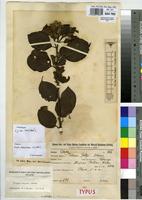
Isotype of Turraea goetzei Harms [family MELIACEAE ] Verified by Not on sheet, Turraea robusta Gurke [family MELIACEAE ] (stored under name); Verified by Styles B.T., 1961
Related name
- Turraea goetzei
- Turraea robusta
Flora
Entry for Turraea robusta Gürke [family MELIACEAE]
Herbarium
Royal Botanic Gardens, Kew (K)
Collection
Flora Zambesiaca
Resource Type
Reference Sources
Entry From
FZ, Vol 2, Part 1, page 285, (1963) Author: F. White and B. T. Styles
Names
Turraea robusta Gürke [family MELIACEAE], in Engl., Bot. Jahrb. 19, Beibl. 47: 34 (1894); in Engl., Pflanzenw. Ost-Afr. C: 231 (1895). — Bak. f. in Journ. of Bot. 41: 12 (1903). — R.E.Fr., Wiss. Ergebn. Schwed. Rhod.-Kongo-Exped. 1: 111 (1914). — Brenan, T.T.C.L.: 321 (1949); in Mem. N.Y. Bot. Gard. 8, 3: 234 (1953). — Eggeling & Dale, Indig. Trees Uganda Prot.: 200 (1952). — Dale & Greenway, Kenya Trees and Shrubs: 275 (1961). — White, F.F.N.R.: 182 (1962). TAB. 61 fig. C. Type from Tanganyika.
Turraea volkensii Gürke [family MELIACEAE], loc. cit. — Gürke in Engl., loc. cit. — Bak. f., loc. cit. Type from Tanganyika.
Turraea goetzei Harms [family MELIACEAE], in Engl., Bot. Jahrb. 28: 415 (1900). — Bak. f., loc. cit. — Brenan, T.T.C.L.: 320 (1949). Type from Tanganyika.
Turraea sacleuxii C.DC. [family MELIACEAE], in Ann. Conserv. Jard. Bot. Genève, 10: 130 (1907). Type from Kenya.
Turraea squamulifera C.DC. [family MELIACEAE], tom. cit.: 133. Type from Kenya.
Turraea nilotica [family MELIACEAE], sensu Staner in Bull. Jard. Bot. Brux. 16: 127, t. 3 (1941) — Staner & Gilbert, F.C.B. 7: 156 (1958).
Information
Shrub or small to medium-sized tree (1) 2–8 (16) m. tall, sometimes weak-stemmed and scrambling; first-year branchlets densely puberulous, second-year almost glabrous, reddish-brown or purple-brown, often with conspicuous white or pale brown lenticels. Leaf-lamina up to 10 × 7 cm., mostly obovate or obovate-elliptic, lower surface shortly pubescent and with tufts of hairs in axils of secondary nerves, apex rounded to apiculate, base cuneate; petiole up to 1·8 cm. long. Inflorescence a terminal or axillary congested cyme or false raceme; peduncle 3–4·5 cm. long, stout; bracts usually 3–4 to each flower, the longest up to 1·5 cm. long, foliaceous; pedicels 1–1·5 cm. long. Calyx 5–8 mm. long, deeply lobed, tomentellous. Petals 12–14 × 4 mm., creamy white tinged with green, becoming yellowish with age, spathulate, pubescent outside. Staminal tube 1·2–1·4 cm. long, distally expanded, bearded at the throat with long hairs arising mostly from the filaments and a few from the appendages, otherwise glabrous inside; appendages irregularly 1–3-lobed, alternate with or opposite the anthers, fused in lower half to form a frill continuing the staminal tube beyond insertion of filaments. Ovary 10–12-locular, densely pilose; style 1·5–2·2 cm. long, pilose at base; style-head broadly ovoid-cylindric. Capsule 6 × 10 mm., depressed-globose, shallowly sulcate, woody, puberulous; aril covering half the seed.
Habitat
In evergreen forest, particularly secondary forest, and at edges in thickets and fire-protected Brachystegia woodland and on termite mounds.
Altitude range
Usually at 1200–2000 m., but occuring locally at lower altitudes in areas of high rainfall.
2000
1200
Distribution
Malawi N Nyika Plateau, fl., McClounie 149 (K).Malawi C Nchisi Mountain, fr. vii.1946, Brass 17056 (BR; K; L; SRGH).Zambia N Sunzu Hill, Abercorn, fl. iii.1960, Fanshawe 5608 (FHO; K).
Distribution (external)
Uganda
Kenya
Tanganyika
Congo
Notes
In East Africa the wood is used by Africans for building and for making spoons.