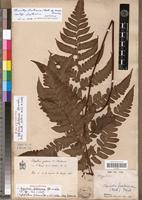
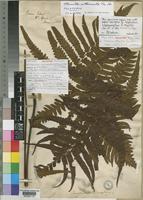
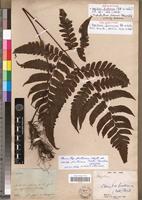
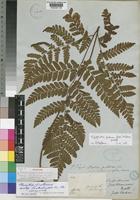
Terrestrial; rhizomelong-creeping, ± 4(–5) mm in diameter, covered in dark brown scales, the smaller tightly appressed and ± 3 mm long, the longer narrowly lanceolate and curved and twisted, 7–8 mm long, tipped by septate, glandular hair. Fronds spaced, 1.5–2 cm apart; stipe± 20–(40) cm long, 2.5(–4) mm diameter at base, decreasing to 1.5–2.5 mm diameter near apex, with dense long scales at base, rest of stipe with dense glandular septate hairs less than 0.5 mm long; laminathin to subcoriaceous, dark green adaxially, green to pale olive below, narrowly deltoid, 27–33≈20–28 cm, 3-pinnate; rachis adaxially sulcate, abaxially with hairs as on stipe; pinnae ± 7 and a gradually decreasing pinnatifid apex, the basal pair longest, to 16 cm, and with the first few basiscopic pinnules up to 8-pinnate and to 7 cm long, other pinnules pinnatifid (first acroscopic) but gradually decreasing in size and dissection to slightly crenate; next two pairs of pinnae slightly stalked, next four pairs adnate, grading into ± five adnate pinnules; margins crenate near base, entire near apex; pale sinus tissue ± 0.2 mm deep; pinna-costae adaxially sulcate and green to stramineous, densely short-hairy; veins and veinlets almost invisible, not reaching margin. Sori median on acroscopic veinlet, 1.2 mm in diameter; indusium honey-brown, 1.2 mm in diameter, of thick-walled square cells, fringed moderately with thick, 2–3-celled glands. Spores monolete, 0.4 mm long, 0.3 mm wide, membranous fringe 0.1 mm wide. Fig. 3: 11–14.A specimen from Uganda,U3, Busoga District: Kyabuma, June 1915, Dummer 2595! matches T. fraternum in dissection, but is glabrous on costa and costules, as in T. jenseniae. Conceivably a hybrid?The description given is based on the East African material cited. Holttum’s description, based on West African and Madagascan material, differed slightly in the rhizome scales (4–5 mm long).This species has been confused with T. jenseniae (C.Chr.) Holttum; among the characteristics of T. fraternum are that pinnae of the basal pair are not very much longer than the pair above, also the absence of buds and the fact that major axes bear glandular hairs adaxially (fide Peter J. Edwards)