JSTOR Global Plants Home
  • Home
  • Browse
  • About
  • Access
  • Account
    • Saved Items
    • Profile
  • Log in

Global Plants

Skip to Main Content
  • JSTOR Global Plants Home
  • Global Plants

    • Browse
    • About
    • Access
    • Account
      • Saved Items
      • Profile
Log in
  • Browse
  • About
  • Access
  • Account
    • Saved Items
    • Profile
Advanced Search

Compilation
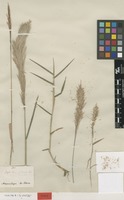
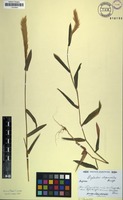
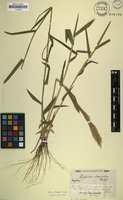
Triodia plumosa

3 Images see all

Type of Leptochloa plumosa Andersson [family POACEAE]
Filed as Triodia plumosa Benth. [family POACEAE]
Previous
Next

Name

Identification
Triodia plumosa Benth. [family POACEAE ] (stored under name); Verified by Not on Sheet, Uralepis alopecuroides Hochst. ex Steud. [family POACEAE ] Verified by Bräuchler, C., 2013
Related name
  • Uralepis alopecuroides
  • Triodia plumosa

Flora

Entry for LEPTOCARYDION Vulpiastrum Stapf [family POACEAE]
Herbarium
Royal Botanic Gardens, Kew (K)
Collection
Flora Capensis
Resource Type
Reference Sources
Entry From
Flora Capensis, Vol 7, page 310, (1900) Author: (By O. STAPF.)
Names
LEPTOCARYDION Vulpiastrum Stapf [family POACEAE]
Rabdochloa Vulpiastrum De Not. [family POACEAE], Cat. Sem. Hort. Genuens. 1852, and in Ann.Sc. Nat. sér. 3, xix. (1853), 372.
Leptochloa plumosa Anderss. [family POACEAE], in Peters, Reise Mossamb. Bot. 557.
Triodia Vulpiastrum K. Schum. [family POACEAE], in Engl. Pfl. Ost-Afr. C. 113.
Triodia plumosa Benth. [family POACEAE], in Journ. Linn. Soc. xix. 110, and in Benth. & Hook. f. Gen. Plant. iii. 1176 (partly); Durand & Schinz, Consp. Fl. Afr. v. 877 (partly).
Information
culms erect or ascending, 2–4 ft. long, simple or sometimes branched (branches intravaginal), many-noded, internodes shortly exserted, glabrous, smooth; sheaths tight, glabrous, smooth or somewhat rough, striate; ligule up to 1/4 lin. long, truncate, ciliolate, soon evanescent; blades lanceolate-oblong from a rounded abruptly constricted base, acute, 1–3 in. by 3–6 lin., flat or involute, smooth or finely scaberulous below, glaucescent, finely many-nerved, primary nerves about 7 on each side; panicle spike-like, 2–8 in. by 1/2– 3/4 in., pallid or faintly purplish, very dense; branches up to 1 in. long, branched from the villous base; branchlets 5–1-spiculate, up to 3 lin. long; spikelets crowded, adpressed, 5–9-flowered, up to 3 lin. long; rhachilla very slender; glumes reddish, subhyaline, the lower lanceolate, acuminate, mucronate, about 1 1/4 lin. long, the upper linear-oblong, about 1 3/4 lin. long; valves 1 1/4 lin. long, pubescent below the middle, long and finely ciliate along the side-nerves; anthers 1/5 lin. long, ovate; grain linear, obtusely triquetrous, less than 1/2 lin. by less than 1/8 lin. null
Range
Also in tropical East Africa as far north as Usambara.
Distribution
EASTERN REGION Natal; banks of the Tugela River and its tributaries, 600–1000 ft., Buchanan, 187!
Notes
Closely allied to L. alopecuroides (Diplachne alopecuroides, Hochst. ex Steud.) from Abyssinia; but this is a smaller plant with very slender culms and smaller leaves, having only 2–3 primary nerves on each side.

Related Materials

  • Terms and Conditions
  • Privacy Policy
  • Cookie Policy
  • Cookie Settings
  • Accessibility
  • Help
  • Contact Us
  • Facebook
  • Twitter
ITHAKA

JSTOR is part of ITHAKA, a not-for-profit organization helping the academic community use digital technologies to preserve the scholarly record and to advance research and teaching in sustainable ways.

©2000-2026 ITHAKA. All Rights Reserved. JSTOR®, the JSTOR logo, JPASS®, Aluka®, and ITHAKA® are registered trademarks of ITHAKA.

╳