JSTOR Global Plants Home
  • Home
  • Browse
  • About
  • Access
  • Account
    • Saved Items
    • Profile
  • Log in

Global Plants

Skip to Main Content
  • JSTOR Global Plants Home
  • Global Plants

    • Browse
    • About
    • Access
    • Account
      • Saved Items
      • Profile
Log in
  • Browse
  • About
  • Access
  • Account
    • Saved Items
    • Profile
Advanced Search

Compilation
Trillium maculatum

7 Images see all

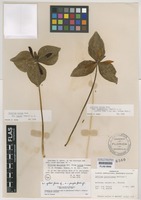
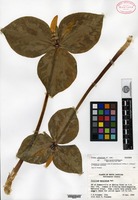
Holotype of Trillium maculatum Raf. forma luteum Freeman [family MELANTHIACEAE]
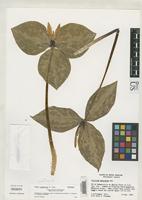
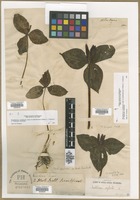
Isotype of Trillium maculatum f. simulans Freeman, J.D. 1975 [family LILIACEAE]
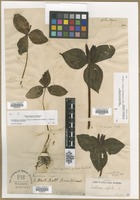
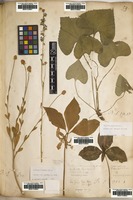
Filed as Trillium maculatum Raf. [family TRILLIACEAE]
Isotype of Trillium maculatum Rafinesque f. simulans J. D. Freeman [family LILIACEAE]
Filed as Trillium maculatum Raf. [family TRILLIACEAE]
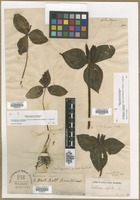
Filed as Trillium maculatum Raf. [family MELANTHIACEAE]
Previous
Next

Name

Identification
Isotype of Trillium maculatum Not on Sheet [family LILIACEAE ] (stored under name); Verified by Not on sheet,
Related name
  • Trillium maculatum
Common name
  • Spotted trillium, Flora of North America Vol. 26

Flora

Entry for Trillium maculatum Rafinesque [family TRILLIACEAE]
Herbarium
Flora of North America (FNA)
Collection
Flora of North America
Resource Type
Reference Sources
Entry From
Flora of North America, Vol 26,
Names
Trillium maculatum Rafinesque [family TRILLIACEAE], Med. Fl., 2: 103. 1830
Treatment Author(s)
Frederick W. Case Jr.
Information
Rhizomes horizontal, brownish, short, thick, praemorse, not brittle. Scapes 1–3, round in cross section, 1.4–4 dm, slender to stout, glabrous. Bracts held well above ground, tips only touching ground in early anthesis, sessile; blade dark green, mottling darker, mottled to varying degrees, mottling becoming obscure with age, broadly ovate-elliptic to elliptic, 7–15 × 4.6–6.7 cm, not glossy, apex rounded or barely acuminate. Flower erect, odor faintly spicy and bananalike; sepals displayed above bracts, spreading almost to horizontal, often suffused or streaked with purple-maroon, lanceolate-linear, 22–50 × 5–7 mm, margins entire, apex rounded-acute, recurving slightly; petals long-lasting, spreading-erect, ± connivent, ± concealing stamens and ovary or sometimes slightly spreading early, only partially obscuring stamens, becoming more erect and even touching in the manner of Trillium cuneatum when older, clear dark red-maroon, or reddish purple, without muddy or brown tones of many purple sessile species, or, rarely, purple basally and yellow toward apex, or clear sulfur yellow, not spirally twisted, narrowly oblanceolate-spatulate to linear-spatulate, widest above middle, narrowing to apex, 4–7 × 0.7–1.7 cm, thick-textured, margins entire, slightly involute in proximal 1/2, apex acute to round-acute; stamens erect, 12–20 mm; filaments dark purple, 2–3 mm, widest at base, much shorter than anther sacs; anthers erect, straight, brownish purple, 10–16 mm, dehiscence introrse on broad connective; connectives brown-purple, straight, essentially not extended beyond anther sacs; ovary dark purple, ovoid, weakly 3-angled to smooth (rarely very obscurely 6-angled), angles often obscured in large, turgid ovary, 8–11 mm; stigmas erect, divergent-recurved, distinct, purplish, subulate, 2–4 mm, fleshy. Fruits dark purplish green, odor not reported, ovoid, obscurely 3- to 6-angled, bearing persistent stigma, 1 × 2 cm, pulpy.
Phenology
dec-feb (winter), mar-may (spring)
Altitude range
0–500 m;
Distribution
USA Ala.USA Fla.USA Ga.USA S.C.
Discussion
In their account of the Carolinas flora, A. E. Radford et al. (1968) did not treat Trillium maculatum or give any explanation of why they omitted this species, which is fairly widely distributed in southeastern South Carolina and morphologically is one of the more distinct sessile trilliums.
Many color forms occur and have been named. In forma luteum J. D. Freeman, for example, all floral organs lack purple pigment, and the petals are clear, soft yellow, whereas forma simulans J. D. Freeman has yellow petals with purple bases, and purple stamens and carpels. These are illustrated in color in F. W. Case and R. B. Case (1997).

Related Materials

  • Terms and Conditions
  • Privacy Policy
  • Cookie Policy
  • Cookie Settings
  • Accessibility
  • Help
  • Contact Us
  • Facebook
  • Twitter
ITHAKA

JSTOR is part of ITHAKA, a not-for-profit organization helping the academic community use digital technologies to preserve the scholarly record and to advance research and teaching in sustainable ways.

©2000-2026 ITHAKA. All Rights Reserved. JSTOR®, the JSTOR logo, JPASS®, Aluka®, and ITHAKA® are registered trademarks of ITHAKA.

╳