JSTOR Global Plants Home
  • Home
  • Browse
  • About
  • Access
  • Account
    • Saved Items
    • Profile
  • Log in

Global Plants

Skip to Main Content
  • JSTOR Global Plants Home
  • Global Plants

    • Browse
    • About
    • Access
    • Account
      • Saved Items
      • Profile
Log in
  • Browse
  • About
  • Access
  • Account
    • Saved Items
    • Profile
Advanced Search

Compilation
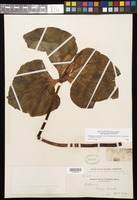
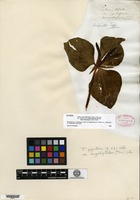
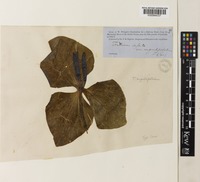
Trillium angustipetalum

3 Images see all

Trillium angustipetalum (Torr.) J. D. Freeman [family LILIACEAE]
Isotype of Trillium sessile Linnaeus var. angustipetalum Torrey [family LILIACEAE]
Type of Trillium angustipetalum (Torrey) J.D.Freeman [family TRILLIACEAE]
Previous
Next

Name

Identification
Trillium angustipetalum (Torrey) J.D.Freeman [family TRILLIACEAE ] (stored under name); Trillium sessile L. [family TRILLIACEAE ]
Related name
  • Trillium angustipetalum
  • Trillium sessile
Common name
  • Narrow-petaled trillium, Flora of North America Vol. 26

Flora

Entry for Trillium angustipetalum (Torrey) J. D. Freeman [family TRILLIACEAE]
Herbarium
Flora of North America (FNA)
Collection
Flora of North America
Resource Type
Reference Sources
Entry From
Flora of North America, Vol 26,
Names
Trillium angustipetalum (Torrey) J. D. Freeman [family TRILLIACEAE], Brittonia, 27: 55. 1975
Trillium sessile Linnaeus var. angustipetalum Torrey [family TRILLIACEAE], Pacif. Railr. Rep., 4(5): 151. 1857
Trillium giganteum (Hooker & Arnott) A. Heller var. angustipetalum (Torrey) R. R. Gates [family TRILLIACEAE]
Treatment Author(s)
Frederick W. Case Jr.
Information
Plants tall, very robust. Rhizomes erect, brownish, thick, somewhat compressed-thickened, praemorse, not brittle. Scapes 1–2, round in cross section, 2.5–6 dm. Bracts held well above ground, spreading horizontally, subsessile; blade very sparsely mottled with dark greenish brown or rarely all green, mottling becoming obscure with age, broadly ovate, 10–22 × 8.7–15 cm, not glossy, often narrowed to falsely petiolate, very short, and narrowly cuneate base 10–20 mm, apex obtuse. Flower erect, odor spicy-musty, musty, or fetid; sepals conspicuous, spreading, often resting on bracts, maroon to green, linear to oblong-lanceolate, 35–47 × 8–10 mm, margins flat, entire, apex acute; petals long-lasting, erect, ± connivent, ± concealing stamens and ovary and partially obscuring stamens, dark purple to red-purple, not spirally twisted, veins obscure, linear, 5–10 × 0.7–1.4 cm, 8–10 times longer than wide, glossy, thick-textured, base linear, margins entire, at first flat but inrolling with age, apex variously acute-obtuse; stamens erect, 12–22 mm; filaments dark maroon, 2–4 mm, slender, widest at base; anthers erect, straight, purple, 12–18 mm, dehiscence introrse; connectives purple, slightly extended 1–1.5 mm beyond anther sacs; ovary dark, ovoid-ellipsoid, 6-angled toward apex, 7.5–12 mm; stigmas erect, divergent-recurved, distinct, purple, sessile, awl-shaped, thickly subulate, 5 mm, thick, fleshy. Fruits dark purple, fragrance unknown, subglobose, 6-angled, almost winged, fleshy. 2n = 10.
Phenology
mar-may (spring), jun-aug (summer)
Altitude range
30–200 m;
Distribution
USA Calif.
Discussion
Trillium angustipetalum occurs in the Sierra Nevada from Fresno County north to Placer County (J. D. Freeman 1975). It is disjunct in the coastal mountains and hills of Santa Barbara and San Luis Obispo counties.
B. D. Ness (1993) listed Trillium kurabayashii as a synonym of T. angustipetalum. In bract orientation, color, and texture, and in petal shape, the two are quite different and certainly not the same species. Cytologist Masataka Kurabayashi found chromosomal differences between the two species (reported by J. D. Freeman 1975).

Related Materials

  • Terms and Conditions
  • Privacy Policy
  • Cookie Policy
  • Cookie Settings
  • Accessibility
  • Help
  • Contact Us
  • Facebook
  • Twitter
ITHAKA

JSTOR is part of ITHAKA, a not-for-profit organization helping the academic community use digital technologies to preserve the scholarly record and to advance research and teaching in sustainable ways.

©2000-2026 ITHAKA. All Rights Reserved. JSTOR®, the JSTOR logo, JPASS®, Aluka®, and ITHAKA® are registered trademarks of ITHAKA.

╳