JSTOR Global Plants Home
  • Home
  • Browse
  • About
  • Access
  • Account
    • Saved Items
    • Profile
  • Log in

Global Plants

Skip to Main Content
  • JSTOR Global Plants Home
  • Global Plants

    • Browse
    • About
    • Access
    • Account
      • Saved Items
      • Profile
Log in
  • Browse
  • About
  • Access
  • Account
    • Saved Items
    • Profile
Advanced Search

Compilation
Tricliceras longepedunculatum

4 Images see all

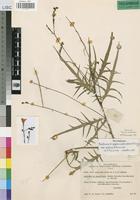
Isotype of Tricliceras longepedunculatum (Mast.) R.Fernandes var. eratense R.Fernandes [family TURNERACEAE]
Tricliceras longepedunculatum (Mast.) R.Fern. var. eratense R.Fern.
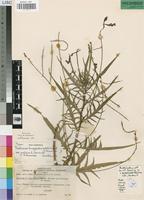
Isotype of Tricliceras longepedunculatum (Mast.) R.Fernandes var. eratense R.Fernandes [family TURNERACEAE]
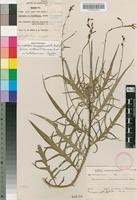
Paratype of Tricliceras longepedunculatum (Mast.) R.Fern. var. eratense R.Fern. [family TURNERACEAE]
Previous
Next

Name

Identification
Tricliceras longepedunculatum (Mast.) R.Fern. [family TURNERACEAE ]
Related name
  • Tricliceras longepedunculatum

Flora

Entry for Tricliceras longepedunculatum Mast. R. Fernandes [family TURNERACEAE]
Herbarium
Royal Botanic Gardens, Kew (K)
Collection
Flora Zambesiaca
Resource Type
Reference Sources
Entry From
FZ, Vol 4, Part 0, page 348, (1978) Author: R. Fernandes
Names
Tricliceras longepedunculatum Mast. R. Fernandes [family TURNERACEAE], in Bol. Soc. Brot., Sér. 2, 49: 21 (1975). Type: Malawi, Maganja Hills, Meller (K, holotype).
Wormskioldia longepedunculata Mast. [family TURNERACEAE], in F.T.A. 2: 502 (1871).—Urb. in Jahrb. Königl. Hot. Gart. Berl. 2: 53 (1883).—Gilg in Engl. & Prantl, Pflanzenfam. 3, 6a: 61 (1893).—Britten et al. in Trans. Linn. Soc., Bot. 4: 14 (1894).—Engl. in Sitz.-Ber. Königl. Preuss. Akad. Wiss. Berl. 52: 13, 24, 28, 31 (1906); Pflanzenw. Afr. 3, 2: 593 (1921).—P. Lima in Asoc. Esp. Progr. Cienc.: 63 (1923).—Burtt Davy, F.P.F.T. 1: 119, fig. 11a (1926).—Gomes e Sousa in Bol. Soc. Estud. Col. Moçamb. 26: 116 (1935).—Martineau, Rhod. Wild Fl.: 55, t. 20 fig. 2 (1953).—Wild, Fl. Vict. Falls: 143 (1953).—J. Lewis in F.T.E.A., Turneraceae: 14 (1954).—Chapman, Veg. Mlanje Mt. Nyasal.: 33 (1962).—A. & R. Fernandes in Mem. Junta Invest. Ultramar., Sér. 2, 34: 18 (1962).—Letty, Wild Fl. Transv.: 224, t. 111 (1962).—Riley, Fam. Fl. Pl. S. Afr.: 59 (1963).—Robyns in F.C.B., Turneraceae: 9 (1967).—Binns, H.C.L.M.: 101 (1968).—Williamson, Useful Pl. Malawi, ed. 2: 127 (1972). Type as above.
Information
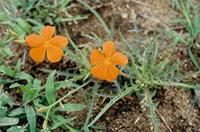
Perennial, usually caulescent, with a long vertical woody rootstock. Stems 1 to numerous, erect or rarely procumbent, simple or branched, both more or less white-pubescent (the individual hairs crisped) and setose, setae 1–5(7) mm. long, usually dark purple, not bulbous at the base, spreading, more or less dense or sometimes sparse, rarely very sparse. Leaves up to 20 cm. long, linear, narrowly lanceolate or elliptic, usually with some (up to 6) scattered, patent, narrowly triangular teeth or lanceolate to linear and acute segments near the base or in the lower half, the rest of the lamina undivided but serrate or serrulate at the margin, rarely all the lamina undivided, pubescent or puberulous to glabrescent, setose on the nerves beneath, subconcolorous, usually somewhat rigid, erect and dense, sessile to shortly petiolate. Flowers (1)4–12(14) per raceme, heterostylous. Peduncles 6–38 cm. long, the uppermost greatly exceeding the stem, pubescent, puberulous or glabrescent and with some sparse, short setae; pedicels up to 8 mm. long, setose above, accrescent and deflexed in fruit. Calyx 11·5–16 mm. long, not or sparsely puberulous, with or without short, appressed, pale setae; lobes c. 6 mm. long, oblong. Petals 25–38 × 5–10 mm., orange or bright vermilion to dull brick-red. Longistylous flowers: styles 10 mm. long, with the stigmas exceeding the anthers of the longest stamens. Brevistylous flowers: styles 3·5 mm. long. Ovary 4·5–5·5× 1 mm., pubescent. Capsule 4–8·5 × 0·1–0·15 (0·2) cm., pendulous, with or without short, sparse setae. Seeds 2·5–3·3 × 1·2–1·7 mm., obovoid.

Related Materials

  • Terms and Conditions
  • Privacy Policy
  • Cookie Policy
  • Cookie Settings
  • Accessibility
  • Help
  • Contact Us
  • Facebook
  • Twitter
ITHAKA

JSTOR is part of ITHAKA, a not-for-profit organization helping the academic community use digital technologies to preserve the scholarly record and to advance research and teaching in sustainable ways.

©2000-2026 ITHAKA. All Rights Reserved. JSTOR®, the JSTOR logo, JPASS®, Aluka®, and ITHAKA® are registered trademarks of ITHAKA.

╳