

Compilation
Trichopteryx dobbelaerei
2 Images see all
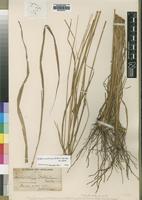
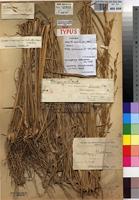
Name
Identification
Loudetia arundinacea (Hochst. ex A.Rich.) Steud. [family POACEAE ] (stored under name); Verified by Sanchez-Ken, Trichopteryx dobbelaerei DeWild. [family POACEAE ]
Related name
- Trichopteryx dobbelaerei
- Loudetia arundinacea
Flora
Entry for LOUDETIA arundinacea (A. Rich.) Steud. [family ]
Herbarium
Royal Botanic Gardens, Kew (K)
Collection
Flora of Tropical East Africa
Resource Type
Reference Sources
Entry From
Flora of Tropical East Africa, Part (Part 2), page 177, (1974) Author: W. D. CLAYTON, S. M. PHILLIPS AND S. A. RENVOIZE
Names
LOUDETIA arundinacea (A. Rich.) Steud. [family ], ,Syn. Pl. Glum. 1: 238 (1854); Hubbard in F.T.A. 10: 20 (1937); Ann. list grasses Ug.: 27 (1947); Imp. grassl. pl. Kenya: 48 (1951); F.P.N.A. 3: 302 (1955); F.P.S. 3: 486 (1956); R.K.G.: 36 (1958); I.G.U.: 41 (1960); G.T.: 52 (1965); Clayton in F.W.T.A., ed. 2, 3: 417 (1972). Type: Ethiopia, Tigre, Guendepta, Schimper 1214 (K, iso.!)
Tristachya arundinacea A. Rich. [family POACEAE], Tent. Fl. Abyss. 2: 417 (1851)
Trichopteryx arundinacea (A. Rich.) Engl. [family POACEAE], Hochgebirgsfl. Trop. Afr.: 129 (1892)
Trichopteryx grisea K. Schum. [family POACEAE], in P.O.A. C: 109 (1895). Types: Kenya, Kitui, Hildebrandt 2671 & Tanzania, Bukoba, Stuhlmann 4096 (both B, syn.)
Trichopteryx convoluta De Wild. [family POACEAE], Notes Fl. Kat. 5: 25 (1920). Types: Zaire, Kinshasa, Nyungu-Katschaka, Vanderyst 3326 (BR, syn. !) and many other syntypes
Trichopteryx dobbelaerei De Wild. [family POACEAE], Notes Fl. Kat. 5: 28 (1920). Type: Zaire, Kasai, Miao, Dobbelaere 13 (BR, holo.!)
Trichopteryx elegans De Wild. var. hensii [family POACEAE], Notes Fl. Kat. 5: 30 (1920). Type: Zaire, Kinshasa, Lutete, Hens 281 (BR, holo.!)
Trichopteryx verticillata De Wild. [family POACEAE], Notes Fl. Kat. 5: 38 (1920). Types: Zaire, Kinshasa, Kimuingu, Vanderyst 303 (BR, syn.!) and many other syntypes
Trichopteryx arundinacea Peter var. trichantha [family POACEAE], F.D.O.-A. 1, Anh.: 96 (1930). Type: Tanzania, Tabora District, Malongwe to Nyahua, Peter 34662 (B, holo. †)
Loudetia thomasii C. E. Hubbard [family ], in K.B. 1934: 427 (1934) & in F.T.A. 10: 23 (1937); Ann. list grasses Ug.: 27 (1947); I.G.U.: 40 (1960). Type: Uganda, Toro District, Kyegegwa, A. S. Thomas 1027 (K, holo.!)
Loudetia eripoda C. E. Hubbard [family ], in K.B. 1934: 433 (1934) & in F.T.A. 10: 23 (1937). Type: Cameroun, Tibati highland, Assun, Tessmann 2728 (K, holo.!)
Loudetia arundinacea (Peter) Hutch. var. trichantha [family ], in F.W.T.A. 2: 544 (1936); C. E. Hubbard in F.T.A. 10: 22 (1937); Ann. list grasses Ug.: 27 (1947)
Loudetia grisea (K. Schum.) Pilg. [family ], in N.B.G.B. 14: 94 (1938)
Loudetia arundinacea (De Wild.) Pic.-Serm. var. hensii [family ], Miss. Studio Lago Tana 7: 180 (1951); F.P.N.A. 3: 302 (1955); R.K.G.: 36 (1958); I.G.U.: 40 (1960); G.T.: 52 (1965)
Information
Robust tufted perennial; culms 60–300 cm. high, glabrous or hairy, sometimes bearded at the nodes; basal leaf-sheaths ± silky pubescent below, rarely woolly tomentose. Leaf-blades linear, flat, 20–70 cm. long, 3–15 mm. wide. Panicle narrowly oblong, 18–70 cm. long, lax or contracted, the branches conspicuously whorled. Spikelets narrowly lanceolate, 6–13 mm. long, brown, glabrous or the glumes setose from dark coloured tubercles; lower glume ovate, 1/3-1/2 as long as the spikelet, obtuse; upper glume lanceolate, as long as the spikelet, narrowly truncate; lower lemma similar to the upper glume; upper lemma 4–7 mm. long, pubescent, bidentate (teeth 0.7–1 mm. long); awn 2–4 cm. long; callus oblong, 0.5–1 mm. long, truncate or slightly emarginate; stamens 2.
Range
DISTR. U1–4; K4–7; T1, 4–8 Senegal to Ethiopia, southwards to Angola and Mozambique
Altitude range
300–1900 m.
Distribution
KENYA Nairobi District 19 km. E. of Nairobi, 15 May 1952, Bogdan 3406 !KENYA Kitui District Embu–Kangondi road 1.5 km. S. of Tana R., 8 May 1960, Napper 1643 !KENYA Masai District Olodungoro, 13 July 1961, Glover et al. 2144 !TANZANIA Old Shinyanga aerodrome, 3 Apr. 1932, B. D. Burtt 2587 !TANZANIA Musoma District 88 km. from Seronera to Kirawira Guard Post, 24 Apr. 1961, Greenway 10087 !TANZANIA Morogoro District 42 km. NE. of Morogoro, near Kitulanghalo Hill, 21 Apr. 1966, Welch 614!UGANDA W. Nile District Logiri, 15 June 1936, A. S. Thomas 2021!UGANDA Masaka District Sese I., Bugoma, June 1925, Maitland 974!UGANDA Mengo District Butemba, 17 Feb. 1957, Harker 629 !
Notes
Typically a robust species with broad leaf-blades, stout culms and spikelets about 10 mm. long; smaller specimens (such as L. thomasii, or the woolly based L. eripoda) have been separated from it, but these seem to represent merely the extreme limit of variation. L. angolensis C. E. Hubbard, with its dense narrow panicle, subacute lower glume and slender callus, is rightly regarded as distinct; it occurs in Angola and Zambia. Two varieties of L. arundinacea may be recognized, the one (var. arundinacea) with glabrous glumes, the other (var. hensii) with setose glumes. The varieties can be found growing side by side, intermediates are common, and the character tends to be rather variable in other members of the genus. There seems no reason to believe that the feature is of particular significance in this species.