

Compilation
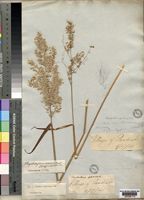
Tricholaena sphacelata
1 Images see all
Name
Identification
Tricholaena sphacelata Benth. [family POACEAE ] Melinis repens (Willd.) Zizka [family POACEAE ] (stored under name); Melinis repens (Willd.) Zizka [family POACEAE ] Panicum insigne Steud. [family POACEAE ] Rhynchelytrum roseum (Nees) Stapf & C.E.Hubb. [family POACEAE ] Verified by Hubbard,C.E., Eriochloa grandiflora Hochst. [family POACEAE ]
Related name
- Eriochloa grandiflora
- Tricholaena sphacelata
- Rhynchelytrum roseum
- Panicum insigne
- Melinis repens
Flora
Entry for RHYNCHELYTRUM repens (Willd.) C.E. Hubbard [family POACEAE]
Herbarium
Royal Botanic Gardens, Kew (K)
Collection
Flora of Tropical East Africa
Resource Type
Reference Sources
Entry From
Flora of Tropical East Africa, page 451, (1982) Author: W. D. CLAYTON and S.A. RENVOIZE
Names
RHYNCHELYTRUM repens (Willd.) C.E. Hubbard [family POACEAE], in K.B. 1934: 110 (1934); Ann. list grasses Ug.: 39 (1947); F.P.N.A. 3: 119 (1955); F.P.S. 3: 522 (1956); R.K.G.: 50 (1958); Ann. list Nyasaland grasses; 55 (1958); I.G.U.: 51 (1960); G.T.: 82 (1965); Clayton in F.W.T.A., ed. 2, 3: 454 (1972). Type: Ghana [Guinea], Isert (B, holo., K, photo.!)
Saccharum repens Willd. [family POACEAE], Sp. Pl., ed. 4, 1: 322 (1798)
Erianthus repens (Willd.) P. Beauv. [family POACEAE], Ess. Agrost.: 162, 177 (1812)
Tricholaena rosea Nees [family POACEAE], Cat. Sem. Hort. Vratis. (1835) & in Linnaea 11, Lit. Ber.: 129 (1837). Types: South Africa, Drège 4319 & 4321 (“4821”) (both B, syn.) and two other Drège numbers
Tricholaena tonsa Nees [family POACEAE], Cat. Sem. Hort. Vratis. (1835) & in Linnaea 11, Lit. Ber.: 128 (1837). Type: South Africa, Drège 4320 (B, holo.)
Rhynchelytrum dregeanum Nees [family POACEAE], in Lindley, Nat. Syst., ed. 2: 447 (1836). Type: South Africa, Durban [Port Natal], Drège 4322 (B, holo.)
Tricholaena fragilis A. Br. [family POACEAE], in Flora 24: 275 (1841). Type: cultivated at Carlsruhe from seed collected in Ethiopia by Schimper (K, iso.!)
Monachyron villosum Parl. [family POACEAE], in Hook., Niger Fl.: 191 (1849). Type: Cape Verde Is., S. Jacobi, Hooker (B, holo.)
Tricholaena sphacelata Benth. [family POACEAE], in Hook., Niger Fl.: 559 (1849). Type: Nigeria, Pandiaki, Ansell (K, holo.!)
Monachyron roseum (Nees) Parl. [family POACEAE], Fl. Ital. 1: 131 (1850)
Monachyron tonsum (Nees) Parl. [family POACEAE], Fl. Ital. 1: 131 (1850)
Tricholaena grandiflora A. Rich. [family POACEAE], Tent. Fl. Abyss. 2: 445 (1851). Types: Ethiopia, Selleuda, Schimper 205 (K, isosyn.!) & Choa, Petit (P, syn.)
Saccharum grandiflorum (A. Rich.) Walp. [family POACEAE], Ann. Bot. Syst. 3: 792 (1852)
Saccharum sphacelatum (Benth.) Walp. [family POACEAE], Ann. Bot. Syst. 3: 793 (1852)
Panicum insigne Steud. [family POACEAE], Syn. Pl. Glum. 1: 92 (1854). Based on Tricholaena grandiflora A. Rich., non Panicum grandiflorum Nees (1829)
Panicum roseum (Nees) Steud. [family POACEAE], Syn. Pl. Glum. 1: 92 (1854)
Panicum sphacelatum (Benth.) Steud. [family POACEAE], Syn. Pl. Glum. 1: 92 (1854), non Schumach. (1827)
Panicum tonsum (Nees) Steud. [family POACEAE], Syn. Pl. Glum. 1: 92 (1854)
Panicum braunii Steud. [family POACEAE], Syn. Pl. Glum. 1: 93 (1854). Based on Tricholaena fragilis A. Br., non Panicum fragile Kunth (1829)
Rhynchelytrum ruficomum Steud. [family POACEAE], Syn. Pl. Glum. 1: 120 (1854). Type: cultivated in Europe from seed collected in Nubia by Schimper (whereabouts uncertain)
Tricholaena rosea Peters var. setosa [family POACEAE], Reise Mossamb., Bot. 2: 561 (1864). Type: Mozambique, Tete, Peters (K, iso.!)
Rhynchelytrum microstachyum Balf. f. var. albicomum [family POACEAE], in Proc. Roy. Soc. Edinb. 12: 411 (1884). Types: Socotra, Balfour 124 & Schweinfurth 467 (both K, isosyn.!)
Monachyron grandiflorum (A. Rich.) Martelli [family POACEAE], Fl. Bogos.: 94 (1886)
Tricholaena ruficoma (Steud.) Hack. [family POACEAE], in Bol. Soc. Brot. 6: 142 (1888)
Tricholaena dregeana (Nees) Th. Dur. & Schinz [family POACEAE], Consp. Fl. Afr. 5: 769 (1894)
Tricholaena microstachya (Balf. f.) Th. Dur. & Schinz var. albicoma [family POACEAE], Consp. Fl. Afr. 5: 770 (1894)
Tricholaena villosa (Parl.) Th. Dur. & Schinz [family POACEAE], Consp. Fl. Afr. 5: 771 (1894)
Tricholaena tonsa Schweinf. var. submutica [family POACEAE], in Bull. Herb. Boiss. 2, App. 2: 96 (1894). Type: Ethiopia, Eritrea, Maldi, Schweinfurth 24 (B, holo.)
Tricholaena monachyron Oliv. [family POACEAE], in Hook., Ic. Pl. 24, t. 2374 (1895), nom. superfl. Based on Monachyron villosum Parl.
Tricholaena grandiflora Rendle var. collina [family POACEAE], Cat. Afr. Pl. Welw. 2: 195 (1899). Types: Angola, Ambriz, Welwitsch 2894 (K, isosyn.!) & several other syntypes
Melinis rosea (Nees) Hack. [family POACEAE], in Oest. Bot. Zeitschr. 51: 464 (1901)
Melinis villosa (Parl.) Hack. [family POACEAE], in Oest. Bot. Zeitschr. 51: 464 (1901)
Panicum setinsigne Mez [family POACEAE], in E.J. 34: 133 (1904). Type: South Africa, Lydenberg, Wilms 1674b (B, holo.)
Melinis ruficoma (Steud.) Chiov. [family POACEAE], in Ann. Bot. Roma 5: 62 (1906)
Rhynchelytrum dregeanum Chiov. var. annuum [family POACEAE], in Ann. Ist. Bot. Roma 8: 309 (1907). Type: Ethiopia, Eritrea, Mai Albo, Pappi 6094 (Fl, holo.!)
Rhynchelytrum dregeanum Chiov. var. intermedium [family POACEAE], in Ann. Ist. Bot. Roma 8: 310 (1907). Types: Ethiopia, Eritrea, Keren, Tellini 933 & Debarroa, Pappi 450 & Pappi 468 & Mansura R., Pappi 7158 (all Fl, syn.!)
Rhynchelytrum villosum (Parl.) Chiov. [family POACEAE], in Ann. Ist. Bot. Roma 8: 310 (1907); F.T.A. 9: 875 (1930); F.P.S. 3: 522 (1956); R.K.G.: 50 (1958); G.T.: 82 (1965); Clayton in F.W.T.A., ed. 2, 3: 454 (1972)
Rhynchelytrum tonsum (Nees) Lanza & Mattei [family POACEAE], in Boll. Ort. Palermo 9: 49 (1910)
Tricholaena rosea (Benth.) A. Chev. var. sphacelata [family POACEAE], Etudes Fl. Afr. Centr. Fr. 1: 366 (1913)
Melinis bertlingii Mez [family POACEAE], in E.J. 57: 195 (1921). Types: Namibia, Bertling Xa & Schäfer 17 (both B, syn.)
Melinis rangei Mez [family POACEAE], in E.J. 57: 195 (1921). Type: Namibia, Bethanie District, Range 1012 (K, iso.!)
Melinis seineri Mez [family POACEAE], in E.J. 57: 195 (1921). Types: Namibia, Omaheke, Seiner 167 & 425 & several other syntypes (all B. syn.)
Melinis affinis Mez [family POACEAE], in E.J. 57: 196 (1921). Type: Namibia, Bethanie District, Range 1012a (K, iso.!)
Melinis pulchra Mez [family POACEAE], in E.J. 57: 196 (1921). Types: Namibia, Tsumeb, Dinter 2477 & Grootfontein, Waibel 57 & 96 (all B, syn.)
Melinis argentea Mez [family POACEAE], in E.J. 57: 197 (1921). Type: Cameroun, Garua, Ledermann 4943 (B, holo.)
Melinis congesta Mez [family POACEAE], in E.J. 57: 197 (1921). Type: Angola, Wellman 1295 (B, holo.)
Melinis mutica Mez [family POACEAE], in E.J. 57: 197 (1921). Type: Namibia, Tsumeb, Dinter 2478 (B, holo.)
Melinis nitens Mez [family POACEAE], in E.J. 57: 198 (1921). Type: Tanzania, Kilimanjaro, Uhlig (B, holo.)
Melinis brachyrhynchus Mez [family POACEAE], in E.J. 57: 199 (1921). Type: Cameroun, Bamboutos Mts. [Bambutoberge], Ledermann 1580 (B, holo.)
Melinis paupera Mez [family POACEAE], in E.J. 57: 199 (1921). Type: Tanzania, Amani Herb. 2325 (B, holo.!)
Melinis stolzii Mez [family POACEAE], in E.J. 57: 199 (1921). Type: Tanzania, Rungwe District, Kyimbila, Stolz 1303 (K, iso.!)
Melinis ugandensis Mez [family POACEAE], in E.J. 57: 200 (1921). Type: cultivated in Britain, seed from Kenya, Nairobi, (“ Sharp ”) Snape (B, holo.)
Rhynchelytrum roseum (Nees) Bews [family POACEAE], The World’s Grasses: 223 (1929); F.T.A. 9: 880 (1930); Fl. Agrost. Congo Belge 2: 299 (1934); Imp. Grassl. Pl. Kenya: 59 (1951)
Rhynchelytrum stolzii (Mez) Stapf & Hubbard [family POACEAE], in F.T.A. 9: 885 (1930); Ann. list Nyasaland grasses: 56 (1958);G.T.: 82 (1965)
Tricholaena repens (Willd.) Hitchc. [family POACEAE], U.S. Dept. Agric. Misc. Publ. 243: 331 (1936)
Rhynchelytrum repens (Nees) Chiov. var. roseum [family POACEAE], Miss. Biol. Borana, Racc. Bot.: 275 (1939)
Tricholaena repens (Nees) Alberts var. rosea [family POACEAE], in Bull. Imp. Bur. Past. For. Crops. 37: 10 (1947)
Information
Annual or loosely tufted perennial; culms 30–100 cm. high, erect or ascending. Leaf-blades flat or folded, 5–30 cm. long, 2–10 mm. wide. Panicle ovate to oblong, 5–20 cm. long, fluffy, silvery pink or purple; pedicels usually pilose at the tip. Spikelets ovate, 2.5–8.5 mm. long, villous with hairs extending 1–4 mm. beyond the tip; lower glume narrowly oblong, 0.3–3.5 mm. long, separated from the upper by an internode 0.1–1.2 mm. long; upper glume conspicuously gibbous, chartaceous, tapering to a glabrous membranous beak 1/4–1/2 its length, emarginate, mucronate or with an inconspicuous awn up to 7(–10) mm. long; lower floret ♂ or barren, its lemma narrower and less gibbous than the upper glume, its palea ciliate on the keels. Fig. 125.
Range
DISTR. U1–4; K1–7; T1–8; Z; P throughout Africa; introduced to most other tropical countries
Altitude range
0–2500 m.
Distribution
KENYA Northern Frontier Province Kailongol Mts., 15 June 1970, Mathew 6824!KENYA Meru District Meru National Park, main Ura Gate road crossing Kiolu R., 19 Dec. 1972, Ament 460!KENYA Teita District Tsavo National Park East, Voi Gate, 5 Jan. 1967, Greenway & Kanuri 12972!TANZANIA Mbulu District Bagoyo R., 20 Mar. 1964, Greenway & Kanuri 11387!TANZANIA Ufipa District Lake Kwela, 4 July 1950, Bullock 2963!TANZANIA Morogoro District opposite Acropol Hotel, 29 Apr. 1968, Renvoize & Abdallah 1804!TANZANIA Zanzibar, Kizimkazi, 19 July 1963, Faulkner 3219!TANZANIA Pemba I., Vaughan 895!UGANDA Karamoja District Lodoketemit catchment, 16 July 1959, Kerfoot 1199!UGANDA Ankole District Mbarara, 3 Aug. 1929, Snowden 1403!UGANDA Kigezi District Kabale, 6 July 1945, A.S. Thomas 4310!
Notes
R. repens is a polymorphic species with considerable variation in the size, indumentum and colouring of the spikelets, and in the habit of the plant. It is customarily divided according to whether there is a long (R. villosum) or short internode between the glumes. In fact the length of this internode (and also that of the lower glume) varies continuously, and is found to be directly proportional to the length of the spikelet.The species closely approaches Melinis ambigua. The latter can usually be recognized by its longer awns, but the nervation of the upper glume is the most reliable distinguishing character.