

Compilation
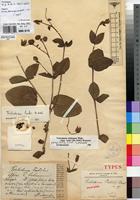
Trichodesma verdickii
1 Images see all
Name
Identification
Trichodesma verdickii Brand [family BORAGINACEAE ] Verified by Not on sheet, Trichodesma ambacense Welw. [family BORAGINACEAE ] (stored under name); Verified by Brummitt R.K., 1981
Related name
- Trichodesma ambacense
- Trichodesma verdickii
Flora
Entry for Trichodesma ambacense subsp. hockii De Wild. Brummitt [family BORAGINACEAE]
Herbarium
Royal Botanic Gardens, Kew (K)
Collection
Flora Zambesiaca
Resource Type
Reference Sources
Entry From
FZ, Vol 7, Part 4, page 59, (1990) Author: E. S. Martins (Trichodesma by R. K. Brummit)
Names
Trichodesma ambacense subsp. hockii De Wild. Brummitt [family BORAGINACEAE], in Kew Bull 37: 446 (1982). Type from Zaire.
Trichodesma hockii De Wild. [family BORAGINACEAE], in Fedde, Repert. Sp. Nov. Regni Veg. 11: 546 (1913). —Brand in Engl., Pflanzenr., 78, [IV, 252]: 26 (1921). —Brenan in Mem. New York Bot. Gard. 9: 6 (1954). —Binns, H.C.L.M.: 24 (1968). —Taton in Fl. Congo, Rwanda et Burundi, Boraginaceae: 44 (1971). —Cribb & Leedal, Mt. Fl. S. Tanzania: 57 (1980). Type as for T. ambacense subsp. hockii.
Trichodesma tinctorium Brand [family BORAGINACEAE], in Bull. Jard. Bot. Brux. 4: 393 (1914); in Engl., Pflanzenr., 78, [IV, 252]: 23 (1921). Type from Zaire.
Trichodesma verdickii Brand [family BORAGINACEAE], in Bull. Jard. Bot. Brux. 4: 392 (1914); in Engl., Pflanzenr., 78, [IV, 252]: 23 (1921). Type from Zaire.
Trichodesma ledermannii Vaupel [family BORAGINACEAE], in Engl., Bot. Jahrb. 48: 529 (1912). —Brand in Engl., Pflanzenr., 78, [IV, 252]: 24 (1921). —Heine in F.W.T.A. ed. 2, 2: 323 (1963). Type from Cameroon.
Information
Perennial herb with 1-several erect stems up to 50(70) cm. from rootstock, usually unbranched except for the inflorescence but sometimes with few sterile axillary shoots; stems variously setose-pubescent with irregularly spreading soft setae and often softer smaller hairs interspersed, or occasionally subglabrous with sparse stiffer tuberculate setae, very rarely subglabrous throughout. Leaves (2)4–7(9) x (0.3)0.7–3(3.6) cm. or very rarely (exceptional leaves perhaps on sterile shoots) up to 16 x 5 cm., lanceolate to broadly ovate or elliptic, acute or obtuse at the apex, cuneate to rounded at the base, sessile, the lower ones opposite, the upper sub-opposite or alternate, regularly clothed on both surfaces by either flat tubercles with or without hairs or with short setose hairs with or almost without tubercles. Inflorescences 2–30 cm. long, with 2–9(12) primary branches each bearing 1 -8( 12) flowers; primary branches usually subtended by very reduced leaves but individual cymes ebracteate; pedicels 1–1.2(2.7) cm. in flower, elongating to up to 3.5(4.5) cm. in fruit, with spreading hairs often hooked upwards at the apex or occasionally with only upwardly appressed hairs which may be sparse. Sepals (10)12–16(18) x (3)5–8(9) mm. in flower, ovate, usually broadly overlapping each other and margins often curved outwards, enlarging to up to 20 mm. broad in fruit and then cordate at the base, clothed with sparse to dense hairs (tuberculate or not) either closely or loosely upwardly appressed in the upper part but often spreading or reflexed towards the base, rarely subglabrous with a line of tuberculate hairs round the margin. Corolla (15)17–25(3) mm. long, the lobes spreading or reflexed (in herbarium specimens usually obscuring the sepals in a majority of fully open flowers) and triangular with an acute apex, usually glabrous but rarely with a line of hairs down the middle of the lobes; lobes usually blue (? occasionally white), the tube usually white or cream and often (? always) with brown markings at the sinus between the lobes. Fruit as in T. physaloides.
Habitat
In grassland and woodland subject to annual burning
Range
Subsp. hockii from southern Sudan southwards to western Zimbabwe and northern Botswana, and in Nigeria and Cameroon; subsp. ambacense in Angola
Altitude range
600–2150 m.
2150
600
Distribution
Zambia S Mapanza N., fl. & fr. 20.ix.1953, Robinson 328 (K; SRGH).Zambia E Katete-Chadiza, mile 26, near Nsadzu R, fl. 8.x.1958, Robson 22 (K; LISC; SRGH).Zambia C 29 km. NE. of Kafue R. fl. 11.vii.1930, Hutchinson & Gillett 3590 (BM; COI; K; LISC; SRGH).Zambia W Mwinilunga Distr., Matonchi Farm, fl. 1936, Paterson 8 (K).Malawi S Mingoli, 11 km. E. of Zomba, fr. 29.xi.1977, Brummitt, Seyani & Dudley 15226 (K; MAL).Malawi C Kasungu Game Reserve, fl. 10.vii.1970, Hall-Martin 1736 (K; SRGH).Zimbabwe E S.of Penhalonga, fr. 1934, Gilliland Q924 (K).Zimbabwe C Gweru Distr., Mlezu Gov. Agric. School Farm, 28 km. SSE. of Kwekwe, fl. 23.ix.1965, Biegel 298 (SRGH).Zimbabwe W Plumtree, fl. ii.1935, McLeod 20 (K; PRE).Mozambique Z between R. Ligonha and Malema, fr. 14.x.1949, Barbosa & Carvalho 4429 (K).Zambia N Isoka, fl. 24.viii.1958, Lawton 444 (K).Mozambique N Mutuali, Nalume R. bridge, fl. & fr. 14.ix.1953, Gomes e Sousa 4115 (COI; K; LISC; PRE; SRGH).Malawi N Katumbi.fr. 1.xi.1966, Gillett 17528 (EA; K).Zimbabwe N Chipoli, Mowbray’s Farm, fl. 3.x.1931, Rattray 377 (PRE; SRGH).Zambia B 46 km. W. of Nangweshi, fl. 6.viii.1952, Codd 7416 (COI; K; PRE; SRGH).Botswana N Chobe Nat. Park, 20 km. S. of Serondella, fr. 17.x.1972, Biegel, Pope & Russell 4005A (SRGH).
Notes
The above description applies only to subsp. hockii. Subsp. ambacense, confined to Angola, differs in having the leaves broadest in their upper half and long-cuneate to the base, and sepals only 3–5 mm. broad.