JSTOR Global Plants Home
  • Home
  • Browse
  • About
  • Access
  • Account
    • Saved Items
    • Profile
  • Log in

Global Plants

Skip to Main Content
  • JSTOR Global Plants Home
  • Global Plants

    • Browse
    • About
    • Access
    • Account
      • Saved Items
      • Profile
Log in
  • Browse
  • About
  • Access
  • Account
    • Saved Items
    • Profile
Advanced Search

Compilation
Trichocladus goetzei

3 Images see all

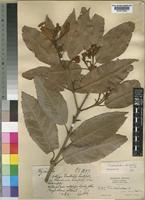
Type of Trichocladus dentatus Hutch. [family HAMAMELIDACEAE]
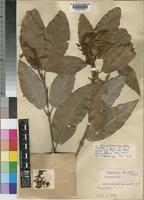
Trichocladus goetzei Engl. [family HAMAMELIDACEAE]
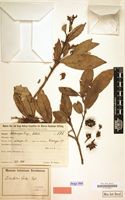
Type of Trichocladus goetzei Engl. [family HAMAMELIDACEAE]
Previous
Next

Name

Identification
Trichocladus goetzei Engl. [family HAMAMELIDACEAE ] (stored under name); Verified by Not on sheet.,
Related name
  • Trichocladus dentatus
  • Trichocladus crinitus
  • Trichocladus cf. crinitus
  • Trichocladus goetzei

Flora

Entry for TRICHOCLADUS goetzei Engl. [family HAMAMELIDACEAE]
Herbarium
Royal Botanic Gardens, Kew (K)
Collection
Flora of Tropical East Africa
Resource Type
Reference Sources
Entry From
Flora of Tropical East Africa, page 1, (1971) Author: B. Verdcourt
Names
TRICHOCLADUS goetzei Engl. [family HAMAMELIDACEAE], in E.J. 49: 455, fig. 1/A–G (1913) & V.E. 3(1), t. 188/A–G (1915); Harms in E. & P. Pf., ed. 2, 18a: 323, fig. 169/A–G (1930); T.T.C.L.: 244 (1949). Type: Tanganyika, Iringa District, Uhehe, Uzungwa [Utschungwe] Mts., ? near Kissinga, Goetze 574 (B, holo. †)
Information
Small evergreen tree 6–10.5(–24, fide Ede 2) m. tall; bark purple-brown, rather rough, flaking in oblong patches; young branchlets very densely hairy with rather coarse reddish-brown stellate hairs, older ones glabrescent. Leaves opposite; blades elliptic, elliptic-lanceolate or oblong, 3–11 cm. long, 0.8–4.2 cm. wide, rather rounded to acute or obtusely acuminate at the apex, truncate to cuneate at the base, not or only minutely peltate (one such leaf observed), entire, the margins sometimes revolute, rather coriaceous, at first thickly covered with rather coarse reddish-brown stellate hairs on both surfaces, soon glabrous above and at length glabrous beneath or retaining only a very few scattered hairs on the midrib and nerves; venation rather prominently reticulate on both surfaces; petiole 0.4–2 cm. long; stipules linear, 5 mm. long, soon falling. Inflorescences capitate, axillary and terminal, 2.5–3.5 cm. in diameter; peduncle 0.1–2 cm. long; bracteoles 2.5–3 mm. long, occasionally adnate to the calyx. Flowers sessile, somewhatsunk into the rhachis, tomentose. Hermaphrodite flowers: calyx-tube 1 mm. long; limb 5 mm. long, divided into 3 lobes (or sometimes 4 if an additional small one included), erect, 2.5–3 mm. long and wide, stellate tomentose outside, tipped with a hairy appendage; petals 5–6, white, linear, (l.4–)l.8– 1.9 cm. long, (l–)2–3.5 mm. wide, narrowed at the base, not revolute, glabrous; stamens 5–6; filaments oblong, flattened, 1 mm. long; anthers 1.3–1.6 mm. long; connective prolonged into an erect beak; styles 1.3 mm. long; ♀ flowers not seen (see note, p. 2). Capsule ± 1–1.1 cm. long including the 4 mm. long apical valves, 0.9–1 cm. across. Seeds creamy to dark brown, ellipsoid or oblong, shiny, 5–6 mm. long, 2–3.5 mm. broad.
Range
DISTR. T6, 7 not known elsewhere
Altitude range
1680–2300 m.
Distribution
TANGANYIKA Uluguru Mts., S. Uluguru Forest Reserve, edge of Lukwangule Plateau, 17 Mar. 1953, Drummond & Hemsley 1655!;TANGANYIKA Iringa District Mufindi, R. Luisenga, 16 Mar. 1962, Polhill & Paulo 1779B ! & Mufindi, Kigogo, May 1953, Eggeling 6625 !;TANGANYIKA Rungwe District Rungwe Crater, 3 Jan. 1912, Stolz 1067 !
Notes
So little material is available of this species that a number of problems remain. The type has been destroyed and Engler's description is not especially detailed; he gives the petal-width as 1 mm., but in Drummond & Hemsley 1655 & Stolz 1067, which I have associated with this species, the petals are much wider. I presume Engler's dimensions refer to immature petals.

Related Materials

  • Terms and Conditions
  • Privacy Policy
  • Cookie Policy
  • Cookie Settings
  • Accessibility
  • Help
  • Contact Us
  • Facebook
  • Twitter
ITHAKA

JSTOR is part of ITHAKA, a not-for-profit organization helping the academic community use digital technologies to preserve the scholarly record and to advance research and teaching in sustainable ways.

©2000-2026 ITHAKA. All Rights Reserved. JSTOR®, the JSTOR logo, JPASS®, Aluka®, and ITHAKA® are registered trademarks of ITHAKA.

╳