

Compilation
Tragiella friesiana
1 Images see all
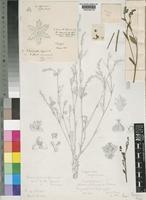
Name
Identification
Tragiella friesiana (Prain) Pax & K.Hoffm [family EUPHORBIACEAE ] (stored under name); Tragia friesiana Prain [family EUPHORBIACEAE ] Tragia angolensis Müll.Arg. [family EUPHORBIACEAE ]
Related name
- Tragia angolensis
- Tragiella friesiana
- Tragia friesiana
Flora
Entry for Tragiella friesiana Prain Pax & K. Hoffm. [family EUPHORBIACEAE]
Herbarium
Royal Botanic Gardens, Kew (K)
Collection
Flora Zambesiaca
Resource Type
Reference Sources
Entry From
FZ, Vol 9, Part 4, (1996) Author: A. Radcliffe-Smith
Names
Tragiella friesiana Prain Pax & K. Hoffm. [family EUPHORBIACEAE], in Engler, Pflanzenr. [IV, fam. 147, ix] 68: 106 (1919). —Engler, Pflanzenw. Afrikas (Veg. Erde 9) 3, 2: 101 (1921). Type: Zambia, Kunkute, near Mporokoso, fl. x.1911, R.E. Fries 1182 (UPS, holotype; K, fragment & drawing of holotype).
Tragia friesiana Prain [family EUPHORBIACEAE], in R.E. Fries, Wiss. Egebn. Schwed. Rhod.-Kongo-Exped. 1, 1: 125 (1914).
Sphaerostylis friesiana Prain Croizat [family EUPHORBIACEAE], in J. Arnold Arbor. 22, 3: 430 (1941).
Information
An erect, weakly urticating, branched perennial herb up to 50 cm tall, monoecious; stems one or more arising from a woody rootstock, the indumentum puberulous and with a mixture of long hairs and stinging bristles.Stipules 3–4 mm long, oblong-lanceolate, puberulous.Petiole 1–3 mm long, or leaves subsessile.Leaf blade 2–5 × 0.3–1.5 cm, narrowly lanceolate to linear-lanceolate, acute at the apex, shallowly and somewhat remotely serrate-denticulate on the margins, rounded-cuneate at the base, thinly chartaceous, sparingly pubescent and setose on the upper surface, more evenly so beneath, 3–5-nerved from the base, with the inner pair of nerves running ± one-third the length of the blade; tertiary nerves reticulate; lateral nerves in 3–5 pairs, not or scarcely prominent above, fairly prominent beneath.Inflorescences up to 10 cm long, the peduncle up to 3 cm long; male bracts 2–2.5 mm long, elliptic, subentire; male bracteoles 1 mm long, linear-lanceolate; female bracts 2–2.5 mm long, ovate-lanceolate, sometimes shallowly toothed; female bracteoles resembling the male bracts.Male flowers: pedicels less than 0.5 mm long; buds turbinate-subglobose; calyx lobes 1 × 1 mm, suborbicular, cucullate, sparingly pubescent to glabrous, yellow; stamens 3, 0.5 mm long; pistillode 3-lobed, the lobes rounded.Female flowers: pedicels 0.5 mm long, extending to 3–5 mm long in fruit; calyx lobes 6, 1.5 × 1.5 mm, accrescent to 4 × 2 mm, pinnatifid with 6–8 lateral lobules, the lobules narrowly oblong-lanceolate and shorter than the width of the calyx-lobe rhachis, sparingly puberulous and setulose, green, the calyx-lobe rhachis loriform or oblong, sparingly puberulous without, glabrous within, becoming hardened and stramineous within; ovary 1.5 mm in diameter, strongly 3-lobed, puberulous, setose on the keels; stylar column 1 mm high, 1 mm wide at the base, conical, sparingly puberulous, persistent, stigmas minute, smooth, recurved.Fruit 5 × 9–10 mm, strongly 3-lobed, smooth, evenly pubescent, sparingly setose on the keels.Seeds 4 mm in diameter, globose, buff, spotted and mottled with dark purplish-brown, with scattered pale circular patches fringed with minute whitish papillae.
Habitat
In high rainfall miombo woodland ground cover, appearing after early season fires
Range
Not known from elsewhere
Altitude range
1500–1525 m.
1525
1500
Distribution
Zambia N Mbala (Abercorn)–Kambole road, fl. 10.ix.1960, Richards 13208 (K); Chilwa Stream, Chitembwa (Chitimbwa) Road, fr. 20.viii.1970, Sanane 1327 (K; SRGH).
Notes
This species presents a remarkable parallel to Tragia lasiophylla Pax & K. Hoffm. resembling it in many vegetative respects.The form of the styles especially serve to distinguish the two, however.