JSTOR Global Plants Home
  • Home
  • Browse
  • About
  • Access
  • Account
    • Saved Items
    • Profile
  • Log in

Global Plants

Skip to Main Content
  • JSTOR Global Plants Home
  • Global Plants

    • Browse
    • About
    • Access
    • Account
      • Saved Items
      • Profile
Log in
  • Browse
  • About
  • Access
  • Account
    • Saved Items
    • Profile
Advanced Search

Compilation
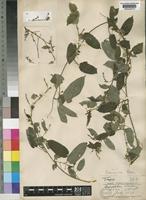
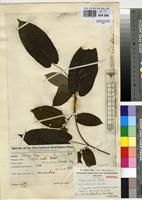
Tragiella anomala

2 Images see all

Tragiella anomala (Prain) Pax & K.Hoffm [family EUPHORBIACEAE]
Isosyntype of Tragia anomala Prain [family EUPHORBIACEAE]
Previous
Next

Name

Identification
Tragia anomala Prain [family EUPHORBIACEAE ] Verified by Not on sheet, Tragiella anomala (Prain) Pax & K.Hoffm. [family EUPHORBIACEAE ] (stored under name); Verified by Not on sheet,
Related name
  • Tragia unrecorded
  • Tragiella anomala
  • Tragia anomala

Flora

Entry for Tragiella anomala Prain Pax & K. Hoffm. [family EUPHORBIACEAE]
Herbarium
Royal Botanic Gardens, Kew (K)
Collection
Flora Zambesiaca
Resource Type
Reference Sources
Entry From
FZ, Vol 9, Part 4, (1996) Author: A. Radcliffe-Smith
Names
Tragiella anomala Prain Pax & K. Hoffm. [family EUPHORBIACEAE], in Engler, Pflanzenr. [IV, fam. 147, ix] 68: 106, t. 24F (1919). —Engler, Pflanzenw. Afrikas (Veg. Erde 9) 3, 2: 101, t. 46F (1921). —Radcliffe-Smith in F.T.E.A., Euphorb. 1: 321 (1987). Syntypes: Malawi, Misuku Hills (Masuku Plateau), 1980–2135 m, fl. vii.1896, Whyte 269 (K); the other syntype from Tanzania (Southern Highlands).
Tragia anomala Prain [family EUPHORBIACEAE], in Bull. Misc. Inform., Kew 1912, 4: 194 (1912); in F.T.A. 6, 1: 975 (1913).
Sphaerostylis anomala Prain Croizat [family EUPHORBIACEAE], in J. Arnold Arbor. 22, 3: 430 (1941).
Tragia sp. 1 [family EUPHORBIACEAE], White in F.F.N.R.: 205 (1962).
Information
A liane extending up to 6 m in length, monoecious.Young stems minutely puberulous and/or retrorsely hispid intermixed with stinging bristles.Stipules 3–5 mm long, linear-lanceolate, sparingly pubescent without, glabrous within, thinly coriaceous, buff, persistent.Petioles 0.5–7 cm long, indumentum similar to that of the stems.Leaf blades 3–11 × 1–5 cm, ovate-oblong to oblong or oblong-lanceolate, shortly ± acute acuminate at the apex, crenate-serrate with the teeth forwardly directed on the margins, shallowly wide-cordate to ± deep and narrowly cordate at the base, membranaceous, 3–5-nerved from the base, sparingly pubescent or hispid on both surfaces, very sparingly setose along the midrib and main nerves on both surfaces; lateral nerves in 3–6 pairs, scarcely to slightly prominent above and beneath.Inflorescences 3–5 cm long, the peduncle 1–2 cm long, ± laxly flowered; male bracts 2–2.5 mm long, obovate-subspathulate, entire, adaxially concave, puberulous without, glabrous within; male bracteoles 1–1.5 mm long, subulate or linear, fugacious; female bracts 3.5 × 2.5 mm, ovate, entire or with a few small sharp lateral teeth; female bracteoles 2.5–3 mm long, linear-lanceolate, entire or subentire.Male flowers: pedicels 3 mm long, minutely puberulous; buds turbinate, truncate at the apex; calyx tube very short, scarcely constricted; calyx lobes c. 1 × 1 mm, broadly ovate, sparingly puberulous without, glabrous within; stamens minute; pistillode minute, circular.Female flowers: pedicels 0.5 mm long, densely pubescent, extending to 3 mm in fruit; calyx lobes 6, 2.5 × 0.5 mm, accrescent to 9 × 4 mm, pinnatifid, with 15–19 lobules, the terminal lobule lanceolate, the lateral lobules narrowly triangular-lanceolate and ± equalling the width of the calyx-lobe rhachis, densely setose, green, the calyx-lobe rhachis narrowly lanceolate, sparingly puberulous without, glabrous within, green without, becoming somewhat hardened and stramineous within; ovary 1.5 mm in diameter, 3-lobed, densely appressed-setose; stylar mass 1.5–2 × 2–2.3 mm, subglobose to turbinate-obpyriform, stipitate, appressed-puberulous, stigmas short, separate, smooth, recurved and closely applied to the rim of the stylar mass and later retracted within it.Fruit 5 × 9 mm, 3-lobed, smooth, sparingly appressed-pubescent, and setose on the keels.Seeds 4.5 mm in diameter, globose, buff, closely spotted, flecked and mottled with dark brown.
Habitat
In montane evergreen forest understorey
Altitude range
1580–2150 m.
2150
1580
Distribution
Malawi N Misuku Hills, Mugesse (Mughesse), fr. 12.ix.1977, Pawek 12994 (K; MAL; MO).Zambia E Nyika Plateau, Mt. Kangampande, fl., y. & o. fr. 7.v.1952, White 2761 (FHO; K).
Distribution (external)
Tanzania
Notes
The genus Sphaerostylis was established by Baillon for a plant from Madagascar with no stinging hairs, suborbicular stipules, entire leaves and entire female calyx lobes.The only feature it has in common with Tragiella is in the nature of the style, but this would not seem to be sufficient to justify Croizat's reduction of the latter thereunder.

Related Materials

  • Terms and Conditions
  • Privacy Policy
  • Cookie Policy
  • Cookie Settings
  • Accessibility
  • Help
  • Contact Us
  • Facebook
  • Twitter
ITHAKA

JSTOR is part of ITHAKA, a not-for-profit organization helping the academic community use digital technologies to preserve the scholarly record and to advance research and teaching in sustainable ways.

©2000-2026 ITHAKA. All Rights Reserved. JSTOR®, the JSTOR logo, JPASS®, Aluka®, and ITHAKA® are registered trademarks of ITHAKA.

╳