JSTOR Global Plants Home
  • Home
  • Browse
  • About
  • Access
  • Account
    • Saved Items
    • Profile
  • Log in

Global Plants

Skip to Main Content
  • JSTOR Global Plants Home
  • Global Plants

    • Browse
    • About
    • Access
    • Account
      • Saved Items
      • Profile
Log in
  • Browse
  • About
  • Access
  • Account
    • Saved Items
    • Profile
Advanced Search

Compilation
Tragia prionoides

7 Images see all

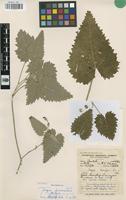
Type of Tragia sonderi Prain [family EUPHORBIACEAE]
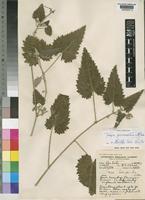
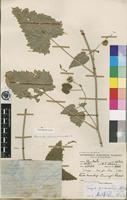
Isotype of Tragia prionoides Radcl.-Sm. [family EUPHORBIACEAE]
Type of Tragia sonderi Prain [family EUPHORBIACEAE]
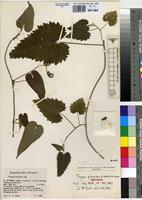
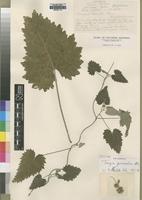
Isotype of Tragia prionoides Radcl.-Sm. [family EUPHORBIACEAE]
Holotype of Tragia prionoides Radcl.-Sm. [family EUPHORBIACEAE]
Previous
Next

Name

Identification
Isotype of Tragia prionoides Radcl.-Sm. [family EUPHORBIACEAE ] (stored under name); Verified by Radcl.-Sm.,
Related name
  • Tragia brevipes
  • Tragia sonderi
  • Tragia prionoides

Flora

Entry for Tragia prionoides Radcl.-Sm. [family EUPHORBIACEAE]
Herbarium
Royal Botanic Gardens, Kew (K)
Collection
Flora Zambesiaca
Resource Type
Reference Sources
Entry From
FZ, Vol 9, Part 4, (1996) Author: A. Radcliffe-Smith
Names
Tragia prionoides Radcl.-Sm. [family EUPHORBIACEAE], in Kew Bull. 42: 397 (1987). Type: Zimbabwe, Mutare Distr., Zimunya's Reserve, Rowa Township, fl. & fr. 2.v.1954, Chase 5232 in GHS 46927 (SRGH, holotype; BM; K; LISC).
Information
A climbing branched severely urticating perennial herb or shrub, up to 9 m tall when supported, monoecious.Stems and petioles tomentellous, or retrorsely puberulous and hispid and sometimes stinging-setose.Stipules 5–6 mm long, linear-lanceolate.Petiole up to 13.5 cm long.Leaf blade 2–18.5 × 1–14 cm, triangular-ovate, acute at the apex, coarsely serrate or biserrate on the margins, deeply or widely cordate at the base, chartaceous, 5–7-nerved from the base, sparingly pubescent and setose on upper surface, whitish-tomentose and setose along the midrib and main nerves beneath; lateral nerves in 3–5 pairs, scarcely prominent above, slightly so beneath, camptodromous or craspedodromous.Inflorescences up to 11 cm long, on peduncles up to 3 cm long, leaf-opposed, mostly male with 1(2) female flowers at the base; axis tomentellous; male bracts 2–3 mm long, linear, 1-flowered; male bracteoles 1–2 mm long, subulate; female bracts and bracteoles resembling those of the male, but slightly larger.Male flowers: pedicels 2 mm long; buds turbinate; calyx lobes 1.5 × 1 mm, elliptic-ovate, obtuse, sparingly puberulous without, glabrous within; stamens 1 mm long; pistillode flat, 3-lobed, the lobes truncate at the apex.Female flowers: pedicels very short, extending to 3 mm long in fruit; calyx lobes 6, 2 × 1.5 mm, accrescent to 7 × 7 mm, each lobe 7-lobulate, the lobules linear, longer than the width of the calyx-lobe rhachis, puberulous and setose, green, the calyx-lobe rhachis lanceolate, sparingly puberulous without, glabrous within, stramineous, at length woody proximally; ovary 1.5 mm in diameter, 3-lobed, densely setose; styles 3, 1.5 mm long, connate at the base, glabrous, stigmas smooth, recurved.Fruit 4–5 × 7–8 mm, 3-lobed, smooth, puberulous and setose.Seeds 3 mm in diameter, globose, greyish-brown, unevenly finely dark brown-granulate and with scattered patches of minute whitish papillae.
Habitat
On granite outcrops amongst boulders and in wooded kloofs
Altitude range
c. 1000–1500 m.
1500
1000
Distribution
Zimbabwe S Masvingo (Ft. Victoria), fl. iv.1921, Eyles 2990 (SRGH).Zimbabwe E Mutare Distr., Zimunya's Reserve, Rowa township, fl. & fr. 2.v.1954, Chase 5232 (BM; K; LISC; SRGH).Zimbabwe C Makoni Distr., Forest Hill, fl. & o. fr. vi.1917, Eyles 816 (BM; K; SRGH).Zimbabwe W Matobo Distr., Lucydale, fl. & fr. 1.i.1948, West 2533 in GHS 25562 (K; SRGH).
Distribution (external)
South Africa (Transvaal)
Notes
Although in the past confused with members of the T. okanyua-brevipes-benthamii complex, this plant is very distinct on account of its ragged saw-like leaf margin, the greyish tomentum on the leaf lower surface and its granulate seeds.The stinging hairs are recorded as being particularly virulent.

Related Materials

  • Terms and Conditions
  • Privacy Policy
  • Cookie Policy
  • Cookie Settings
  • Accessibility
  • Help
  • Contact Us
  • Facebook
  • Twitter
ITHAKA

JSTOR is part of ITHAKA, a not-for-profit organization helping the academic community use digital technologies to preserve the scholarly record and to advance research and teaching in sustainable ways.

©2000-2026 ITHAKA. All Rights Reserved. JSTOR®, the JSTOR logo, JPASS®, Aluka®, and ITHAKA® are registered trademarks of ITHAKA.

╳