JSTOR Global Plants Home
  • Home
  • Browse
  • About
  • Access
  • Account
    • Saved Items
    • Profile
  • Log in

Global Plants

Skip to Main Content
  • JSTOR Global Plants Home
  • Global Plants

    • Browse
    • About
    • Access
    • Account
      • Saved Items
      • Profile
Log in
  • Browse
  • About
  • Access
  • Account
    • Saved Items
    • Profile
Advanced Search

Compilation
Tragia micromeres

2 Images see all

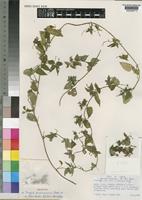
Holotype of Tragia micromeres Radcl.-Sm. [family EUPHORBIACEAE]
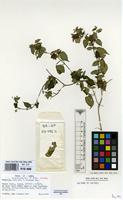
Isotype of Tragia micromeres Radcl.-Sm. [family EUPHORBIACEAE]
Previous
Next

Name

Identification
Isotype of Tragia micromeres Radcl.-Sm. [family EUPHORBIACEAE ] (stored under name); Verified by Not on sheet,
Related name
  • Tragia micromeres
  • Tragia brevipes

Flora

Entry for Tragia micromeres Radcl.-Sm. [family EUPHORBIACEAE]
Herbarium
Royal Botanic Gardens, Kew (K)
Collection
Flora Zambesiaca
Resource Type
Reference Sources
Entry From
FZ, Vol 9, Part 4, (1996) Author: A. Radcliffe-Smith
Names
Tragia micromeres Radcl.-Sm. [family EUPHORBIACEAE], in Kew Bull. 47: 681 (1992). Type: Zambia, Samfya, near shore of L. Bangweulu, 11°21'S, 29°33'E, 21.iv.1989, Radcliffe-Smith, Pope & Goyder 5752 (K, holotype; LISC; MAL; NDO; PRE; SRGH).
Information
A scrambling weakly urticating perennial herb, monoecious; stems, petioles and inflorescence axes evenly retrorsely puberulous and sparingly retrorsely- or patent-hirsute.Stipules 1.5–2 × 0.5–1 mm, lanceolate, sparingly pubescent.Petiole up to 5 cm long.Leaf blade 2–8 × 1–5 cm, ovate to ovate-lanceolate, scarcely or not at all 3-lobed, acutely acuminate at the apex, shallowly cordate at the base, sharply to indistinctly serrate on the margins, membranous, 5(7)-nerved from the base, sparingly hirsute on upper surface, ± evenly setose along the midrib and main nerves beneath; lateral nerves in 3–4 pairs, scarcely prominent above, somewhat prominent beneath.Inflorescences up to 5 cm long, the peduncle up to 2 cm long, leaf-opposed or supra-axillary, bisexual with only 1 female flower at the base; male bracts 1 mm long, linear-lanceolate; female bracts 1.5 mm long, 3-lobed, all ciliate and 1-flowered; male bracteoles 0.5 mm long, subulate; female bracteoles resembling the male bracts.Male flowers: pedicels 1–2 mm long, jointed at the base; buds subglobose; calyx lobes 1 × 0.75 mm, elliptic-obovate, apiculate, sparingly pubescent without, glabrous within; stamens 3, 0.5 mm long, anthers with a broad connective; pistillode 3-lobed, the lobes rounded.Female flowers: pedicels 0.5 mm long, scarcely extending in fruit; calyx lobes 6, 1.5 × 1 mm, accrescent to 3 × 1.5 mm, each lobe 7-lobulate on the margins, the lobules 0.5–1 mm long, linear-lanceolate, equalling or longer than the width of the calyx-lobe rhachis, puberulous and setose, dark green, the calyx-lobe rhachis linear-lanceolate, sparingly pubescent without, glabrous and stramineous within, becoming thinly woody in part; ovary 1.25 mm in diameter, 3-lobed, densely setose; styles 3, 2.25 mm long, erect, connate for two-thirds of their length, glabrous, stigmas smooth, strongly recurved.Fruit 4 × 7 mm, 3-lobed, smooth, sparingly setose, urticating, pale yellow-green.Seeds 2.75 mm in diameter, globose, pale brownish-grey, shining and irregularly dark purplish-brown mottled and flecked, and sinuously whitish-lined.
Habitat
On fixed dunes with Alchornea bangweolensis, Phyllanthus polyanthus, Croton polytrichus subsp. brachystachyus, Hymenocardia ulmoides, Thecacoris trichogyne and Bridelia duvigneaudii
Range
Known only from this locality
Altitude range
1067 m.
1067
1067
Distribution
Zambia N Samfya, near shore of Lake Bangweulu, 11°21'S, 29°33'E, fr. 21.iv.1989, Radcliffe-Smith, Pope & Goyder 5752 (K; LISC; MAL; NDO; PRE; SRGH); Radcliffe-Smith, Pope & Goyder 5754 (K; SRGH).

Related Materials

  • Terms and Conditions
  • Privacy Policy
  • Cookie Policy
  • Cookie Settings
  • Accessibility
  • Help
  • Contact Us
  • Facebook
  • Twitter
ITHAKA

JSTOR is part of ITHAKA, a not-for-profit organization helping the academic community use digital technologies to preserve the scholarly record and to advance research and teaching in sustainable ways.

©2000-2026 ITHAKA. All Rights Reserved. JSTOR®, the JSTOR logo, JPASS®, Aluka®, and ITHAKA® are registered trademarks of ITHAKA.

╳