JSTOR Global Plants Home
  • Home
  • Browse
  • About
  • Access
  • Account
    • Saved Items
    • Profile
  • Log in

Global Plants

Skip to Main Content
  • JSTOR Global Plants Home
  • Global Plants

    • Browse
    • About
    • Access
    • Account
      • Saved Items
      • Profile
Log in
  • Browse
  • About
  • Access
  • Account
    • Saved Items
    • Profile
Advanced Search

Compilation
Tragia glabrata

3 Images see all

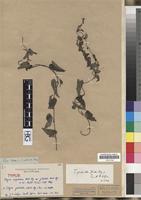
Type of Tragia glabrata (Müll. Arg.) Pax & K. Hoffm. [family EUPHORBIACEAE]
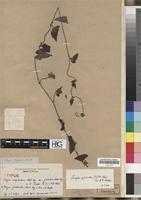
Type? of Tragia glabrata (Müll. Arg.) Pax & K. Hoffm. [family EUPHORBIACEAE]
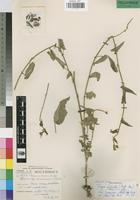
Holotype of Tragia glabrata (Müll. Arg.) Pax & K.Hoffm. var. hispida Radcl.-Sm. [family EUPHORBIACEAE]
Previous
Next

Name

Identification
Tragia glabrata (Müll. Arg.) Pax & K. Hoffm. [family EUPHORBIACEAE ] (stored under name); Verified by Pax, F., Tragia meyeriana Müll. Arg. [family EUPHORBIACEAE ] Verified by HBG-formal name entry, 2010
Related name
  • Tragia glabrata
  • Tragia meyeriana

Flora

Entry for Tragia glabrata Müll. Arg. Pax & K. Hoffm. [family EUPHORBIACEAE]
Herbarium
Royal Botanic Gardens, Kew (K)
Collection
Flora Zambesiaca
Resource Type
Reference Sources
Entry From
FZ, Vol 9, Part 4, (1996) Author: A. Radcliffe-Smith
Names
Tragia glabrata Müll. Arg. Pax & K. Hoffm. [family EUPHORBIACEAE], in Engler, Pflanzenr. [IV, fam. 147, ix] 68: 94 (1919). —Engler, Pflanzenw. Afrikas (Veg. Erde 9) 3, 2: 107 (1921). Types from South Africa (KwaZulu-Natal and Eastern Cape Province).
Tragia capensis E. Mey. [family EUPHORBIACEAE], in Drège, Zwei Pflanzengeogr. Dokum.: 226 (1843), ex Sond. in Linnaea 23: 110 (1850) non Thunb. (1794).
Tragia meyeriana var. glabrata Müll. Arg. [family EUPHORBIACEAE], in De Candolle, Prodr. 15, 2: 938 (1866).
Tragia durbanensis Kuntze [family EUPHORBIACEAE], Revis. Gen. Pl. 3, 3: 293 (1898). —Prain in F.C. 5, 2: 510 (1920). Types as for T. glabrata.
Information
A much-branched climbing perennial herb, weakly urticating, monoecious; stems from a woody rootstock, up to 2.5 m long, twining, subglabrous or sparingly puberulous, rarely evenly hispid.Stipules 3–4 mm long, ovate-lanceolate, glabrous.Petiole 0.5–3 cm long.Leaf blade 2–6 × 1.5–4.5 cm, triangular-ovate to triangular, sometimes with 2 weakly developed lateral lobes at the base, acute to subacute or obtuse at the apex, crenate to crenate-serrate or crenate-dentate on the margins, wide-cordate at the base, membranaceous, 5–7-nerved from the base, very sparingly puberulous and with a few scattered setae to almost glabrous on both surfaces; lateral nerves in 3–4 pairs, scarcely prominent above or beneath.Inflorescences up to 5.5 cm long with peduncles up to 2 cm long, terminal on lateral shoots and leaf-opposed on the main stems, composed mostly of male flowers with 1–2 female flowers below or else all male; male bracts 1 mm long, lanceolate; male bracteoles 0.7 mm long, linear-lanceolate; female bracts 2 × 1.5 mm, ovate; female bracteoles resembling the male bracts.Male flowers: pedicels 1 mm long; buds 3-lobed to subglobose; calyx lobes 1 × 1 mm, suborbicular, obtuse, subglabrous, green; stamens 3, 0.5 mm long; pistillode 3-lobed, minute.Female flowers: pedicels 0.5 mm long, extending to 2–3 mm in fruit; calyx lobes 3, 1.5 × 2 mm, accrescent to 4 × 6 mm, each lobe palmately 18–22-lobulate, the lobules linear-lanceolate, shorter than the width of the calyx-lobe rhachis, sparingly puberulous and setose, green, the calyx-lobe rhachis transversely ovate-suborbicular, sparingly puberulous and setose without, glabrous within, yellowish, only becoming slightly hardened; ovary 1.5 mm in diameter, 3-lobed, setose; styles 3, 2–3 mm long, connate to halfway, glabrous, stigmas smooth, recurved.Fruit 5 × 8 mm, 3-lobed, smooth, setose on the keels, otherwise ± glabrous.Seeds 4 mm in diameter, globose, pale greyish-fulvous, with chestnut-brown flecks, and with scattered circular patches fringed with papillae.

Related Materials

  • Terms and Conditions
  • Privacy Policy
  • Cookie Policy
  • Cookie Settings
  • Accessibility
  • Help
  • Contact Us
  • Facebook
  • Twitter
ITHAKA

JSTOR is part of ITHAKA, a not-for-profit organization helping the academic community use digital technologies to preserve the scholarly record and to advance research and teaching in sustainable ways.

©2000-2026 ITHAKA. All Rights Reserved. JSTOR®, the JSTOR logo, JPASS®, Aluka®, and ITHAKA® are registered trademarks of ITHAKA.

╳