JSTOR Global Plants Home
  • Home
  • Browse
  • About
  • Access
  • Account
    • Saved Items
    • Profile
  • Log in

Global Plants

Skip to Main Content
  • JSTOR Global Plants Home
  • Global Plants

    • Browse
    • About
    • Access
    • Account
      • Saved Items
      • Profile
Log in
  • Browse
  • About
  • Access
  • Account
    • Saved Items
    • Profile
Advanced Search

Compilation
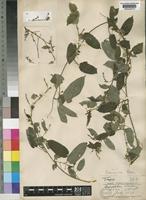
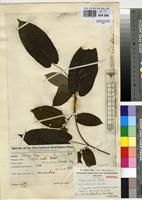
Tragia anomala

2 Images see all

Tragiella anomala (Prain) Pax & K.Hoffm [family EUPHORBIACEAE]
Isosyntype of Tragia anomala Prain [family EUPHORBIACEAE]
Previous
Next

Name

Identification
Tragia anomala Prain [family EUPHORBIACEAE ] Verified by Not on sheet, Tragiella anomala (Prain) Pax & K.Hoffm. [family EUPHORBIACEAE ] (stored under name); Verified by Not on sheet,
Related name
  • Tragiella anomala
  • Tragia anomala

Flora

Entry for TRAGIA anomala Prain [family EUPHORBIACEAE]
Herbarium
Royal Botanic Gardens, Kew (K)
Collection
Flora of Tropical Africa
Resource Type
Reference Sources
Entry From
Flora of Tropical Africa, Vol 6, Part 1, page 441, (1913) Author: (By J. G. Baker, with additions by C. H. Wright.)
Names
TRAGIA anomala Prain [family EUPHORBIACEAE], in Kew Bulletin, 1912, 194.
Information
Stems long, slender, twining, armed with stinging hairs. Leaves distinctly petioled, membranous, oblong, acute, base distinctly narrow-cordate, margin closely crenate or dentate, 3–6 in. long, 1 1/4–2 1/4 in. wide, sparingly bristly setose on the nerves above, more densely setose on the nerves beneath, otherwise glabrous; petiole 3/4–1 1/2 in. long, glabrescent or glabrous; stipules linear-lanceolate, reflexed, 1/5– 1/4 in. long, very sparingly pubescent externally. Racemes lateral, slender, rather lax, 1 1/4–1 1/2 in. long, with a naked slender finely puberulous peduncle 1/2–1 in. long, with several male flowers above and 1–2 basal female flowers; pedicels in both sexes solitary to their bracts, the male pedicels up to 1/4 in. long finely puberulous and longer than the bracts; male bracts oblong-subspathulate, obtuse or subacute, 1–2 lin. long, membranous, puberulous externally; female bracts oblanceolate-oblong, acute, margin with 2–3 lateral teeth but not lobed; bracteoles ovate, acute, toothed like their bracts. Male sepals 3, wide-ovate, sparingly puberulous externally. Stamens 3; filaments short. Female calyx-segments 6, ovate-lanceolate, membranous, at length accrescent but hardly coriaceous, 5 lin. long, pinnately 7–9-lobulate on each side, lateral lobules and rhachis very densely and softly woolly with long hairs, terminal laminula narrowly ovate almost glabrous, not much larger than the male lateral lobules. Ovary densely adpressed setose; styles 3, puberulous, united throughout in a wide pyriform tube, at first as large as the ovary; the stigmas free, recurved and closely applied to the swollen style-column, at length retracted within the mouth of the columnar tube. Capsule 3-coccous, rather sparingly pilose, 1/3 in. across; cocci subglobose. Seeds globose, dark brown with grey blotches.
Distribution
German East Africa Mozamb. Dist. Ukinga; Mount Kirunde, 6500 ft., Goetze, 907!Nyasaland Mozamb. Dist. Masuku Plateau, 6500–7000 ft., Whyte, 269!
Notes
A very distinct species with a large style resembling that of Tragia (Sphaerostylis) tulasneana, from Madagascar.

Related Materials

  • Terms and Conditions
  • Privacy Policy
  • Cookie Policy
  • Cookie Settings
  • Accessibility
  • Help
  • Contact Us
  • Facebook
  • Twitter
ITHAKA

JSTOR is part of ITHAKA, a not-for-profit organization helping the academic community use digital technologies to preserve the scholarly record and to advance research and teaching in sustainable ways.

©2000-2026 ITHAKA. All Rights Reserved. JSTOR®, the JSTOR logo, JPASS®, Aluka®, and ITHAKA® are registered trademarks of ITHAKA.

╳