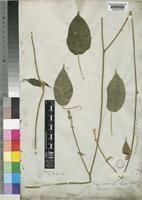
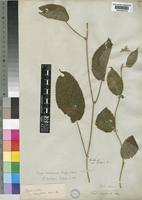
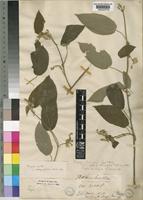
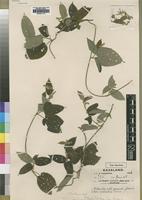
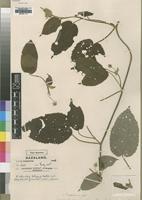
a herb with woody base; stems twining, 6–10 ft. long, much branched, sparingly pubescent with somewhat reflexed hairs and armed with stinging bristles; leaves long-petioled, membranous, ovate or ovate-oblong, acuminate, base rounded or shallow-cordate, margin closely and sharply serrate, 2–4 in. long, 1–2 in. wide, uniformly and sparingly pubescent throughout and bristly on the nerves on both surfaces; petiole patently pubescent and bristly, 1–3 in. long; stipules linear-lanceolate, 1/5 in. long, reflexed, pubescent; racemes lateral, peduncled, 1 1/2 in. long; peduncle pubescent and sparingly bristly, with many male flowers above and 1–2 basal female flowers; male bracts lanceolate or ovate-lanceolate or subspathulate, acute, entire or the lowest sometimes dentate; female bracts large, subreniform or suborbicular, their margin dentate; pedicels in both sexes shorter than and solitary to the bracts; male calyx 3-partite; lobes ovate, obtuse; stamens 3; filaments as long as the anthers; female calyx 6-partite; lobes pinnately 8–10-lacinulate on each side, rhachis lanceolate, indurated in fruit, at length 1/4 in. long; ovary hispid; styles 3, united almost to the apex in a slender narrow-infundibuliform tube, the short triangular reflexed stigmas alone free; capsule 3-coccous, 1/3 in. across; cocci subglobose, hispid; seeds globose. null