JSTOR Global Plants Home
  • Home
  • Browse
  • About
  • Access
  • Account
    • Saved Items
    • Profile
  • Log in

Global Plants

Skip to Main Content
  • JSTOR Global Plants Home
  • Global Plants

    • Browse
    • About
    • Access
    • Account
      • Saved Items
      • Profile
Log in
  • Browse
  • About
  • Access
  • Account
    • Saved Items
    • Profile
Advanced Search

Compilation
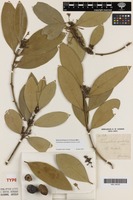
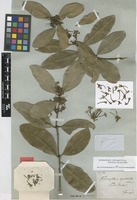
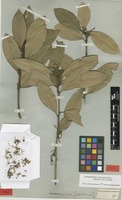
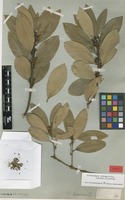
Toxicophlaea spectabilis

4 Images see all

Type of Toxicophlaea spectabilis Sond. [family APOCYNACEAE]
Isolectotype of Toxicophlaea spectabilis Sond. [family APOCYNACEAE]
Previous
Next

Name

Identification
Toxicophlaea spectabilis Sond. [family APOCYNACEAE ] (stored under name); Verified by [Not on sheet], Acokanthera oblongifolia (Hochst.) Codd [family APOCYNACEAE ] Verified by Leeuwenberg, A.J.M., 1980
Related name
  • Acokanthera oblongifolia
  • Toxicophlaea spectabilis

Flora

Entry for Acokanthera oblongifolia Hochst. Codd [family APOCYNACEAE]
Herbarium
Royal Botanic Gardens, Kew (K)
Collection
Flora Zambesiaca
Resource Type
Reference Sources
Entry From
FZ, Vol 7, Part 2, (1985) Author: A. J. M. Leeuwenberg and F. K. Kupicha et al.
Names
Acokanthera spectabilis Sond. Hook. f. [family APOCYNACEAE], Bot. Mag.: t. 6359 (1878). — Stapfin F. C. 4: 501 (1907). — Markgraf in Notizbl. Bot. Gart. Berlin 8: 470, fig. 9 (1923). Syntypes as above.
Acokanthera venenata var. spectabilis Sond. Sim. [family APOCYNACEAE], For. Fl. Cape Col.: 270, t. 154 fig. 2 (1907). Syntypes as above.
Carissa spectabilis Sond. Pichon [family APOCYNACEAE], in Mém. Mus. Nation. Hist. Nat. Paris, N.S. 24: 132 (1948). Syntypes as above.
Acokanthera oblongifolia Hochst. Codd [family APOCYNACEAE], in Bothalia 7: 449 (1961); in Fl. Southern Afr. 26: 246, fig. 36, 2 (1963). — Kupicha in Kew Bull. 37: 62 (1982). Type from S. Africa (Natal).
Carissa oblongifolia Hochst. [family APOCYNACEAE], in Flora 1844: 827 (1844). Type as above.
Toxicophlaea spectabilis Sond. [family APOCYNACEAE], in Linnaea 23: 79 (1850). Syntypes from S. Africa (Natal).
Information
Evergreen shrub or small tree up to 6 m. high. Young branches glabrous, conspicuously angled and ribbed. Leaves coriaceous, glabrous, smooth; petiole 4–9 mm. long; lamina 6–8·4 x 1·5–4·5 cm., ± elliptic, the apex obtuse to acute, mucronate, the base cuneate or rounded; upper surface glossy, with midrib shallowly impressed and lateral veins slightly raised but usually inconspicuous; lower surface mat, midrib and lateral veins raised but the latter inconspicuous; lateral veins looped to join their neighbours. Inflorescences dense contracted many-flowered axillary cymes; flowers fragrant, white tinged pink. Calyx c. 3 mm. long, lobes lanceolate, weakly imbricate, puberulous and ciliate. Corolla tube 14–20 mm. long, glabrous or pubescent on external surface, pilose within in upper half, faintly wrinkled below; corolla lobes broadly ovate with rounded apex, 3–7 mm. long, glabrous to pubescent, ciliate or not. Stamens inserted near the top of the corolla tube so that the anthers reach to within 1 mm. of the mouth and are not visible at anthesis; anthers 1·5–1·7 mm. long. Ovary c. 1 mm. long, cylindrical, longitudinally ribbed. Fruit 2–2·5 cm. long, ellipsoid or subglobose, purplish-black, 2(l)-seeded. Seeds up to 1·5 cm. long.
Habitat
In sclerophyllous maquis on littoral dunes.
Distribution
Mozambique M Maputo (Lourenço Marques), Costa do Sol, fr. 20.vi.1944, Torre 6641 (BM; LISC).Mozambique GI Inhambane, Praia de Zavora, fr. 27.ii.1955, E.M. & W. 688 (BM; LISC; SRGH).
Distribution (external)
S. Africa (eastern Cape Prov. and Natal).
Notes
Leaf-lamina lengths of up to 12·25 cm. have been recorded from S. African specimens.

Related Materials

  • Terms and Conditions
  • Privacy Policy
  • Cookie Policy
  • Cookie Settings
  • Accessibility
  • Help
  • Contact Us
  • Facebook
  • Twitter
ITHAKA

JSTOR is part of ITHAKA, a not-for-profit organization helping the academic community use digital technologies to preserve the scholarly record and to advance research and teaching in sustainable ways.

©2000-2026 ITHAKA. All Rights Reserved. JSTOR®, the JSTOR logo, JPASS®, Aluka®, and ITHAKA® are registered trademarks of ITHAKA.

╳