JSTOR Global Plants Home
  • Home
  • Browse
  • About
  • Access
  • Account
    • Saved Items
    • Profile
  • Log in

Global Plants

Skip to Main Content
  • JSTOR Global Plants Home
  • Global Plants

    • Browse
    • About
    • Access
    • Account
      • Saved Items
      • Profile
Log in
  • Browse
  • About
  • Access
  • Account
    • Saved Items
    • Profile
Advanced Search

Compilation
Tillaea erecta

8 Images see all

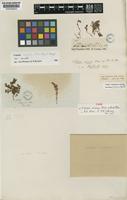
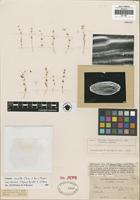
Type of Tillaea minima Miers ex Hook. & Arn. [family CRASSULACEAE]
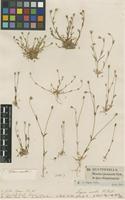
Filed as Sagina erecta L. [family CARYOPHYLLACEAE]
Filed as Tillaea erecta [family CRASSULACEAE]
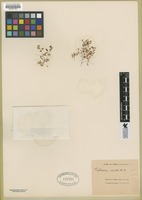
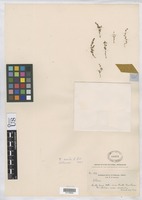
Isotype of Tillaea erecta H. & A. var. eremica Jepson [family CRASSULACEAE]
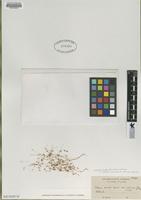
Holotype of Tillaea erecta Hook. and Arn. var. eremica Jeps. [family CRASSULACEAE]
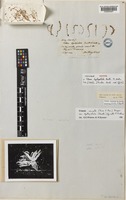
Tillaea erecta Hook. & Arn. [family CRASSULACEAE]
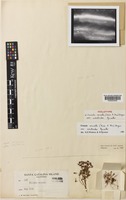
Isotype of Tillaea leptopetala Benth. [family CRASSULACEAE]
Holotype of Crassula connata (Ruiz & Pav.) Berger var. erectoides Bywater [family CRASSULACEAE]
Previous
Next

Name

Identification
Tillaea erecta Hook. and Arn. [family CRASSULACEAE ] (stored under name); Verified by Not on Sheet, Crassula connata (Ruiz and Pav.) A. Berger et al. [family CRASSULACEAE ] Verified by Wickens, G. E.; Bywater, M., 1981
Related name
  • Sagina erecta
  • Crassula connata
  • Tillaea erecta
  • Tillaea minima
Common name
  • Sand pygmyweed, Flora of North America Vol. 8

Flora

Entry for Crassula connata (Ruiz & Pavón) A. Berger et al. [family CRASSULACEAE]
Herbarium
Flora of North America (FNA)
Collection
Flora of North America
Resource Type
Reference Sources
Entry From
Flora of North America, Vol 8,
Names
Crassula connata (Ruiz & Pavón) A. Berger et al. [family CRASSULACEAE], in H. G. A. Engler, Nat. Pflanzenfam. ed., 2, 18a: 389. 1930 ,
Tillaea connata Ruiz & Pavón [family CRASSULACEAE], Fl. Peruv., 1: 70, plate 106, fig. a. 1798
Crassula connata var. erectoides M. Bywater & Wickens [family CRASSULACEAE]
Crassula connata var. eremica (Jepson) M. Bywater & Wickens [family CRASSULACEAE]
Crassula connata var. subsimplex (S. Watson) M. Bywater & Wickens [family CRASSULACEAE]
Crassula erecta (Hooker & Arnott) A. Berger [family CRASSULACEAE]
Tillaea erecta Hooker & Arnott [family CRASSULACEAE]
Tillaea leptopetala Bentham [family CRASSULACEAE]
Treatment Author(s)
Reid V. Moran
Information
Plants terrestrial, annual. Stems erect, red in age, simple or bushy-branching, 2–6(–10) cm. Leaf blades ovate to oblong, 1–3(–6) mm, apex acute to rounded. Inflorescences often compact; flowers (1–)2 per node. Pedicels 0.2–6 mm. Flowers (3–)4[–5]-merous; sepals lanceolate, 0.5–2 mm, apex acute to acuminate; petals narrow-triangular, 0.6–1.5 mm. Follicles ascending, 1–2-seeded, ovoid; old follicles ascending, boat-shaped. Seeds ellipsoid, 0.3–0.6 × 0.1–0.3 mm, not papillate, dull, rugulose. 2n = ca. 16.
Phenology
Flowering spring
Altitude range
0–1500 m
Distribution
MexicoCentral America (Guatemala)South America (Argentina, Chile, Uruguay).USA Ariz.USA Calif.USA Oreg.USA Tex.USA Wash.Canada B.C.
Discussion
M. Bywater and G. E. Wickens (1984) proposed five varieties, four partly in the flora area, where they have largely overlapping ranges and overlapping characteristics. Further, some supposed differences probably result from local and year-to-year rainfall differences. Although probably having some genetic basis, these varieties seem too poorly defined to be useful (R. V. Moran 1992b).
S. L. Hatch et al. (1990) were first to report Crassula connata in Texas, from a 1968 collection (F. B. Jones 7292), suggesting that it may be a recent arrival there. It was first discovered in British Columbia and Washington in 1977 (A. Ceska and O. Ceska 1980) and is treated as a rare native species by the heritage program in British Columbia and the Washington Natural Heritage Program, where it has a habitat typical of other southern disjunct natives (A. Ceska, pers. comm.).

Related Materials

  • Terms and Conditions
  • Privacy Policy
  • Cookie Policy
  • Cookie Settings
  • Accessibility
  • Help
  • Contact Us
  • Facebook
  • Twitter
ITHAKA

JSTOR is part of ITHAKA, a not-for-profit organization helping the academic community use digital technologies to preserve the scholarly record and to advance research and teaching in sustainable ways.

©2000-2026 ITHAKA. All Rights Reserved. JSTOR®, the JSTOR logo, JPASS®, Aluka®, and ITHAKA® are registered trademarks of ITHAKA.

╳