

Compilation
Tidestromia carnosa
1 Images see all
Name
Identification
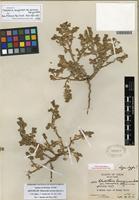
Isotype of Tidestromia carnosa (Steyerm.) I.M. Johnst. [family AMARANTHACEAE ] (stored under name); Verified by I. Sánchez-del Pino (MEXU),, Cladothrix lanuginosa Not on sheet [family AMARANTHACEAE ] Verified by Not on sheet, Isotype of Cladothrix lanuginosa Not on sheet [family AMARANTHACEAE ] Verified by Not on sheet,
Related name
- Tidestromia carnosa
- Cladothrix lanuginosa
Flora
Entry for Tidestromia carnosa (Steyermark) I. M. Johnston [family AMARANTHACEAE]
Herbarium
Flora of North America (FNA)
Collection
Flora of North America
Resource Type
Reference Sources
Entry From
Flora of North America, Vol 4,
Names
Tidestromia carnosa (Steyermark) I. M. Johnston [family AMARANTHACEAE], J. Arnold Arbor., 24: 232. 1943
Cladothrix lanuginosa (Nuttall) Nuttall ex S. Watson var. carnosa Steyermark [family AMARANTHACEAE], Ann. Missouri Bot. Gard., 19: 389. 1932
Tidestromia lanuginosa (Nuttall) Standley var. carnosa (Steyermark) Cory [family AMARANTHACEAE]
Treatment Author(s)
Ivonne Sánchez del Pino
Steven E. Clemants
Information
Herbs, annual, yellowish green, to 22 cm, glabrous or lanuginose; trichomes all candelabriform. Stems ascending or decumbent, herbaceous; buds absent on stem bases. Leaves: petiole to 1.5 cm; blade yellowish green, widely obovate, trullate, or lanceolate, 0.7–2.4 × 0.6–2.1 cm, fleshy, membranous when dry, base attenuate or oblique, glabrous or nearly so. Inflorescences 2–3-flowered; involucral leaf petiole to 0.4 cm, blade ovate, very widely ovate, narrowly elliptic, widely depressed-ovate, or obovate, 0.2–2.5 × 0.2–1.4 cm, fleshy, base attenuate or oblique, apex acute to obtuse; involucres on secondary branches formed by connation of involucral leaf bases, which become indurate and sometimes adnate with leaf bases; bracts widely ovate, 0.8–1 × 0.3–0.6 mm, apex acute or obtuse, distinctly lanuginose or glabrous; bracteoles 0.7–2 × 0.5–0.7 mm, apex acute, distinctly lanuginose or glabrous. Flowers 2–4 mm; tepals yellowish, 2–3.5 × 0.8–1.7 mm, distinctly lanuginose; staminal cup 0.5–0.6 mm; filaments 0.3–0.7 mm; anthers 0.4–0.6 mm; pseudostaminodes on short tissue lobes or absent; ovary 0.6–0.7 × 0.7–0.8 mm; style absent; stigmas 0.1–0.3 mm. Utricles 1.3–1.6 × 0.9–1.2 mm. Seeds white or brown-red, 1.5–1.8 × 1.4–1.7 mm.
Conservation Status
of conservation concern;
Phenology
mar-may (spring), jun-aug (summer), sep-nov (fall)
Altitude range
700–900 m;
Distribution
Mexico (Chihuahua).USA Tex.
Discussion
Tidestromia carnosa was accepted as a variety by C. F. Reed (1970) and K. R. Robertson (1981). We follow I. M. Johnston in recognizing it as a species. Tidestromia carnosa is distinctive in being glabrous or nearly so, having fleshy stems, yellowish green true and involucral leaves (particularly apparent in the field but membranous on dry material), and involucres formed by the connation of involucral leaf bases, which become indurate and adnate with or without the true leaf base.