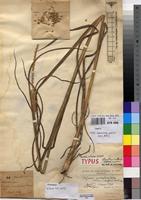
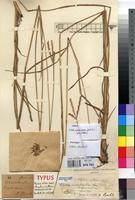
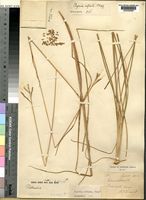
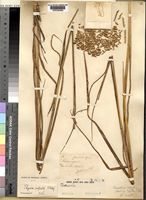
Perennial, tufted. Culms erect, up to over 3 ft. high, densely covered at the base with persistent sheath-bases, simple, smooth and glabrous or very slightly rough and hairy below the inflorescences, terete, 4–5-noded, the upper internodes exserted. Leaf-sheaths striate, more or less hairy to glabrous, the basal compressed, particularly those of the innovation shoots, nodes slightly bearded; ligules very short, membranous, ciliolate; blades linear, long-attenuated to a fine point, passing at the base into the sheath, up to over 1 ft. long and 1 1/2–3 lin. wide, folded or flattened out, soft or sometimes rather stiff, softly hirsute, particularly along the rough margins, or more or less glabrescent, midrib and lateral nerves slender, slightly prominent. Racemes quite glabrous, 3–4 on a common rhachis, which is 1/2– 3/4 in. long, subterete and more or less hairy, shortly peduncled, of unknown length, about 1 1/2 lin. wide, stiff, pale yellowish green, tinged with purple; joints stout, much inflated and hollow upwards, 1 1/2–2 lin. long, very convex on the back, slightly concave on the face, smooth, distinctly striate, disarticulating horizontally, with a smooth, almost square scar; pedicels similar to the joints but more narrowed at the base and more or less curved, usually shorter than the joints and subcontiguous with them. Sessile spikelet, including the very short subannular callus, slightly over 2 lin. long, ovate-oblong. Glumes equal; lower coriaceous along the keels, chartaceous between them, subobtuse, sometimes minutely emarginate, with narrow inflexed margins, distinctly 2-keeled, keels very minutely ciliolate, intracarinal nerves very fine, 3–4, with few transverse veins above; upper glume boat-shaped, thinly chartaceous, semiovate in profile, subacute, with a marked minutely ciliate keel and a submarginal nerve on each side. Lower floret barren: valve hyaline, broadly lanceolate to oblong, 2-nerved, finely ciliate above; valvule 0. Upper floret: valve broadly lanceolate, acute, 3-nerved; valvule slightly shorter, oblong, subobtuse, obscurely 2-nerved. Anthers 1 1/4–1 1/2 lin. long. Stigmas purple, 3/4 lin. long, exserted from near the base. Grain oblong, dorsally much compressed, 3/4 lin. long, scutellum extending beyond the middle. Pedicelled spikelet showing various degrees of development from a perfect state with a hermaphrodite flower, when it is very similar to the sessile spikelet, down to 2 very minute glumes or only a single one.