JSTOR Global Plants Home
  • Home
  • Browse
  • About
  • Access
  • Account
    • Saved Items
    • Profile
  • Log in

Global Plants

Skip to Main Content
  • JSTOR Global Plants Home
  • Global Plants

    • Browse
    • About
    • Access
    • Account
      • Saved Items
      • Profile
Log in
  • Browse
  • About
  • Access
  • Account
    • Saved Items
    • Profile
Advanced Search

Compilation
Thunbergia laevis

5 Images see all

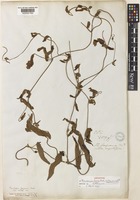
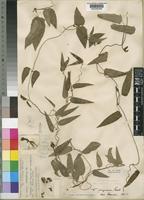
Lectotype of Thunbergia laevis Wall. & Nees var. vestita (Nees) L.H.Cramer [family ACANTHACEAE]
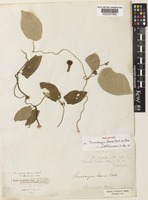
Holotype of Thunbergia laevis Wall.ex Nees [family ACANTHACEAE]
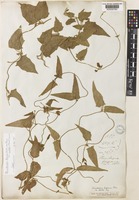
Type of Thunbergia laevis Wall. & Nees var. vestita (Nees) L.H.Cramer [family ACANTHACEAE]
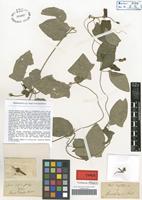
Type of Thunbergia laevis Wall. & Nees [family ACANTHACEAE]
Thunbergia laevis Nees [family ACANTHACEAE]
Previous
Next

Name

Identification
Thunbergia laevis Wall. & Nees [family ACANTHACEAE ] (stored under name); Verified by Nees s.d.,
Related name
  • Thunbergia unrecorded
  • Thunbergia fragrans
  • Thunbergia laevis

Flora

Entry for Thunbergia laevis Nees [family ACANTHACEAE]
Herbarium
Royal Botanic Gardens, Kew (K)
Collection
Flora of West Tropical Africa
Resource Type
Reference Sources
Entry From
Flora of West Tropical Africa, Vol 2,
Names
Thunbergia laevis Nees [family ACANTHACEAE], in Wallich Pl. As. Rar. 3: 77 (1832); Bremekamp l.c. 51.
Thunbergia fragrans var. laevis (Nees) C. B. Cl. [family ACANTHACEAE], in Hookf., FlBritInd4: 391 (1884)
Thunbergia fragrans [family ACANTHACEAE], of F.W.T.A., ed1, 2: 250 (1931), not strictly of Roxb(1795).
Information
A slender twiner, sparingly hairy with whitish flowers 11/3 in. long; cultivated and more or less naturalized.
Range
A native of tropical Asia, now widespread in the tropics.
Distribution
S. L.: Lane-Poole 278! Freetown (May) Deighton 2689! Regent (Oct.) Jordan 948! Sc. Elliot 4141b!
Notes
[The specimens cited, above have pubescent ovaries, but one gathering from Ghana (Achimota Morton GC 25399) has glabrous ovaries and therefore appears to be the true T. fragrans Roxb., also a tropical Asian plant.]

Related Materials

  • Terms and Conditions
  • Privacy Policy
  • Cookie Policy
  • Cookie Settings
  • Accessibility
  • Help
  • Contact Us
  • Facebook
  • Twitter
ITHAKA

JSTOR is part of ITHAKA, a not-for-profit organization helping the academic community use digital technologies to preserve the scholarly record and to advance research and teaching in sustainable ways.

©2000-2026 ITHAKA. All Rights Reserved. JSTOR®, the JSTOR logo, JPASS®, Aluka®, and ITHAKA® are registered trademarks of ITHAKA.

╳