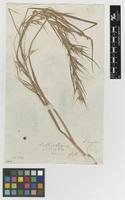
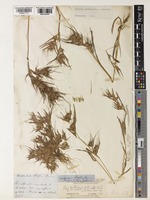
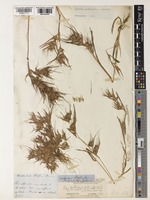
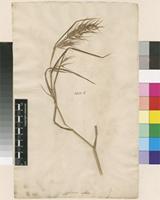
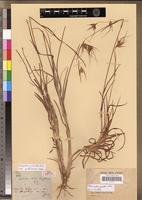
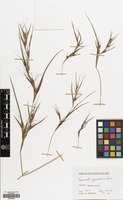
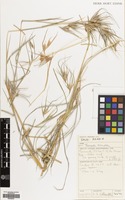
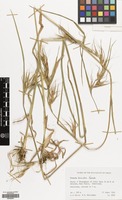
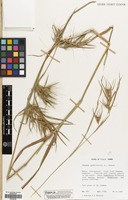
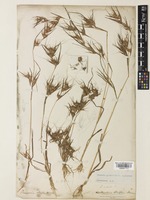
Annual. Culms erect or more often geniculate-ascending with stilt roots from the lower nodes, slender to stout (almost 3 lin. in diam.), terete, glabrous, often glaucous-pruinose below the nodes, 5–7-noded and simple below the panicle or here and there with additional flowering branches from the lower nodes, sometimes trailing among shrubs and other plants and then frequently many feet long. Leaf-sheaths compressed and keeled (the lowest) or terete, tight and much shorter than the internodes (the upper of the culms), glabrous, smooth; ligules membranous, glabrous, rounded, about 1 lin. long; blades somewhat flaccid, folded in bud, soon flat, linear from a slightly rounded base, shortly acute, particularly the lower, or more or less tapering to a slender point, the basal short, the intermediate up to 1 ft. long by 2–3 lin., green or slightly glaucous, glabrous on both sides or sparingly fimbriate with long fine tubercle-based hairs towards the base, finely rough above or smooth all over except on the scabrid and upwards often spinulously ciliolate margins; midrib slender, primary lateral nerves very fine, 3–4 on each side. Spatheate panicle leafy, erect, or more or less nodding, from 6 in. (in meagre specimens) to over 2 ft. long, in robust specimens decompound to the third degree; primary internodes few to over 9, if numerous the lower much elongated, the intermediate rapidly shorter, the upper very short (10–15 lin.); lowest branches sometimes undivided at the base with a more or less elongated basal internode or more usually like the following forming tiers of up to 5 rays, all these tiers except the uppermost mixed; compound rays of the lower tiers from over 6 in. to 2 in. long, often nodding, the longest with up to 8 secondary tiers, the lowest of these secondary tiers frequently with a short 1–2-noded compound ray bearing 1 or 2 tertiary few-rayed tiers; all simple rays filiform, somewhat compressed, glabrous or shortly bearded at the tips, short and usually enclosed in the sheath of the supporting leaf or spathe, those of the ultimate tiers about 3 lin. long, hence the monostachya crowded into dense apparently sessile heads, scattered or more or less closely approximate along the longer branches and the upper part of the primary axis of the panicle; degree of division of the panicle very variable according to the vigour of the plant; subtending leaves of all tiers distinctly differentiated into sheath and blade, the sheaths rapidly shortening upwards (down to 6–4 lin.), relatively broad, compressed, keeled, more or less herbaceous, often with a few tubercle-based stiff hairs near the mouth, blades always conspicuously longer than the sheath, linear, tapering almost from the base, very acute, somewhat rigid, often sparingly fimbriate at the base, keeled, the keel and the margins sharply scabrid. Spatheoles compressed, cymbiform, lanceolate, caudate-acuminate, glabrous, more or less scarious with subhyaline margins, 8–6 lin. long, turning reddish; peduncles usually under 2/3 lin. long, glabrous. Racemes with a single fertile spikelet. Fertile spikelet including the callus 2 lin. long, awned; callus very short, obtuse, densely and shortly rufously bearded. Lower glume rigidly and minutely puberulous all over except at the membranous obtuse tip, at length dark brown, very faintly 7–9-nerved; upper glabrous, ciliolate. Lower floret: valve delicate, ovate-lanceolate, acute, 1 1/2 lin. long. Upper floret hermaphrodite: awn about 1 1/2 in. long, slender, flexuous, more or less distinctly kneed at the middle, often bent again below it, brown, paler upwards, column very finely hirtellous. Anthers 2/3– 3/4 lin. long. Involucral spikelets inserted at almost the same level, oblong, up to 2 1/2 lin. long, persistent; glumes equal, lower acute with a fine point, produced at the base into a minute swelling, closely nerved, green, at length straw-colour, quite glabrous apart from a few (4–6) long submarginal tubercle-based bristles near the tip, one margin narrowly involute, the other very narrowly inflexed, the corresponding keel with a membranous margin or very narrow wing; upper glume 3-nerved; valves oblong, subobtuse, 1-nerved to nerveless, more or less reduced; anthers often rudimentary or 0. Pedicelled spikelets linear-subulate with a fine point, glabrous, neuter; lower glume many-nerved, upper shorter, 3-nerved, ciliolate; valves 0.