JSTOR Global Plants Home
  • Home
  • Browse
  • About
  • Access
  • Account
    • Saved Items
    • Profile
  • Log in

Global Plants

Skip to Main Content
  • JSTOR Global Plants Home
  • Global Plants

    • Browse
    • About
    • Access
    • Account
      • Saved Items
      • Profile
Log in
  • Browse
  • About
  • Access
  • Account
    • Saved Items
    • Profile
Advanced Search

Compilation
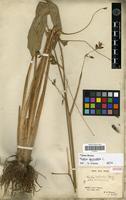
Thalia trichocalyx

5 Images see all

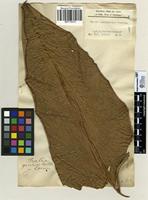
Filed as Thalia trichocalyx Gagnep. [family MARANTACEAE]
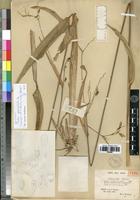
Lectotype of Thalia trichocalyx Gagnep. [family MARANTACEAE]
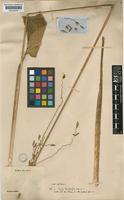
Type of Thalia trichocalyx Gagnep. [family MARANTACEAE]
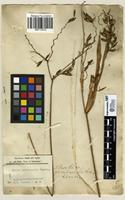
Filed as Thalia trichocalyx Gagnep. [family MARANTACEAE]
Syntype of Thalia trichocalyx Gagnep. [family MARANTACEAE]
Previous
Next

Name

Identification
Thalia trichocalyx Gagnep. [family MARANTACEAE ] (stored under name); Verified by [Sandwith, N.Y.],
Related name
  • Thalia geniculata
  • Thalia trichocalyx
  • Blechnum orientale
  • Trichomanes capillaceum
Common name
  • arrowroot, Flora of North America Vol. 22
  • Fire-flag, Flora of North America Vol. 22

Flora

Entry for Thalia geniculata Linnaeus [family MARANTACEAE]
Herbarium
Flora of North America (FNA)
Collection
Flora of North America
Resource Type
Reference Sources
Entry From
Flora of North America, Vol 22,
Names
Thalia geniculata Linnaeus [family MARANTACEAE], Sp. Pl., 2: 1193. 1753
Thalia divaricata Chapman [family MARANTACEAE]
Thalia trichocalyx Gagnepain [family MARANTACEAE]
Thalia welwitschii Ridley [family MARANTACEAE]
Information
Plants 1--3.5 m. Leaves: basal 2--6, cauline 0--1(--2); sheath green or occasionally red-purple, glabrous; petiole green or occasionally red-purple, glabrous; pulvinus caramel-colored, olive-green, or red-purple, 0.3--2.5 cm, glabrous; blade ovate to narrowly ovate, 19--60 ´ 4--26 cm, firm, stiff-papery, base rounded to subtruncate, apex acute to acuminate, occasionally obtuse with acuminate tip, abaxial surface green, faintly pruinose, glabrous, adaxial surface glabrous. Inflorescences lax, broadly spreading to pendeant, paniclelike array, up to ca. 0.6  1 m; scapes 0.8--2.5 m; rachis not pruinose; internodes 5--20 mm; bracts not pruinose, green or streaked or tinged with purple, narrowly ovate, 1.3--2.8 cm, herbaceous, sparsely to densely villous. Flowers: sepals 0.5--2 mm; outer staminode faint lavender to purple, 15--20 ´ 5--10 mm; callose staminode base yellow, apex purple, apical rim, reflexed, petal-like. Fruits ellipsoid, 9--12 ´ 6--7 mm. Seeds smooth dark brown to black, ellipsoid, 7--10 ´ 5--6 mm. 2n = 18 (Senegal) 2n = 26 (in cultivation).
Phenology
Flowering summer--fall (late Jun--Dec)
fruiting summer--winter (Aug--Jan)
Distribution
USA Fla.USA La.
Discussion
This species has the widest distribution known for any of the Marantaceae, occurring in both Africa and the Americas. Because of the marked lack of variation among the African populations, it is believed that its occurrence in west Africa was a historically recent, probably accidental, introduction (L. Andersson 1981b). The variation in pubescence and bract size within the American continent has been used as the basis for describing additional species or varieties (L. Andersson 1981b). Populations of Thalia geniculata with a striking red-purple coloration on the petiole, sheath, and pulvinus were described as T. geniculata f. rheumoides Shuey (A. G. Shuey 1975) . Such homogeneous populations are to be expected in a mainly selfing species.

Related Materials

  • Terms and Conditions
  • Privacy Policy
  • Cookie Policy
  • Cookie Settings
  • Accessibility
  • Help
  • Contact Us
  • Facebook
  • Twitter
ITHAKA

JSTOR is part of ITHAKA, a not-for-profit organization helping the academic community use digital technologies to preserve the scholarly record and to advance research and teaching in sustainable ways.

©2000-2026 ITHAKA. All Rights Reserved. JSTOR®, the JSTOR logo, JPASS®, Aluka®, and ITHAKA® are registered trademarks of ITHAKA.

╳