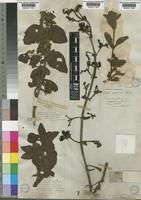
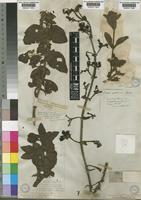
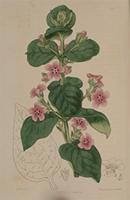
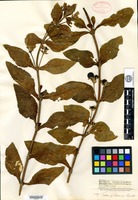
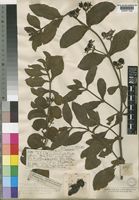
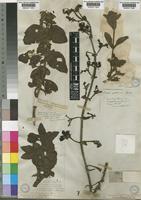
a pubescent shrub, about 2 ft. high, biennial, smelling disagreeably but less strongly than the previous species; stem diffuse, tetragonous, soft, rigid, branched; branches few, ascending, leafy, unctuously pubescent; leaves ovate or oval, obtuse, apiculate or acute, more or less narrowed or subtruncate at the sessile or shortly petiolate semi-amplexicaul often decurrent base, chartaceous, denticulate or serrulate, 1/2–3 1/2 in. long, 3/8–1 3/4 in. broad; petioles ranging up to 3/8 in. long or less, winged, decurrent at the base; cymes axillary or terminal; axillary peduncles 3–5-flowered, 1/4–1 1/2 in. long, spreading; pedicels short, ranging up to 1/2 in. in fruit; bracts opposite, about equalling the pedicels; bracteoles smaller; flowers scentless, 3/8– 1/2 in. long; calyx-segments oblong-lanceolate, pointed, 1/4– 1/3 in. long; corolla-tube pubescent outside, 1/3 in. long, white-rosy, marked at the hairy throat with 5 black-purple stellately arranged decurrent spots; limb patent, 3/4 in. in diam., regular; anthers pale yellow; ovary depressedly globose; style very short; stigma capitate, oblique; fruit globose, 1/2 in. in diam., glabrous, black-purple, 2-celled; seeds numerous, oval, scrobiculate, black. null