

Compilation
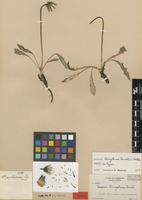
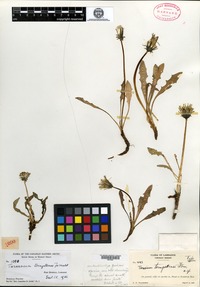
Taraxacum torngatense
2 Images see all
Name
Identification
Related name
- Taraxacum torngatense
Common name
- pissenlit de Laponie, Flora of North America Vol. 19
- Lapland dandelion, Flora of North America Vol. 19
Flora
Entry for Taraxacum lapponicum Kihlman ex Handel-Mazzetti [family COMPOSITAE]
Herbarium
Flora of North America (FNA)
Collection
Flora of North America
Resource Type
Reference Sources
Entry From
Flora of North America, Vol 19,
Names
Taraxacum lapponicum Kihlman ex Handel-Mazzetti [family COMPOSITAE], Monogr. Taraxacum, 73. 1907
Taraxacum alukense R. Doll [family COMPOSITAE]
Taraxacum ambigens Fernald [family COMPOSITAE]
Taraxacum atroglaucum M. P. Christensen [family COMPOSITAE]
Taraxacum campylodes G. E. Haglund [family COMPOSITAE]
Taraxacum croceum Dahlstedt [family COMPOSITAE]
Taraxacum curvidens M. P. Christensen [family COMPOSITAE]
Taraxacum cyclocentrum M. P. Christensen [family COMPOSITAE]
Taraxacum davidssonii M. P. Christensen [family COMPOSITAE]
Taraxacum dilutisquameum M. P. Christensen [family COMPOSITAE]
Taraxacum firmum Dahlstedt [family COMPOSITAE]
Taraxacum latispinulosum M. P. Christensen [family COMPOSITAE]
Taraxacum naevosum Dahlstedt [family COMPOSITAE]
Taraxacum obtusatum Dahlstedt [family COMPOSITAE]
Taraxacum pleniflorum M. P. Christensen [family COMPOSITAE]
Taraxacum spectabile Dahlstedt [family COMPOSITAE]
Taraxacum torngatense Fernald [family COMPOSITAE]
Treatment Author(s)
Luc Brouillet
Information
Plants (3–)5–37(–47 in fruit) cm; taproots sometimes branched. Stems 1–5, erect to ascending, purplish, (usually exceeding leaves), glabrate to sparsely villous proximally, ± densely villous distally. Leaves 5–20, erect to patent, sometimes horizontal; sessile (bases sometimes as wide as blade) to ± broadly winged petiolate (occasionally slender on young or deeply shaded specimens, usually at least some ± winged); blades oblanceolate or oblong-oblanceolate (often runcinate), (3–)3.5–27 × 0.6–5 cm, bases usually cuneate, sometimes attenuate, margins regularly and shallowly lobed, sometimes ± deeply (not lacerate) to dentate, lobes mostly retrorse, usually triangular, sometimes deltate or lanceolate, ± acuminate, often replaced by teeth, teeth 0–5 on lobes or irregular, often coarse, triangular to lanceolate, ± acuminate, apices obtuse or acute to short-acuminate, faces glabrous or glabrate, midveins often sparsely villous. Calyculi of 10–12, spreading to eventually reflexed, often pale, sometimes purplish-tinged, lance-ovate to broadly lanceolate (thin) bractlets in 3 series, 5.5–9.5 × 1.8–2.7(–4.2) mm, margins not or narrowly scarious, apices long-acuminate, hornless. Involucres green to dark green, campanulate to cylindro-campanulate, 12–22 mm. Phyllaries 14–18 in 2 series, lanceolate, 1.4–3.2 mm wide, margins not or very narrowly scarious (outer) to narrowly scarious in proximal 1/2 (inner), apices long-acuminate, hornless, tips ± hyaline, blackish and/or purplish, scarious. Florets 60–110+; corollas yellow (outer abaxially gray and/or purplish striped), 15–22 × 1.1–1.7 mm. Cypselae tan to reddish brown, bodies oblanceoloid, 2.8–3.5 mm, cones conic, 0.5–0.8 mm, beaks slender, 6.5–12 mm, ribs 4–5 prominent (to 13–15 fine), faces proximally smooth to occasionally slightly tuberculate, muricate in distal 1/4–1/3 (spines usually sparse); pappi white to cream, 5–7.5 mm. 2n = 32.
Phenology
early summer
Altitude range
0–1100 m;
Distribution
GreenlandEurasia.Canada Nfld. and Labr.Canada NunavutCanada Que.
Discussion
Taraxacum lapponicum is an amphi-Atlantic taxon whose North American distribution lies in the eastern Arctic and boreal zones.
This species has the most controversial taxonomy. Barely distinguishable morphotypes have received species names, and the phenotypic plasticity of the taxon has not been taken into account in that process. In particular, it is often found in more shaded habitats than other dandelions in the south of its range, particularly when growing along streams in eastern Canada. The correct name to be applied to this species is controversial, and many European names have been applied to North American plants in the complex, sometimes without regard to the type. Here, I am recognizing a more widely defined species, using the name Taraxacum lapponicum, the one most often used in North America (correctly or not), pending more rigorous experimental study of variation in the complex.
The name Taraxacum islandiciforme Dahlstedt ex M. P. Chistiansen is invalid.