

Compilation
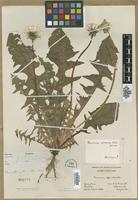
Taraxacum sylvanicum
1 Images see all
Name
Identification
Taraxacum sylvanicum R.Doll [family ASTERACEAE ] (stored under name); Verified by Not on Sheet, Taraxacum officinale (L.) Weber [family ASTERACEAE ] Verified by Not on Sheet,
Related name
- Taraxacum sylvanicum
- Taraxacum officinale
Common name
- pissenlit officinal, Flora of North America Vol. 19
- Common dandelion, Flora of North America Vol. 19
Flora
Entry for Taraxacum officinale F. H. Wiggers [family COMPOSITAE]
Herbarium
Flora of North America (FNA)
Collection
Flora of North America
Resource Type
Reference Sources
Entry From
Flora of North America, Vol 19,
Names
Taraxacum officinale F. H. Wiggers [family COMPOSITAE], Prim. Fl. Holsat., 56. 1780
Leontodon taraxacum Linnaeus [family COMPOSITAE], Sp. Pl., 2: 798. 1753
Taraxacum officinale var. palustre Blytt [family COMPOSITAE]
Taraxacum sylvanicum R. Doll [family COMPOSITAE]
Treatment Author(s)
Luc Brouillet
Information
Plants (1–)5–40(–60) cm; taproots seldom branched. Stems 1–10+, erect or ascending, sometimes ± purplish (usually equaling or surpassing leaves), glabrous or sparsely villous, slightly more so distally. Leaves 20+, horizontal to erect; petioles ± narrowly winged; blades oblanceolate, oblong, or obovate (often runcinate), (4–)5–45 × (0.7–)1–10 cm, bases attenuate to narrowly cuneate, margins usually shallowly to deeply lobed to lacerate or toothed, lobes retrorse, broadly to narrowly triangular to nearly lanceolate, acute to long-acuminate, terminals ± as large as distal laterals, ultimate margins toothed or entire (secondary lobules irregular, perpendicular to retrorse), teeth minute to pronounced apices acute to acuminate or obtuse, faces glabrous or sparsely villous (commonly on midveins). Calyculi of 12–18, reflexed, sometimes ± glaucous, lanceolate bractlets in 2 series, 6–12 × 2.8–3.5 mm, margins very narrowly white-scarious, sometimes villous-ciliate distally, apices acuminate, hornless. Involucres green to dark green or brownish green, tips dark gray or purplish, campanulate, 14–25 mm. Phyllaries 13–18 in 2 series, lanceolate, 2–2.8 mm wide, margins scarious (proximal 2/3) to narrowly scarious, apices acuminate, erose-scarious, usually hornless (seldom appendaged), callous. Florets 40–100+; corollas yellow (orange-yellow), 15–22 × 1.7–2 mm (outer). Cypselae olivaceous or olive-brown, or straw-colored to grayish, bodies oblanceoloid, (2–)2.5–2.8(–4) mm, cones shortly terete, 0.5–0.9 mm, beaks slender, 7–9 mm, ribs 4–12, sharp, faces proximally smooth to ± tuberculate, muricate in distal 1/3; pappi white to sordid, 5–6(–8) mm. 2n = 24, 40, [16, 32].
Phenology
dec-feb (winter), mar-may (spring), jun-aug (summer), sep-nov (fall)
Altitude range
0–2000+ m;
Distribution
GreenlandSt. Pierre and MiquelonEuropealso introduced in Mexicointroduced nearly worldwide.USA Ala.USA AlaskaUSA Ariz.USA Ark.USA Calif.USA Colo.USA Conn.USA Del.USA D.C.USA Fla.USA Ga.USA IdahoUSA Ill.USA Ind.USA IowaUSA Kans.USA Ky.USA La.USA MaineUSA Md.USA Mass.USA Mich.USA Minn.USA Miss.USA Mo.USA Mont.USA Nebr.USA Nev.USA N.H.USA N.J.USA N.Mex.USA N.Y.USA N.C.USA N.Dak.USA OhioUSA Okla.USA Oreg.USA Pa.USA R.I.USA S.C.USA S.Dak.USA Tenn.USA Tex.USA UtahUSA Vt.USA Va.USA Wash.USA W.Va.USA Wis.USA Wyo.Canada Alta.Canada B.C.Canada Man.Canada N.B.Canada Nfld. and Labr.Canada N.W.T.Canada N.S.Canada NunavutCanada Ont.Canada P.E.I.Canada Que.Canada Sask.Canada Yukon
Discussion
Taraxacum officinale is the most widespread dandelion in temperate North America, though its abundance decreases in the arid south. It is a familiar weed of lawns and roadsides. It is also the species most commonly used for medicinal and culinary purposes (e.g., E. Small and P. M. Catling 1999).
Phenotypic and genotypic variation of this species have been studied in North America (L. M. King 1993; King and B. A. Schaal 1990; J. C. Lyman and N. C. Ellstrand 1998; O. T. Solbrig 1971; R. J. Taylor 1987), but results of those studies did not lead to the recognition of microspecies.
Specimens of Taraxacum officinale with deeply lobed leaves are sometimes difficult to distinguish from those of T. erythrospermum when fruits are missing (see also R. J. Taylor 1987). Usually, however, early leaves of the former are much less deeply lobed than those of the latter, which are more consistently lacerate throughout development, though broadly winged initially. The two taxa are easily distinguished in fruit, the red cypselae of T. erythrospermum standing out from the dull olive ones of T. officinale.
In northeastern North America, Taraxacum officinale and T. lapponicum often are confused, which has led to reports of the common dandelion farther north than I have been able to verify (it has yet to be collected from the Nunavik region of Quebec, for instance). The characters in the key above help separate the two taxa.
The typification by A. J. Richards (1985) would leave the common dandelion of both Europe and North America without a valid name (J. Kirschner and J. Štepánek 1987). For the time being, with the nomenclatural situation still not resolved, I am following traditional usage of the name Taraxacum officinale.
Native/Introduced
introduced;