JSTOR Global Plants Home
  • Home
  • Browse
  • About
  • Access
  • Account
    • Saved Items
    • Profile
  • Log in

Global Plants

Skip to Main Content
  • JSTOR Global Plants Home
  • Global Plants

    • Browse
    • About
    • Access
    • Account
      • Saved Items
      • Profile
Log in
  • Browse
  • About
  • Access
  • Account
    • Saved Items
    • Profile
Advanced Search

Compilation
Taraxacum scanicum

3 Images see all

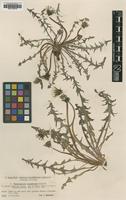
Type? of Taraxacum scanicum Dahlst. [family ASTERACEAE]
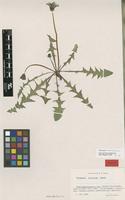
Isotype of Taraxacum bellicum Sonck [family ASTERACEAE]
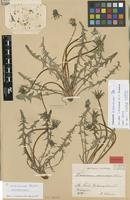
Lectotype of Taraxacum scanicum Dahlst. [family ASTERACEAE]
Previous
Next

Name

Identification
Taraxacum scanicum Dahlst. [family ASTERACEAE ] (stored under name);
Related name
  • Taraxacum bellicum
  • Taraxacum scanicum
Common name
  • pissenlit à graines rouges, Flora of North America Vol. 19
  • Red-seeded dandelion, Flora of North America Vol. 19

Flora

Entry for Taraxacum erythrospermum Andrzejowski ex Besser [family COMPOSITAE]
Herbarium
Flora of North America (FNA)
Collection
Flora of North America
Resource Type
Reference Sources
Entry From
Flora of North America, Vol 19,
Names
Taraxacum erythrospermum Andrzejowski ex Besser [family COMPOSITAE], Enum. Pl., 75. 1822
Taraxacum laevigatum (Willdenow) de Candolle var. erythrospermum (Andrzejowski ex Besser) J. Weiss [family COMPOSITAE]
Taraxacum officinale F. H. Wiggers var. erythrospermum (Andrzejowski ex Besser) Babington [family COMPOSITAE]
Taraxacum scanicum Dahlstedt [family COMPOSITAE]
Treatment Author(s)
Luc Brouillet
Information
Plants (1–)5–30(–60) cm; taproots seldom branched. Stems 1–15+, ascending to erect, pinkish to reddish, (± equaling foliage), glabrous or sparsely villous, usually more densely so distally. Leaves 20+, horizontal to erect; petioles ± slightly winged distally; blades obovate to oblanceolate (runcinate), 5–25 × 1–4 cm, bases attenuate, margins lacerate, lobes retrorse, triangular to nearly lanceolate, acute to long-acuminate, terminals about as large as distal laterals, teeth usually few, rarely 0, irregular, straight to retrorse, minute to pronounced or secondary lobules, apices usually acute or acuminate, sometimes obtuse, rarely rounded, faces glabrous or glabrate to sparsely villosulous (mainly midveins). Calyculi of 16–18, reflexed to recurved, sometimes glaucous or purplish, lanceolate bractlets in 2 series, 3.8–10 × 1–2 mm, margins white to purplish, narrowly scarious, apices acute or long-acuminate, erose, hornless. Involucres green, tips reddish gray, urceolate (closed) to cylindro-campanulate (open), 10–25 mm. Phyllaries 18–19 in 2 series, lanceolate-linear, 1.2–2.1 mm wide, margins scarious, slightly revolute at green edge, apices long-acuminate, erose-scarious, usually at least some horned. Florets ca. 70–75+; corollas sulphur yellow, outer with abaxial purplish or grayish stripe, 12–16 × 1–1.5 mm. Cypselae brick red to reddish brown or reddish purple, bodies oblanceoloid to obovoid, (2.2–)2.5–3(–4) mm, cones terete, 0.8–1.3 mm, beaks slender, (5–)7–8.5 mm, ribs ca. 15, sharp, faces proximally ± tuberculate (sometimes barely so) to conspicuously muricate in distal 1/2; pappi white to sordid, 4–7 mm. 2n = 16, 24, 32 (Europe).
Phenology
mar-may (spring), jun-aug (summer)
Altitude range
0–1500+ m;
Distribution
Europealso introduced in Mexico.USA Ala.USA AlaskaUSA Ariz.USA Ark.USA Ga.USA IowaUSA MaineUSA Mass.USA Mich.USA Miss.USA Nebr.USA N.J.USA N.Mex.USA N.C.USA N.Dak.USA OhioUSA Okla.USA Oreg.USA Pa.USA Tex.USA Wash.USA W.Va.USA Wis.USA Wyo.Canada Alta.Canada B.C.Canada Man.Canada N.B.Canada N.W.T.Canada N.S.Canada Ont.Canada Que.Canada Sask.Canada Yukon
Discussion
Early leaves of Taraxacum erythrospermum sometimes may be broadly winged along the midvein, making distinction from T. officinale difficult; usually, its later leaves become more deeply lobed with time.
The name Taraxacum laevigatum has been used for L. erythrospermum in North America, following H. Handel-Mazzetti (1907). L. H. Shinners (1949) questioned that usage. The name is listed in the index of Flora Europaea (A. J. Richards and P. D. Sell 1973) as an unassigned synonym; it could be related to three different entities of sect. Spectabilia. And, it is not mentioned by other modern students of the group. Therefore, (1) given that the North American entity has not been identified with a particular Eurasian taxon; (2) to avoid using a microspecies name such as T. scanicum; and (3) despite the lack of typification of the name, I am using T. erythrospermum as a place holder until nomenclatural issues are resolved. This clearly associates the taxon with the section to which it belongs.
Native/Introduced
introduced;

Related Materials

  • Terms and Conditions
  • Privacy Policy
  • Cookie Policy
  • Cookie Settings
  • Accessibility
  • Help
  • Contact Us
  • Facebook
  • Twitter
ITHAKA

JSTOR is part of ITHAKA, a not-for-profit organization helping the academic community use digital technologies to preserve the scholarly record and to advance research and teaching in sustainable ways.

©2000-2026 ITHAKA. All Rights Reserved. JSTOR®, the JSTOR logo, JPASS®, Aluka®, and ITHAKA® are registered trademarks of ITHAKA.

╳