JSTOR Global Plants Home
  • Home
  • Browse
  • About
  • Access
  • Account
    • Saved Items
    • Profile
  • Log in

Global Plants

Skip to Main Content
  • JSTOR Global Plants Home
  • Global Plants

    • Browse
    • About
    • Access
    • Account
      • Saved Items
      • Profile
Log in
  • Browse
  • About
  • Access
  • Account
    • Saved Items
    • Profile
Advanced Search

Compilation
Tapiphyllum burnettii

7 Images see all

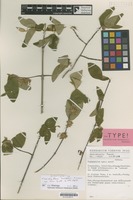
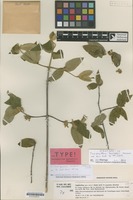
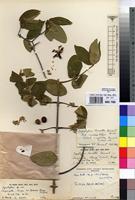
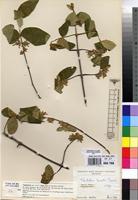
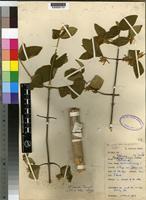
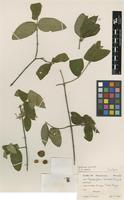
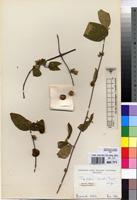
Isotype of Tapiphyllum burnettii Tennant [family RUBIACEAE]
Previous
Next

Name

Identification
Isotype of Tapiphyllum burnettii Tennant [family RUBIACEAE ] Verified by Not on sheet, Vangueria burnettii (Tennant) Lantz [family RUBIACEAE ] (stored under name); Verified by Not on sheet,
Related name
  • Tapiphyllum burnettii
  • Vangueria burnettii

Flora

Entry for Tapiphyllum burnettii Tennant [family RUBIACEAE]
Herbarium
Royal Botanic Gardens, Kew (K)
Collection
Flora Zambesiaca
Resource Type
Reference Sources
Entry From
FZ, Vol 5, Part 2, (1998) Author: D. Bridson
Names
Tapiphyllum burnettii Tennant [family RUBIACEAE], in Kew Bull. 19: 280, fig. 1 (1965). —Verdcourt in Kew Bull. 36: 537 (1981). —Havard & Verdcourt in Kew Bull. 42: 606, fig. 1C (1987). —Verdcourt in F.T.E.A., Rubiaceae: 784, figs. 132/7, 139 (1991). TAB. 52. Type from Tanzania.
Information
Shrub or small tree, 1.5–6 m tall, sometimes scrambling; branches slender, densely pale ferruginous-hairy on young parts but soon glabrescent or glabrous and revealing fissured ± purplish-brown bark.Leaves paired; blades 1.5–9.5 × 1–4.4 cm, oblong to ovate-lanceolate, rounded to acute at the apex, ± rounded at the base, discolorous, green with appressed ± ferruginous hairs above, densely velvety beneath with silvery to pale ferruginous hairs, the main nervation usually slightly darker ferruginous; petiole 1–2 mm long; stipules 8 mm long, linear-lanceolate, deciduous.Flowers in 3–several-flowered cymes, ferruginous pubescent; peduncles 4 mm long; lower bracts small, upper bracts ± leaf-like, up to 7 × 2 mm, lanceolate; pedicels obsolete.Calyx densely pale ferruginous-pilose; tube 1.2 mm long; lobes 2.5–6 × 0.4–1 mm, linear to lanceolate, sometimes slightly spathulate.Corolla capitate, acute or apiculate at the apex in bud; pale green, creamy-green or white, densely ferruginous hairy; tube 11–12.5 mm long, slender, cylindrical; lobes 3–4 × 1–2 mm, ovate-lanceolate, shortly apiculate.Anthers 1.1–1.5 mm long, shortly exserted.Style 11–13 mm long; pollen presenter 1.2 mm long, coroniform.Fruits orange-yellow, subglobose, 1–1.3 cm in diameter with 2–5 pyrenes, sulcate in dry state, densely ferruginous-tomentose with short and longer hairs; pyrenes reddish-brown, up to 9 × 5.5 mm, rugose.
Habitat
Dry rocky streambed
Altitude range
c. 150 m.
150
150
Distribution
Zambia N Isoka, fl. 22.xii.1962, Fanshawe 7205 (K; NDO).
Distribution (external)
southern Tanzania
Notes
This species stands apart from the rest of Tapiphyllum (see Bridson in Kew Bull. 51: 349 (1996)) but nonetheless in the absence of flowers it can be difficult to distinguish from T. cinerascens. However, the cotyledons are shorter than the radicle in T. burnettii but longer than the radicle in T. cinerascens. Brummitt et al. 15977 (Malawi, S: Mangochi Distr. fr. 19.ii.1982), a climber to 8 m, very likely belongs here, and one or two sterile specimens named T. cinerascens also resemble this.

Related Materials

  • Terms and Conditions
  • Privacy Policy
  • Cookie Policy
  • Cookie Settings
  • Accessibility
  • Help
  • Contact Us
  • Facebook
  • Twitter
ITHAKA

JSTOR is part of ITHAKA, a not-for-profit organization helping the academic community use digital technologies to preserve the scholarly record and to advance research and teaching in sustainable ways.

©2000-2026 ITHAKA. All Rights Reserved. JSTOR®, the JSTOR logo, JPASS®, Aluka®, and ITHAKA® are registered trademarks of ITHAKA.

╳