JSTOR Global Plants Home
  • Home
  • Browse
  • About
  • Access
  • Account
    • Saved Items
    • Profile
  • Log in

Global Plants

Skip to Main Content
  • JSTOR Global Plants Home
  • Global Plants

    • Browse
    • About
    • Access
    • Account
      • Saved Items
      • Profile
Log in
  • Browse
  • About
  • Access
  • Account
    • Saved Items
    • Profile
Advanced Search

Compilation
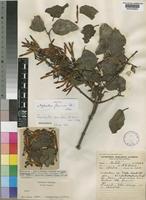
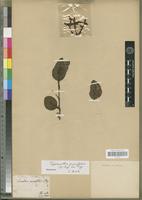
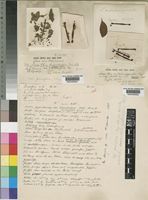
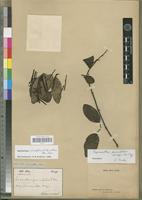
Tapinanthus prunifolius

7 Images see all

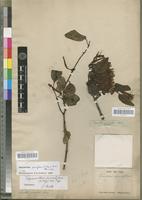
Holotype of Agelanthus flammeus Polhill & Wiens [family LORANTHACEAE]
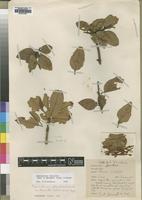
Isotype of Loranthus prunifolius Harv. [family LORANTHACEAE]
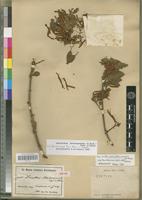
Tapinanthus rubromarginatus (Engl.) Danser [family LORANTHACEAE]
Isotype of Loranthus prunifolius Harv. [family LORANTHACEAE]
Type of Tapinanthus prunifolius (E. Meyer ex Harvey) Danser var. gamwelii [family LORANTHACEAE]
Isotype of Loranthus tambermensis Engl.&Krause [family LORANTHACEAE]
Previous
Next

Name

Identification
Tapinanthus prunifolius (E. Meyer ex Harvey) Danser [family LORANTHACEAE ] Verified by S.Balle, Agelanthus nyasicus (Baker&Sprague) Polhill&Wiens [family LORANTHACEAE ] (stored under name); Verified by Polhill,R.M.,
Related name
  • Loranthus prunifolius
  • Agelanthus prunifolius
  • Tapinanthus prunifolius
  • Agelanthus heteromorphus
  • Agelanthus flammeus
  • Loranthus tambermensis
  • Loranthus bulawayensis
  • Agelanthus nyasicus

Flora

Entry for LORANTHUS prunifolius E. Meyer [family LORANTHACEAE]
Herbarium
Royal Botanic Gardens, Kew (K)
Collection
Flora Capensis
Resource Type
Reference Sources
Entry From
Flora Capensis, Vol 5, Part 2, page 100, (1925) Author: (By T. A. SPRAGUE.)
Names
LORANTHUS prunifolius E. Meyer [family LORANTHACEAE], in Drège, Zwei Pfl. Documente, 140, 142, name only;—Harv. in Harv. & Sond. Fl. Cap. ii. 578; Engl. in Engl. Jahrb. xx. 109.
Tapinanthus prunifolius Van Tiegh. [family LORANTHACEAE], in Bull. Soc. Bot. France, xlii. 267.
Information
vegetative parts glabrous; branches 1 1/2–2 lin. in diam. 1 ft. below the apex, the younger ones brown, much wrinkled in a dried state, the older greyish-brown, conspicuously lenticellate; branchlets rather slender, smooth, pale green, often turning black on drying; internodes 1/2–2 1/2 lin. long; leaves opposite or subopposite, conspicuously petioled, ovate or ovate-lanceolate, 1–3 in. long, 2/3–1 3/4 in. broad, obtuse or rounded at the apex, obtuse or subcuneate at the base, coriaceous, dull, penninerved, nerves irregular, patulous or rather oblique, more or less raised on both surfaces in a dried state or hardly visible; petiole 3–10 lin. long; umbels borne on the branchlets, axillary, solitary, 6–10-flowered; peduncle 1 1/2–4 lin. long, like the pedicels, bracts, receptacle and calyx minutely and densely pilose with rusty hairs; pedicels 1 1/2–2 1/2 lin. long, rather oblique at the apex; bract unilaterally developed from a saucer-shaped or platter-shaped base, ovate or oblong, 5/8– 7/8 lin. long, slightly thickened on the back; flowers pentamerous, expanding as in L. kraussianus; receptacle and calyx together campanulate, 1 1/4–1 1/2 lin. long; calyx shortly 5-toothed or repand, 1/3– 1/2 lin. long including the teeth and the intramarginal ring, which is 1/12– 1/8 lin. high; corolla orange, 1 1/2–2 in. long, basal swelling oblong-ovoid or ellipsoid, 2–3 1/2 lin. long, apical swelling oblong, 2 1/2 lin. long, pentagonal, 5-ribbed; tube constricted for about 1 lin. above the basal swelling, then broadened upwards to the middle and again narrowed to the base of the apical swelling; lobes erect, spathulate-linear, 4–5 1/2 lin. long, lower part soft, distinctly ribbed outside, upper part with a hard inner layer, 2–2 1/2 lin. long, narrowly boat-shaped as seen from the side, keeled; filaments inserted at the base of the corolla-lobes, deflexed or inflexed, produced in front of the anther into a tooth 1/8– 1/6 lin. long, 2 1/2–3 lin. long excluding the tooth; anthers oblong-linear, 1 3/8–1 1/2 lin. long; disc 1/6– 1/4 lin. high, hardly lobed; style skittle-shaped above, thickened part 2 1/2–3 lin. long; stigma subglobose, 3/8 lin. in diam.; berry obovoid, 3 1/2–4 lin. long. null
Distribution
CENTRAL REGION Somerset Div.; near Somerset East, Bowker!COAST REGION Bathurst Div.; Glenfilling. Drège! by the Kowie River, Ecklon & Zeyher! Albany Div.; Grahamstown, on Ficus capensis, Thunb., Galpin. 2922! Fish River, Schlechter, 6109! and without precise locality, Hutton! Bedford Div.; in the valley of the Mankasana River, MacOwan, 411! King Williamstown Div.; between Keiskamma River and the Buffalo River, Drège! Perie Forest, Kuntze! Komgha Div.; near Komgha, Flanagan, 111! British Kaffraria, Cooper, 329! 543!
Notes
L. prunifolius is closely allied to L. kraussianus, from which it differs in the shape of the receptacle, the more or less distinctly 5-toothed calyx, the longer corolla-lobes, which are less strongly keeled, and the indumentum of the corolla. The leaves are on the whole broader, thicker and less obliquely nerved than those of L. kraussianus. L. kraussianus var. puberulus resembles L. prunifolius in the indumentum of the inflorescence and corolla, but agrees with L. kraussianus in other respects.

Related Materials

  • Terms and Conditions
  • Privacy Policy
  • Cookie Policy
  • Cookie Settings
  • Accessibility
  • Help
  • Contact Us
  • Facebook
  • Twitter
ITHAKA

JSTOR is part of ITHAKA, a not-for-profit organization helping the academic community use digital technologies to preserve the scholarly record and to advance research and teaching in sustainable ways.

©2000-2026 ITHAKA. All Rights Reserved. JSTOR®, the JSTOR logo, JPASS®, Aluka®, and ITHAKA® are registered trademarks of ITHAKA.

╳