

Compilation
Tapinanthus longipes
1 Images see all
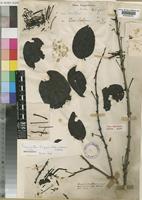
Name
Identification
Isotype of Tapinanthus longipes (Baker & Sprague) Danser [family LORANTHACEAE ] Verified by Balle, S., Agelanthus longipes (Baker & Sprague) Polhill & Wiens [family LORANTHACEAE ] (stored under name); Loranthus unrecorded unrecorded [family LORANTHACEAE ]
Related name
- Loranthus unrecorded
- Agelanthus longipes
- Tapinanthus longipes
Flora
Entry for Agelanthus longipes (Baker & Sprague) Polh. & Wiens [family LORANTHACEAE]
Herbarium
Royal Botanic Gardens, Kew (K)
Collection
Flora of Tropical East Africa
Resource Type
Reference Sources
Entry From
Flora of Tropical East Africa, page 1, (1999) Author: POLHILL & D. WIENS
Names
Agelanthus longipes (Baker & Sprague) Polh. & Wiens [family LORANTHACEAE], in Lebrun & Stork, Énum. Pl. Fl. Afr. Trop. 2: 164 (1992) & Mistletoes Afr.: 151 (1998). Type: Tanzania, Uzaramo District, Dar es Salaam, Kirk (K!, holo., B!, iso.)
Loranthus longipes Baker & Sprague [family LORANTHACEAE], in F.T.A. 6(1): 341 (1910) & in K.B. 1911: 146 (1911); F.D.O.-A. 2: 172 (1932); T.T.C.L.: 291 (1949)
Tapinanthus longipes (Baker & Sprague) Danser [family LORANTHACEAE], in Verh. K. Akad. Wet., sect. 2, 29(6): 115 (1933)
Information
Stems spreading and pendent to 1 m. long, often with rather short lateral branches; branchlets slightly compressed at first, soon terete; plant glabrous. Leaves opposite or subopposite; petiole 3–7 mm. long; lamina thinly coriaceous, dark green, mostly ovate-elliptic to elliptic, 3–11 cm. long, 2–6.5 cm. wide, lowest on side branches smaller and more obovate, narrowed or acuminate to acute or shortly rounded apex, cuneate to rounded at the base, with 6–12 pairs of lateral nerves, the lower ones stronger and more ascending. Umbels axillary or terminal on short branches, 4–8(–14)-flowered; peduncle 1.5–4 cm. long; pedicels 2–4 mm. long; bract saucer-shaped with a small triangular-ovate limb 1.5–2.5 mm. long. Receptacle 1–1.5 mm. long; calyx 0.2–0.5 mm. long. Corolla 3.5–4.5 cm. long, tube pink or pinkish mauve (sometimes white below), often darker lined, then green with head yellow or green in bud, ± darker marked around vents; lobes green inside; apex of bud ovoid-ellipsoid to ellipsoid, angled, slightly ribbed, pointed or slightly acuminate at the apex, 3–4 mm. long, 2–2.5 mm. in diameter; basal swelling slight; lobes erect, 10–11 mm. long, the upper expanded part narrowly elliptic, 4 mm. long, 1.2 mm. wide. Stamen-filaments dark red or purple; tooth 0.5–0.7 mm. long; anthers 2–2.5 mm. long. Style green, slender, only slightly narrowed above; stigma capitate, 0.7–0.8 mm. across. Berry red, not seen.
Range
DISTR. K 7; T 3, 6, 8
Altitude range
30–650 m.
Distribution
KENYA Kwale District Kaya Funga, 19 June 1994, Luke 4023! & Shimba Hills, Kwale Forest Reserve, 2 May 1968, Magogo & Glover 968!;TANZANIA Tanga District Pongwe, 23 May 1966, Faulkner 3788!;KENYA Kilifi District Arabuko-Sokoke Forest, N. of Sokoke Forest Station, 8 June 1973, Musyoki & Hansen 999!TANZANIA Uzaramo District Pugu Hills, 18 June 1983, Polhill & Lovett 4878!;TANZANIA Lindi District Rondo Plateau, St. Cyprians College, 17 Feb. 1991, Bidgood, Abdallah & Vollesen 1623!
Distribution (external)
; Mozambique