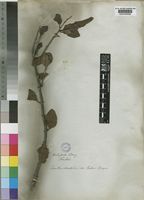
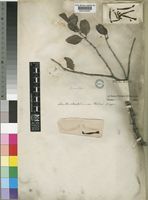
Entry for Tapinanthus forbesii [family LORANTHACEAE]
Herbarium
South African National Biodiversity Institute, Compton Herbarium, Cape Town (SAM)
Collection
Flora of Southern Africa
Resource Type
Reference Sources
Entry From
Flora of South Africa, (2003) Author: Dr J.P. Roux
Names
Tapinanthus forbesii [family LORANTHACEAE]
Common names
Loranthus oleifolius (Wendl.) Cham. & Schlechtd. var. forbesii Sprague in F.C. 5,2: 118 (1915).
Information
Relatively large shrubs over 1 m high. Stems rather thin, puberulent when young, glabrate with age. Leaves opposite-suboppo-site, occasionally fascicled on older stems, glabrous, mostly lanceolate-oblong, 30-40 x 10-20 mm, somewhat chartaceous, conspiÂcuously penninerved; petioles 2-4 mm long, usually puberulent. Inflorescence: umbels sessile-subsessile, 4-6-flowered, mostly soliÂtary in axils; pedicels and bracts pubescent. Corolla with conspicuous, rounded-oblong basal swelling, pilose, base green, tube reddish-purple, apex green, 35-40 mm long, tube split 10-12 mm below lobes; lobes reflexed. Filaments with a small tooth below anthers. Style constricted below stigma. Berries ellipsoid, 10-12 mm long, red, slightly warty. Flowering from April through September and probably also in other months; n=9. Fig. 2.
Habitat
Although considered by Sprague to be a variety of T. oleifolius, T. leendertziae is quite distinct and appears to have little in common with T. oleifolius. Sprague mentioned the occurrence of intermediate collections but field studies in the northern Transvaal did not reveal their presence.
Use
2. Tapinanthus forbesii (Sprague) Wiens in Bothalia 12: 423 (1978). Type: Mozambique, Delagoa Bay, Forbes s.n. (K, lecto.!).
Range
Parasitic primarily on species of Acacia, but also Euclea, Ochna, Peltophorum and Rhus. Occurs throughout the Transvaal and the northern Orange Free State, with an apparently disjunct population in northern Natal (Map 2).