JSTOR Global Plants Home
  • Home
  • Browse
  • About
  • Access
  • Account
    • Saved Items
    • Profile
  • Log in

Global Plants

Skip to Main Content
  • JSTOR Global Plants Home
  • Global Plants

    • Browse
    • About
    • Access
    • Account
      • Saved Items
      • Profile
Log in
  • Browse
  • About
  • Access
  • Account
    • Saved Items
    • Profile
Advanced Search

Compilation
Takakia lepidozioides

5 Images see all

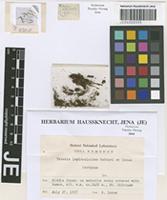
Isotype of Takakia lepidozioides S. Hatt. & Inoue [family TAKAKIACEAE]
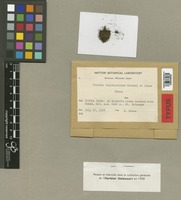
Type of Takakia lepidozioides S. Hatt. & Inoue [family TAKAKIACEAE]
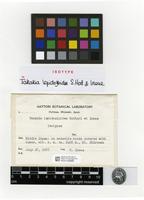
Isotype of Takakia lepidozioides S.Hatt. & Inoue [family TAKAKIACEAE]
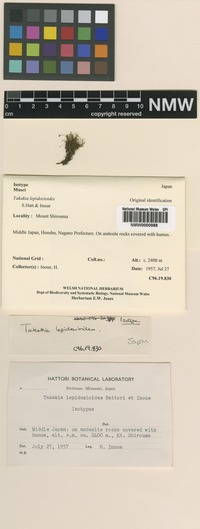
Isotype of Takakia lepidozioides Hattori et Inoue [family TAKAKIACEAE]
Type of Takakia lepidozioides S. Hatt. & Inoue [family TAKAKIACEAE]
Previous
Next

Name

Identification
Takakia lepidozioides S. Hatt. & Inoue [family TAKAKIACEAE ] (stored under name); Verified by Not on sheet,
Related name
  • Takakia lepidozioides

Flora

Entry for Takakia lepidozioides S. Hattori & Inoue [family ]
Herbarium
Flora of North America (FNA)
Collection
Flora of North America
Resource Type
Reference Sources
Entry From
Flora of North America, Vol 27,
Names
Takakia lepidozioides S. Hattori & Inoue [family ], J. Hattori Bot. Lab., 19: 137, figs. 1–24. 1958,
Information
Plants with cinnamon-like odor when dry; distal part of leafy shoots not caducous. Stems in cross section usually with 1 layer of thicker walled epidermal cells; stoloniferous stems well developed and extensive above surface of substrate. Leaves typically of 2 segments, not or only occasionally connate at base, some solitary, occasionally of 3–4 segments, sometimes caducous, in cross section of thin-walled cells, in distal part of segment with single large central cell and 7–10 smaller outer cells, these 30–45 × 20–25 µm, irregularly arranged. Slime hairs thin-walled. Sporophytes unknown.
Altitude range
low to moderate elevations (0–1000 m);
Distribution
Asia (Borneo, Japan, Nepal, Taiwan).USA AlaskaCanada B.C.
Discussion
Takakia lepidozioides grows most frequently in highly humid or misty sites, often deeply shaded. Algae and cyanobacteria are frequent associates. The shoots are often lax, and extensive rhizomatous shoots are conspicuous.

Related Materials

  • Terms and Conditions
  • Privacy Policy
  • Cookie Policy
  • Cookie Settings
  • Accessibility
  • Help
  • Contact Us
  • Facebook
  • Twitter
ITHAKA

JSTOR is part of ITHAKA, a not-for-profit organization helping the academic community use digital technologies to preserve the scholarly record and to advance research and teaching in sustainable ways.

©2000-2026 ITHAKA. All Rights Reserved. JSTOR®, the JSTOR logo, JPASS®, Aluka®, and ITHAKA® are registered trademarks of ITHAKA.

╳