

Compilation
Tacsonia mollissima
1 Images see all
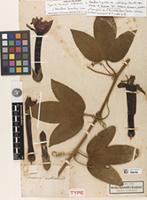
Name
Identification
Tacsonia mollissima Kunth [family PASSIFLORACEAE ] (stored under name); Verified by Kunth, K.S., Passiflora tomentosa Lam. [family PASSIFLORACEAE ] Verified by Feuillet, C., 1984
Related name
- Tacsonia mollissima
- Passiflora tomentosa
Flora
Entry for PASSIFLORA mollissima (Kunth) Bailey [family PASSIFLORACEAE]
Herbarium
Royal Botanic Gardens, Kew (K)
Collection
Flora of Tropical East Africa
Resource Type
Reference Sources
Entry From
Flora of Tropical East Africa, page 1, (1975) Author: W. J. J. O. de Wildem (Rijksherbarium, Leiden)
Names
PASSIFLORA mollissima (Kunth) Bailey [family PASSIFLORACEAE], in Rhodora 18 : 156 (1916); Killip in Field Mus. Nat. Hist. Chicago, Bot. 19 : 291 (1938); Young in Rec. Auckland Inst. Mus. 7 : 159, figs. 29–32 (1970). Type : Colombia, Bogota, Humboldt & Bonpland 1767 (P, holo.)
Tacsonia mollissima Kunth [family PASSIFLORACEAE], Nov. Gen. Sp. 2 : 144 (1817)
Information
Climber to 20 m., perennial, subglabrous to densely pubescent throughout; stem terete, finely striate. Leaf-blades 3-lobed, the depth varying from about half-way to ± six-sevenths, in outline suborbicular, 5–11 by 6–13 cm., base truncate to cordate, 3(–5)-nerved from the base, membranous to thinly coriaceous, glabrous or subglabrous above, pubescent to various degrees beneath; lobes elliptic to lanceolate, 2.5–6 cm., top acute or up to 1.5 cm. acuminate; margin glandular serrate-dentate up to 2 mm.; petiole 0.7–2.5(–5) cm. Glands on petiole absent or mostly 2–5 pairs, minute, sessile or subsessile; blade-glands, except marginal glands and sometimes a small gland in the lobe-sinuses, absent. Stipules subcircular or obliquely reniform, either ± 2 mm. or ± 0.5(–0.9) cm. in diameter, finely glandular dentate, if small caducous. Inflorescences 1-flowered, the peduncle 1.5–5 cm., inserted beside a simple tendril 5–18 cm.; bracts and bracteoles 2–4 cm., acute-acuminate, connate for half-way to up to ± three-fourths, forming a tubiform involucre. Flowers 5–10 cm. in diameter, pinkish or pinkish red to pinkish orange. Hypanthium tubiform, (5–)6–9 by 0.5–1.5 cm.; sepals oblong, 2–5.5 cm., subobtuse, mucronate below apex. Petals oblong, 2–5 cm., obtuse. Corona a low lobulate edge at the throat of the hypanthium; operculum an inward curved membrane, at the base of the hypanthium. Androgynophore 6–10 cm.; filaments 10–15 mm., dilated; anthers 7–13 mm. Ovary oblong, 10–12 mm., pubescent; styles 10–15 mm. Fruit rather dry, ± ellipsoid, excluding the long gynophore 6–12 cm. long, softly pubescent, yellowish. Seeds many, ellipsoid, ± 6 mm.
Range
DISTR. K2–4 introduced in many tropical countries
Altitude range
1000–3000 m.
Distribution
KENYA Naivasha District Kinangop, 11 July 1965, Gillet 16768 !KENYA Kiambu District Kibata, 20 Aug. 1940, Greenway 5987 !KENYA Nairobi, Aug. 1940, Nattrass 15 !, 16 ! & 135 ! (cult.)
Notes
Selection of specimens deviating from typical P. mollissima (see ). W. Suk District: Kapenguria, Mar. 1956, Meinertzhagen !; Kiambu District: Kibata, 20 Aug. 1940, Greenway 5985 ! & 27 Aug. 1940, Nattrass 39 !; Nairobi, 16 Nov. 1940, Bell 45 ! (cult.) P. mollissima is extensively cultivated in the South American Andes, and widely distributed in other tropical mountainous regions, and in the subtropics, as an ornamental or for the flavoured fruit (“ banana passion fruit ”). It commonly occurs as an escape. The species doubtlessly hybridizes with other related species of the subgen. Tacsonia (Juss.) Tr. & Planch. (see Killip, 1938; Young, 1970), e.g. with P. mixta L.f. and P. pinnatistipula Cav. A third very closely related species, P. psilantha (Sodiro) Killip, is regarded as a hybrid of P. mollissima and P. tripartita (Juss.) Poir. The East African material of P. mollissima as described above comprises two rather easily segregated forms. About half of the specimens come closest to true mollissima, characterized by the following. Stipules rather large, measuring 5 mm. or more, mostly persistent. Leaves usually densely pilose on both surfaces. Hypanthium tube ± 7–10 cm. long, the tepals 2–3.5 cm. long, hence less than half the hypanthium. The remainder of the East African material possibly belongs to some undescribed form or is a hybrid with an unknown related species. This is differentiated by the following. Stipules small, ± 2 mm., caducous. Leaves usually glabrous or glabrescent above. Hypanthium tube 5–7 cm., the tepals 3–5.5 cm. long, hence longer than half the hypanthium. These latter specimens cannot be assigned to the related P. mixta mainly because of the distinctly angular stem in that species. P. psilantha does not agree because of its very narrow hypanthium tube, and the narrowly lanceolate free bract-portions. A part of the present specimens at EA is determined by Killip (in 1947) as “ possibly a horticultural hybrid of perhaps P. mixta and P. pinnatistipula ”, but in fact the plants show few intermediate features between these species. Similar difficulties in identifying material of the same alliance of introduced species in New Zealand is discussed by Young (loc. cit.).