JSTOR Global Plants Home
  • Home
  • Browse
  • About
  • Access
  • Account
    • Saved Items
    • Profile
  • Log in

Global Plants

Skip to Main Content
  • JSTOR Global Plants Home
  • Global Plants

    • Browse
    • About
    • Access
    • Account
      • Saved Items
      • Profile
Log in
  • Browse
  • About
  • Access
  • Account
    • Saved Items
    • Profile
Advanced Search

Compilation
Tacca quanzensis

7 Images see all

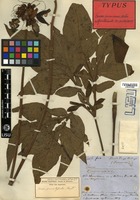
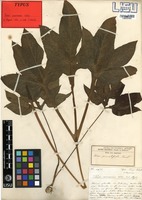
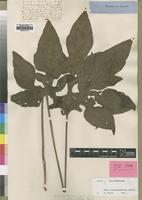
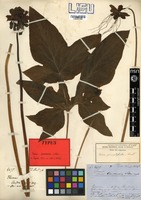
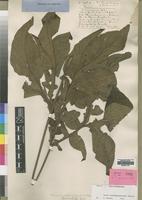
Type of Tacca quanzensis Welw. [family DIOSCOREACEAE]
Isotype of Tacca quanzensis Welw. [family TACCACEAE]
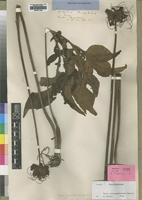
Type of Tacca quanzensis Welw. [family DIOSCOREACEAE]
Isotype of Tacca quanzensis Welw. [family TACCACEAE]
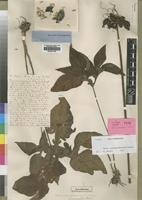
Type? of Tacca quanzensis Welw. [family TACCACEAE]
Previous
Next

Name

Identification
Tacca quanzensis Welw. [family TACCACEAE ] Tacca leontopetaloides (L.) Kuntze [family TACCACEAE ] (stored under name); Verified by Drenth,E.,
Related name
  • Tacca leontopetaloides
  • Tacca quanzensis

Flora

Entry for TACCA leontopetaloïdes (L.) O. Ktze. [family TACCACEAE]
Herbarium
Royal Botanic Gardens, Kew (K)
Collection
Flora of Tropical East Africa
Resource Type
Reference Sources
Entry From
Flora of Tropical East Africa, page 1, (1962) Author: Susan Carter
Names
TACCA leontopetaloïdes (L.) O. Ktze. [family TACCACEAE], Rev. Gen. 2 : 704 (1891) ; Troupin, Fl. Parc Nat. Garamba 209 (1956). Type : India ; Tab. & descr. of Leontopetaloïdes by J. Amman in Comm. Acad. Imp. Sci. Petrop. 8 : 211, t. 113 (1736) (holo.!)
Leontice leontopetaloïdes L. [family BERBERIDACEAE], Sp. Pl. : 313 (1753)
Tacca pinnatifida J. R. & G. Forst. [family TACCACEAE], Char. Gen. : 70, t. 35 (1776) ; F.T.A. 7 : 413 (1898). Type : Tahiti, Forster (K, holo. !)
Tacca involucrata Schumach. & Thonn. [family TACCACEAE], Beskr. Guin. Pl. : 177 (1872) ; F.W.T.A. 2 : 397, fig. 320 (1934). Type : Ghana, Thonning (C, holo.†)
Tacca quanzensis Welw. [family TACCACEAE], Apont. : 591 (1858). Type : Angola, Pungo Andongo, Welwitsch 6475 (BM, holo. !)
Tacca pinnatifida Limpr. f. subsp. madagascariensis [family TACCACEAE], Beitr. Kenntn. Tacc. Diss. : 53 (1902). Type : Ethiopia, Schimper 1946 (K, syn. !). Syntypes also from Senegal and Portuguese East Africa
Tacca pinnatifida (Schumach. & Thonn.). Limpr. f. subsp. involucrata [family TACCACEAE], Beitr. Kenntn. Tacc. Diss. : 55 (1902)
Tacca pinnatifida Limpr. f. var. acutifolia [family TACCACEAE], Beitr. Kenntn. Tacc. Diss. : 55 (1902). Syntypes from Ethiopia, Tanganyika and Nyasaland
Tacca umbrarum Jum. & Perr. [family TACCACEAE], in Ann. Mus. Colon. Mars., sér. 2, 8 : 386, t. 1, 2 (1910). Type : Madagascar, Jumelle (location not known)
Tacca madagascariensis (Limpr. f.) Limpr. f. [family TACCACEAE], in E.P. IV. 42 : 29 (1928)
Tacca involucrata (Limpr. f.) Limpr. f. var. acutifolia [family TACCACEAE], in E.P. IV. 42 : 29 (1928)
Information
Stout herb, up to 1.5 m. Tuber up to 10 cm. across ; roots fibrous. Leaves 1–3 ; sheathing cataphylls 2 or 3, up to 5 cm. long, enclosing the bases of the petioles and flowering stems ; petiole ridged longitudinally, up to 1 m. long, with a sheathing base ; leaf-blade trisected at the apex of the petiole, each segment 1–3-pinnatisect ; lobes ovate-acuminate, up to 12 × 7 cm., and with smaller orbicular lobes between them up to 3 × 2.5 cm. Flowering stems usually 1, ridged longitudinally, up to 1.5 m. high ; outer bracts 2, spreading, ovate-lanceolate, usually with 2–3-fid tips, (2–)4(–7) × (l–)2.5(–4) cm. ; inner bracts 3–4, erect, ovate, almost sessile, slightly shorter than the outer ones ; both types green tinged with purple ; filiform bracts many, purplish with whitish tips, stiff and pendulous, up to 20 cm. long ; flowers 20–40, but only a few of these produce fruit ; pedicels about 2.5 cm. long, elongating to about 4 cm. in fruit. Perianth-segments erect, green tinged with purple, thickened ; outer segments oblong, 6 × 3.5 mm. ; inner segments oblong, emarginate, 8 × 6 mm. ; perianth-tube 4 mm. long. Filaments 2.5 mm. wide, adnate to the perianth-tube but with free margins ; hood 2 × 2 mm. ; anthers 2 mm. long. Style 2 mm. long, set upon a basal swelling covered with small stalked glands ; stigma-lobes heart-shaped, 3 × 2.5 mm. ; stigmatic surface a slit, 1.5 mm. long ; ovary obovate, 4 × 3 mm. Fruit subglobose, 6-ridged, up to 3 × 2.5 cm. Seeds ovate, longitudinally ridged, 5 × 3 mm., red-brown, but surrounded by a thin fleshy aril which is not evident when the seeds are dry. Fig. 1.
Range
DISTR. Ul–4 ; K7 ; T3, 4, 6–8 ; Z ; P tropical and subtropical ; from India and China through Malaya to the Pacific islands and north Australia, Madagascar and the Mascarene Is., and in Africa from Sierra Leone to Ethiopia and southwards to Southern Rhodesia
Altitude range
0–1100 m.
Distribution
KENYA Mombasa, English Point, 26 May 1935, Napier 6294 !KENYA Kilifi District Mida, May 1929, R. M. Graham 2120!TANGANYIKA Lushoto District Korogwe, Magunga, 26 May 1953, Faulkner 1192 !TANGANYIKA Ufipa District near Lake Rukwa, 7 Jan. 1938, Michelmore 1454 !TANGANYIKA Songea District 7 km. W. of Songea, 18 Jan. 1956 (fl.), Milne-Redhead & Taylor 8263 ! & 6 Feb. 1956 (fr.), 8263A !UGANDA West Nile District Terego, Apr. 1938, Hazel 497 !UGANDA Bunyoro District Masindi, 12 May 1941, A. S. Thomas 3888 !UGANDA Teso District Serere, Apr.-May 1932, Chandler 571 !ZANZIBAR Zanzibar I., Apr. 1874, Hildebrandt 1285 !ZANZIBAR Donge, 20 June 1950, Oxtoby 18 !ZANZIBAR Pemba I., Chake-Chake, Vaughan 309 !
Notes
VARIATION. Various leaf-forms of this plant have been described as distinct species. The size and shape of the lobes, however, appear to depend on environmental conditions, the plants growing in dry, open situations having many small narrow lobes, while those with a few large lobes are found in relatively damp, shady places.

Related Materials

  • Terms and Conditions
  • Privacy Policy
  • Cookie Policy
  • Cookie Settings
  • Accessibility
  • Help
  • Contact Us
  • Facebook
  • Twitter
ITHAKA

JSTOR is part of ITHAKA, a not-for-profit organization helping the academic community use digital technologies to preserve the scholarly record and to advance research and teaching in sustainable ways.

©2000-2026 ITHAKA. All Rights Reserved. JSTOR®, the JSTOR logo, JPASS®, Aluka®, and ITHAKA® are registered trademarks of ITHAKA.

╳