JSTOR Global Plants Home
  • Home
  • Browse
  • About
  • Access
  • Account
    • Saved Items
    • Profile
  • Log in

Global Plants

Skip to Main Content
  • JSTOR Global Plants Home
  • Global Plants

    • Browse
    • About
    • Access
    • Account
      • Saved Items
      • Profile
Log in
  • Browse
  • About
  • Access
  • Account
    • Saved Items
    • Profile
Advanced Search

Compilation
Syndesmanthus glaucus

3 Images see all

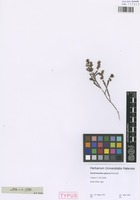
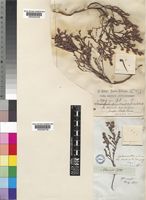
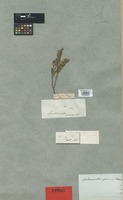
Syntype of Syndesmanthus glaucus Klotzsch [family ERICACEAE]
Syndesmanthus articulatus (L.) Klotzsch [family ERICACEAE]
Isotype of Syndesmanthus glaucus Klotzsch [family ERICACEAE]
Previous
Next

Name

Identification
Syndesmanthus glaucus Klotzsch [family ERICACEAE ] Syndesmanthus articulatus (L.) Klotzsch [family ERICACEAE ] (stored under name); Blairia unrecorded unrecorded [family ERICACEAE ]
Related name
  • Syndesmanthus articulatus
  • Blairia unrecorded
  • Syndesmanthus glaucus

Flora

Entry for SYNDESMANTHUS articulatus Klotzsch [family ERICACEAE]
Herbarium
Royal Botanic Gardens, Kew (K)
Collection
Flora Capensis
Resource Type
Reference Sources
Entry From
Flora Capensis, Vol 4, page 2, (1909) Author: By H. BOLUS, F. GUTHRIE, and N. E. BROWN.
Names
SYNDESMANTHUS articulatus Klotzsch [family ERICACEAE], in Linnæa, xii. 241;—Benth. in DC. Prodr. vii. 706 (incl. var. hirtus).
SYNDESMANTHUS glaucus Klotzsch [family ERICACEAE], l.c. 242; Benth. l.c. 707.
Blæria articulata Linn. [family ], Mant. ii. 198; Lam. Encycl. i. 429, Suppl. i. 640, and Illust. i. 315, t. 78; Wendl. Collect. ii. 19, t. 44; Roem. & Schultes, Syst. Veg. iii. 169; Dietr. Synop. Pl. i. 444; Klotzsch in Linnæa, viii. 666; G. Don, Gen. Syst. iii. 804, excl. the synonym Erica articulata, Thunb. from all.
Blæria eriantha Willd. ex Steud. [family ], Nom. ed. 2, i. 208.
Erica eriocephala Lam. [family ERICACEAE], Encycl. i. 489, and Suppl. i. 640, under Blæria.
Erica paleacea Salisb. [family ERICACEAE], in Trans. Linn. Soc. vi. 341.
Information
6–10 in. high, compactly branched; branchlets puberulous or pubescent; leaves 4-nate, 1–1 1/2 lin. long, straight or incurved, erect, imbricate or shorter than the internodes, linear or lanceolate, subacute, more or less rugulose and puberulous, pubescent or minutely scabrid on the back; flowers numerous, subsessile or very shortly pedicellate, in axillary and terminal heads about 1/4 in. in diam.; bracts 0, except the floral leaves; calyx 2/3– 3/4 lin. long, obconic-tubular, sharply 4-angled, thin, hairy on the tube and ciliate on the teeth with long white spreading hairs; teeth opposite the angles, erect, 1/3– 1/2 as long as the tube, deltoid-ovate or oblong-ovate, obtuse or subacute; corolla 1 1/4–2 lin. long, oblong-tubular to somewhat funnel-shaped in the upper part, rapidly narrowed into a slender tube below the middle, curved or almost straight, glabrous, the exserted part varying from shorter to much longer than the calyx; lobes 4, erect, broadly ovate, rounded; anthers exserted, 1/3– 1/2 lin. long, basifixed, linear-oblong or sometimes by divergence of the cells narrowed to the base, spurless; ovary glabrous; stigma simple. null
Distribution
COAST REGION Cape Div.; Cape Flats, Burchell, 705 partly! 828! 8380! Prior! Bolus, 2949! Wolley Dod, 903! Table Mountain, Prior! Red Hill, near Simonstown, Mrs. Jameson! Stellenbosch Div.; Hottentots Holland Mountains, MacOwan & Bolus, Herb. Norm. Austr.-Afr., 38! Var. β: Worcester Div.; Dutoits Kloof, 3000–4000 ft., Drège, 7788! Cape Div.; Cape Flats, Burchell, 705 partly! Burke! Wolley Dod, 905! Lions Rump, Schlechter, 47!SOUTH AFRICA without locality; Herb. Linnæus! Herb. Salisbury! Drège! Mund! Var. β: Mund & Maire!
Notes
Var. hirtus, Benth. l.c. founded upon Erica paleacea, Salisb., has rather more hairy leaves than usual, but is otherwise indistinguishable from the typical form. The type specimen of S. fasciculatus (which by the courtesy of the Berlin authorities I have been able to examine) is labelled “7788 Drège,” although the number is not quoted by Klotzsch or Bentham.

Related Materials

  • Terms and Conditions
  • Privacy Policy
  • Cookie Policy
  • Cookie Settings
  • Accessibility
  • Help
  • Contact Us
  • Facebook
  • Twitter
ITHAKA

JSTOR is part of ITHAKA, a not-for-profit organization helping the academic community use digital technologies to preserve the scholarly record and to advance research and teaching in sustainable ways.

©2000-2026 ITHAKA. All Rights Reserved. JSTOR®, the JSTOR logo, JPASS®, Aluka®, and ITHAKA® are registered trademarks of ITHAKA.

╳