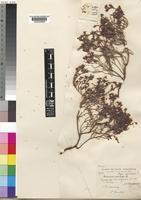
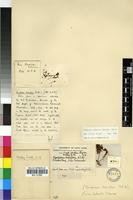
Sympieza brevifloraN.E.Br. [family ERICACEAE ] Verified by Not on sheet, Erica labialisSalisb. [family ERICACEAE ] (stored under name); Verified by Not on sheet,
Related name
Blaeria ericoides
Erica labialis
Sympieza breviflora
Flora
Entry for SYMPIEZA breviflora N. E. Br. [family ERICACEAE]
Herbarium
Royal Botanic Gardens, Kew (K)
Collection
Flora Capensis
Resource Type
Reference Sources
Entry From
Flora Capensis, Vol 4, page 2, (1909) Author: By H. BOLUS, F. GUTHRIE, and N. E. BROWN.
Names
SYMPIEZA brevifloraN. E. Br. [family ERICACEAE]
Information
apparently about 6 in. high, much branched; branchlets tortuous, pubescent or puberulous; leaves 3-nate, as long as or slightly exceeding the internodes, erect, 1–2 lin. long, lanceolate, acute, glabrous or slightly puberulous on the back, ciliate on the acute edges, the cilia often intermingled with minutely stalked glands; flower-heads numerous, subglobose, 2–2 1/2 lin. in diam.; calyx of the lower flowers 2/3– 3/4 lin. long, 1/2– 2/3 lin. broad, obovate, ciliate on the obtuse or rounded lobes, otherwise glabrous; corolla 1 lin. long, 2/3–1 lin. broad across the 2 widely gaping lobes, compressed funnel-shaped, gradually narrowing to the base, red or pink; anthers partly exserted, 1/2 lin. long, oblong; stigma simple. null
Distribution
COAST REGION Cape Div.; Simons Berg, Wolley Dod, 315!