JSTOR Global Plants Home
  • Home
  • Browse
  • About
  • Access
  • Account
    • Saved Items
    • Profile
  • Log in

Global Plants

Skip to Main Content
  • JSTOR Global Plants Home
  • Global Plants

    • Browse
    • About
    • Access
    • Account
      • Saved Items
      • Profile
Log in
  • Browse
  • About
  • Access
  • Account
    • Saved Items
    • Profile
Advanced Search

Compilation
Symphyotrichum praealtum

10 Images see all

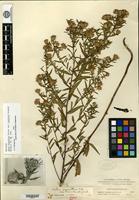
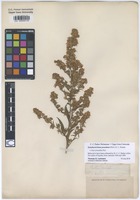
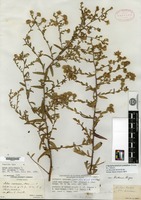
Syntype of Aster novi-belgii Linnaeus var. litoreus A. Gray [family ASTERACEAE]
Holotype of Aster praealtus Poiret var. texicola Wiegand [family ASTERACEAE]
Syntype of Aster novi-belgii Linnaeus var. litoreus A. Gray [family ASTERACEAE]
Filed as Symphyotrichum praealtum (Poir.) G. L. Nesom [family ASTERACEAE]
Type? of Aster novi-belgii Linnaeus var. litoreus A. Gray [family ASTERACEAE]
Previous
Next

Name

Identification
Symphyotrichum praealtum (Poiret) G. L. Nesom [family ASTERACEAE ] (stored under name); Verified by Not on Sheet, Aster praealtus Poiret [family ASTERACEAE ] Verified by Wiegand, 1933
Related name
  • Aster praealtus
  • Symphyotrichum praealtum
Common name
  • Willowleaf or willow aster, Flora of North America Vol. 20

Flora

Entry for Symphyotrichum praealtum (Poiret) G. L. Nesom [family ]
Herbarium
Flora of North America (FNA)
Collection
Flora of North America
Resource Type
Reference Sources
Entry From
Flora of North America, Vol 20,
Names
Symphyotrichum praealtum (Poiret) G. L. Nesom [family ], Phytologia, 77: 289. 1995
Aster praealtus Poiret [family COMPOSITAE], in J. Lamarck et al., Encycl., suppl., 1: 493. 1811
Aster salicifolius Aiton [family COMPOSITAE], 1789. not Lamarck 1784
Treatment Author(s)
Luc Brouillet
John C. Semple
Geraldine A. Allen
Kenton L. Chambers
Scott D. Sundberg†
Information
Perennials (10–)50–150(–200) cm, colonial; fleshy long-rhizomatous. Stems 1, erect to ascending (stout, ± glaucous or reddish), glabrate to moderately hispidulous-hirsute (mostly in lines) distally. Leaves thick, firm, margins often revolute, scabrous, apices mucronate, abaxial faces glabrous, vein areoles conspicuous, ± isodiametric, adaxial waxy, glabrate to strigose, ± scabrous (distal cauline with axillary leaf clusters, sometimes becoming branches); basal withering by flowering, petiolate to subpetiolate (petioles winged, bases sheathing, ciliate), blades spatulate, 40–70 × 10–25 mm, bases attenuate, margins entire to shallowly serrate, apices rounded to obtuse; proximal cauline withering by flowering, sessile (subpetiolate), blades elliptic or lanceolate to oblanceolate or linear-lanceolate, 40–100(–150) × 3–18 mm, progressively reduced distally, bases cuneate, often slightly rounded, apices acute to attenuate, callus-pointed, abaxial faces scabrellous, adaxial glabrous or ± puberulent; distal sessile, blades ovate or elliptic-lanceolate to lanceolate or linear, 10–85 × 2–17 mm, progressively reduced distally, bases cuneate, margins entire, apices acute or obtuse, callus-pointed. Heads in ample, foliaceous, usually dense, paniculiform arrays, branches ascending to spreading, ± racemiform. Peduncles 0.3–2 cm, ± pilose, bracts 5–12+, ascending or recurved-spreading, lance-elliptic to lanceolate or linear-lanceolate, foliaceous, distal closely subtending heads, not grading into phyllaries. Involucres campanulate, (4–)5–7(–8) mm. Phyllaries in 4–6 series, appressed, oblong-lanceolate to linear (innermost) (outer sometimes ± foliaceous), unequal, bases indurate 1/2–3/4, margins scarious, erose, hyaline, sparsely ciliolate (often ciliate basally), green zones lanceolate to lance-rhombic, apices sometimes spreading, acute to acuminate, mucronate, often reddish purple apically, faces glabrous. Ray florets (6–)20–35; corollas pale blue-violet to lavender or rose-purple, rarely white, laminae 5–10(–12) × 1–1.7 mm. Disc florets 20–30(–35+); corollas cream or light yellow turning pinkish purple, 4–6.5 mm, tubes shorter than narrowly funnelform throats, lobes lanceolate, 0.5–1.3 mm. Cypselae purple or stramineous with purple, obovoid, sometimes ± compressed, 1.5–2 mm, 4–5-nerved, faces thinly strigillose; pappi white, 4–6.5 mm. 2n = 32, 48, 64.
Phenology
aug (summer), sep-oct (fall)
Altitude range
0–400+ m;
Distribution
Mexico (Chihuahua)Mexico (Coahuila)Mexico (Nuevo Léon)introduced in Europe.USA Ala.USA Ark.USA Conn.USA Del.USA D.C.USA Fla.USA Ill.USA Ind.USA IowaUSA Kans.USA Ky.USA La.USA MaineUSA Md.USA Mass.USA Mich.USA Miss.USA Mo.USA Nebr.USA N.H.USA N.J.USA N.Y.USA OhioUSA Okla.USA Pa.USA R.I.USA S.Dak.USA Tenn.USA Tex.USA Va.USA W.Va.USA Wis.Canada Ont.
Discussion
Symphyotrichum praealtum was reported by H. R. Hinds (2000) as a possible introduced, non-persisting ephemeral in New Brunswick. The species is introduced in central Europe, where it has been confused with S. lanceolatum (J. C. Semple et al. 2002). A. G. Jones (1989) reported hybridization with S. lanceolatum and S. firmum.
G. L. Nesom (1994b, 1997) and J. C. Semple et al. (2002) recognize several varieties within the species: var. praealtum [syn. Aster coerulescens de Candolle, A. praealtus var. coerulescens (de Candolle) A. G. Jones, A. praealtus var. imbricatior Wiegand] (2n = 32); var. angustior (Wiegand) G. L. Nesom (syn. A. praealtus var. angustior Wiegand) (2n = 64); var. nebraskense (Britton) G. L. Nesom (syn. A. praealtus var. nebraskensis Britton); var. subasperum (Lindley) G. L. Nesom [syn. A. praealtus var. subasper (Lindley) Wiegand, A. subasper Lindley]; and var. texicola (Wiegand) G. L. Nesom (syn. A. praealtus var. texicola Wiegand). Some of these varieties deserve recognition, but the validity of others needs confirmation.

Related Materials

  • Terms and Conditions
  • Privacy Policy
  • Cookie Policy
  • Cookie Settings
  • Accessibility
  • Help
  • Contact Us
  • Facebook
  • Twitter
ITHAKA

JSTOR is part of ITHAKA, a not-for-profit organization helping the academic community use digital technologies to preserve the scholarly record and to advance research and teaching in sustainable ways.

©2000-2026 ITHAKA. All Rights Reserved. JSTOR®, the JSTOR logo, JPASS®, Aluka®, and ITHAKA® are registered trademarks of ITHAKA.

╳