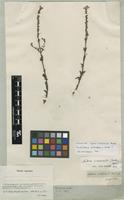
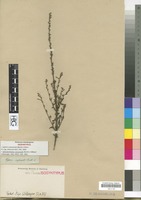
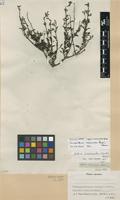
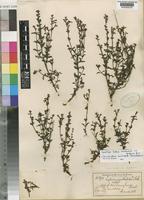
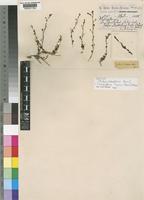
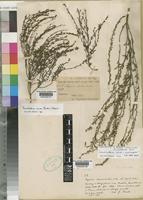
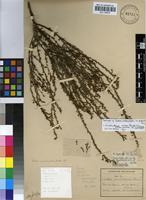
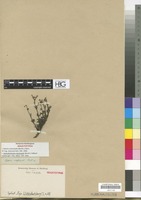
an undershrub, woody and much branched at least at the base, more or less lepidote-glandular and fœtid, scented like Rue, perennial or annual?, 1/4–1 1/2 ft. high; root-stock usually thick; branches opposite or subfasciculate or the upper alternate, divaricate or ascending or straight, often virgate, rigid, woody or wiry; branchlets rather leafy and slender; leaves subfasciculate, oval, oblong or ovate, obtuse, more or less narrowed at the base, pinnatisect or pinnatifid, shortly petiolate, 1/5– 1/2 in. long, 1/8– 1/4 in. broad, sprinkled with small white sessile shining glands; segments linear or oblong-cuneate, entire or 2–3-fid; flowers 1/3– 1/2 in. long, racemose and axillary, numerous, usually bright yellow; racemes straight, narrow, interrupted, not dense except near the apex, rigid, elongating; pedicels 1/24– 1/8 in. long, rigid, glandular; calyx 1/16– 1/10 in. long in flower, 1/10– 1/5 in. long in fruit, glandular, deeply 5-lobed; segments sublinear, subobtuse; corolla-tube subcylindrical, curved and a little gibbous-dilated not far from the apex, somewhat glandular-papillose outside, 1/4– 2/5 in. long; limb subpatent, 1/6– 1/5 in. in diam.; lobes 1/16– 1/12 in. long, obovate-rotund, retuse; stamens included; style nearly glabrous, filiform, 1/5– 1/3 in. long; capsule oblong, 1/6– 1/3 in. long, pallid, more or less sprinkled with white shining sessile glands. null