JSTOR Global Plants Home
  • Home
  • Browse
  • About
  • Access
  • Account
    • Saved Items
    • Profile
  • Log in

Global Plants

Skip to Main Content
  • JSTOR Global Plants Home
  • Global Plants

    • Browse
    • About
    • Access
    • Account
      • Saved Items
      • Profile
Log in
  • Browse
  • About
  • Access
  • Account
    • Saved Items
    • Profile
Advanced Search

Compilation
Sutera brunnea

7 Images see all

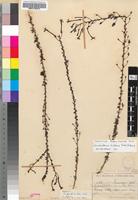
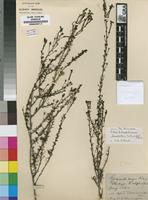
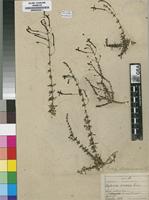
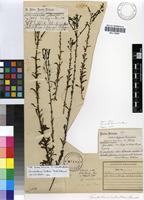
Isosyntype of Sutera brunnea Hiern [family SCROPHULARIACEAE]
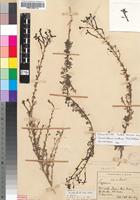
Isolectotype of Sutera brunnea Hiern [family SCROPHULARIACEAE]
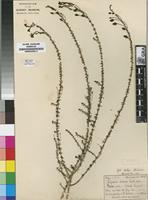
Isosyntype of Sutera brunnea Hiern [family SCROPHULARIACEAE]
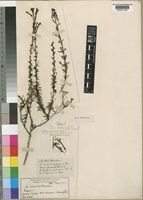
Type of Sutera brunnea Hiern [family SCROPHULARIACEAE]
Previous
Next

Name

Identification
Sutera brunnea Hiern [family SCROPHULARIACEAE ] Verified by Not on sheet, Jamesbrittenia huillana (Diels) Hilliard [family SCROPHULARIACEAE ] (stored under name); Verified by Hilliard, O.M.,
Related name
  • Jamesbrittenia huillana
  • Lyperia crocea
  • Lyperia burkeana
  • Sutera brunnea

Flora

Entry for SUTERA brunnea Hiern [family SCROPHULARIACEAE]
Herbarium
Royal Botanic Gardens, Kew (K)
Collection
Flora Capensis
Resource Type
Reference Sources
Entry From
Flora Capensis, Vol 4, page 121, (1904) Author: By W. P. HIERN, F.R.S.
Names
SUTERA brunnea Hiern [family SCROPHULARIACEAE]
Information
an undershrub, 3/4–2 1/2 ft. high; branches erect or procumbent, glabrous and ashy below, papillose or glandular-puberulous above; branchlets alternate, opposite or quasi-fasciculate, rather slender and leafy; leaves spathulate or narrowly oblanceolate, obtuse, narrowed to the sessile or subsessile base, entire, or with a few small teeth towards the apex, rather thick, glabrous or more or less glandular-papillose, opposite or fasciculate with abbreviated axillary leafy shoots, 1/6– 1/2 in. long; flowers axillary and racemose, rather numerous, chocolate-brown, 3/4–1 in. long; pedicels rather slender, 1/3–1 in. long; calyx papillose, deeply 5-lobed, 1/2– 1/7 in. long; segments broadly linear, obtuse; corolla-tube cylindrical, slender, curved and somewhat dilated near the apex, sparingly glandular-papillose outside, 2/3– 7/8 in. long; limb spreading, about 1/2 in. in diam.; lobes oval-oblong, about 1/5– 1/4 in. long, entire or nearly so; stamens included; capsules ovoid-oval, pallid, glabrous, 1/5– 1/3 in. long. null
Distribution
CENTRAL REGION Graaff Reinet Div.; hills near Graaff Reinet, 2500 ft., Bolus, 3, partly! VAR. β: Calvinia Div.; Karoo below the Bokkeveld Mountains, doubtfully referred to this variety or species, Masson!COAST REGION Komgha Div.; roadsides near Kei bridge, Flanagan, 436!EASTERN REGION Transkei Div.; Kreilis country, Bowker! Natal; near the Mooi River, Gerrard, 1243! VAR. β: Delagoa Bay; between the Lebombo Mountains and the Komati River, 500 ft., Bolus, 7609!KALAHARI REGION Transvaal; near Barberton, 2400 ft., Galpin, 645! VAR. β: Transvaal; Houtbosch (Woodbush), Rehmann, 6008!
Notes
This is one of the species called by the colonists “Geele Bloemetjes.”

Related Materials

  • Terms and Conditions
  • Privacy Policy
  • Cookie Policy
  • Cookie Settings
  • Accessibility
  • Help
  • Contact Us
  • Facebook
  • Twitter
ITHAKA

JSTOR is part of ITHAKA, a not-for-profit organization helping the academic community use digital technologies to preserve the scholarly record and to advance research and teaching in sustainable ways.

©2000-2026 ITHAKA. All Rights Reserved. JSTOR®, the JSTOR logo, JPASS®, Aluka®, and ITHAKA® are registered trademarks of ITHAKA.

╳