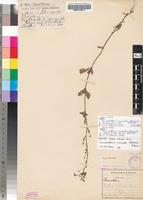
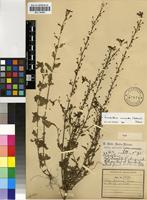
an erect, annual, somewhat wiry herb, branched at the base, about 1 1/2 ft. high; stems erect or ascending, several, rather slender, firm, purplish below, pale green above, simple or nearly so, viscid-puberulous with short rather thick whitish hairs; internodes mostly 1–2 in. long; leaves opposite or subopposite or the uppermost alternate, usually quasi-fasciculate, ovate or narrowly elliptical, obtuse or subobtuse, wedge-shaped at the base, membranous, minutely glandular, somewhat finely pilose, irregularly pinnatilobed, 2/5–1 in. long, 1/6– 3/4 in. broad; lobes dentate or subentire; petioles 1/12– 1/2 in. long, glandular-pubescent; flowers racemose and the lower axillary, numerous, 1/6– 1/5 in. long, yellow; racemes simple, rather lax, 6–9 in. long or in flower shorter; pedicels 1/4– 2/3 in. long, slender, firm, divaricate, bracteate or axillary to the upper leaves, glandular-pilose; bracts narrow, smaller than the leaves, entire or dentate, glandular-puberulous; calyx glandular-puberulous, 1/12– 1/10 in. long, in fruit about 1/8 in. long, deeply 5-lobed; segments oval-oblong or linear-oblong, obtuse; corolla-tube 1/8– 1/6 in. long, subcylindrical, nearly straight or a little curved above, about 1/24 in. in diam. at the middle, dilated near the limb, sprinkled with small glands; limb spreading, 1/6– 1/5 in. in diam.; lobes oval or subrotund, rounded, entire, 1/15– 1/12 in. long; stamens included; capsule oval, pallid, minutely or obsoletely glandular, 1/8– 1/7 in. long. null