JSTOR Global Plants Home
  • Home
  • Browse
  • About
  • Access
  • Account
    • Saved Items
    • Profile
  • Log in

Global Plants

Skip to Main Content
  • JSTOR Global Plants Home
  • Global Plants

    • Browse
    • About
    • Access
    • Account
      • Saved Items
      • Profile
Log in
  • Browse
  • About
  • Access
  • Account
    • Saved Items
    • Profile
Advanced Search

Compilation
Suaeda esteroa

5 Images see all

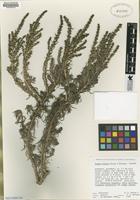
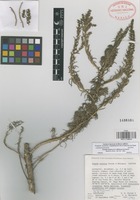
Isotype of Suaeda esteroa Ferren & Whitmore [family CHENOPODIACEAE]
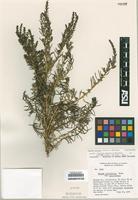
Isoparatype of Suaeda esteroa W. R. Ferren & S. A. Whitmore [family CHENOPODIACEAE]
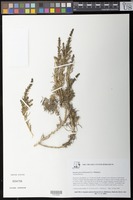
Isotype of Suaeda esteroa Ferren & S.A. Whitmore [family CHENOPODIACEAE]
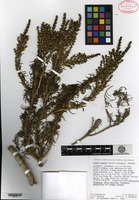
Isotype of Suaeda esteroa S.A. Whitmore & Ferren [family CHENOPODIACEAE]
Isotype of Suaeda esteroa Ferren & S. A. Whitmore [family CHENOPODIACEAE]
Previous
Next

Name

Identification
Suaeda esteroa W. R. Ferren & S. A. Whitmore [family CHENOPODIACEAE ] (stored under name); Verified by K. Rice, 2010
Related name
  • Suaeda esteroa
Common name
  • Estuary sea-blite, Flora of North America Vol. 4

Flora

Entry for Suaeda esteroa Ferren & S. A. Whitmore [family CHENOPODIACEAE]
Herbarium
Flora of North America (FNA)
Collection
Flora of North America
Resource Type
Reference Sources
Entry From
Flora of North America, Vol 4,
Names
Suaeda esteroa Ferren & S. A. Whitmore [family CHENOPODIACEAE], Madroño, 30: 182, fig. 1. 1983
Treatment Author(s)
Wayne R. Ferren Jr.
H. Jochen Schenk
Information
Herbs or subshrubs, annual or usually perennial, yellow-green, green, or occasionally reddish, 1–6 dm, glaucous. Stems decumbent to erect, straw colored, branched, often woody at base, often with exfoliations; branches usually ascending. Leaves ascending, imbricate; blade green or reddish, linear-lanceolate, adaxial surface flat, 10–60 × 0.5–2.5 mm, base not narrowed, apex acute; proximal leaves usually withered, persistent or breaking apart into fibers, straw colored. Glomes in dense, mostly (2–)5–20 cm compound spikes; (1–)3–5-flowered; bracts smaller than leaves, 5–20 mm, usually widest at base. Flowers bisexual; perianth zygomorphic or irregular (one segment usually larger), 1.5–3(–3.5) mm diam.; perianth segments abaxially rounded and keeled and distally hooded; stigmas (2–)3. Seeds dimorphic; lenticular, 1–1.3 mm diam., with seed coat black to reddish brown, obscurely reticulate, shiny; or flat, 1.2–2 mm, with seed coat brown, dull.
Phenology
jun-aug (summer), sep-nov (fall)
Altitude range
1–2 m;
Distribution
Mexico (Baja California).USA Calif.

Related Materials

  • Terms and Conditions
  • Privacy Policy
  • Cookie Policy
  • Cookie Settings
  • Accessibility
  • Help
  • Contact Us
  • Facebook
  • Twitter
ITHAKA

JSTOR is part of ITHAKA, a not-for-profit organization helping the academic community use digital technologies to preserve the scholarly record and to advance research and teaching in sustainable ways.

©2000-2026 ITHAKA. All Rights Reserved. JSTOR®, the JSTOR logo, JPASS®, Aluka®, and ITHAKA® are registered trademarks of ITHAKA.

╳